


















Lesson 4 of 45 · Getting Started
Financial statements for finance people
A practical tour of the balance sheet, income statement and cash flow statement, why cash flow differs from profit, and how finance uses free cash flow.
Finance runs on numbers that come from accounting. Before you can value a project or a company, you need to read the three statements that describe it: the balance sheet, the income statement and the cash flow statement. This lesson is not a full accounting course (the Financial Accounting track on this site covers that), but it gives you what you need for the rest of corporate finance, with one point to remember above all others: finance follows cash, accounting follows rules.
We will use one small invented company, Brightway Bikes, all in millions of dollars, and we will check that its three statements agree with one another. By the end, you will be able to compute a few key ratios and the free cash flow that chapters 4 and 8 rely on.
What you will learn
- Read a simple balance sheet and explain the equation assets = liabilities + equity.
- Read an income statement from revenue to net income.
- Explain why profit and cash flow differ.
- Compute and interpret net margin, return on equity and the current ratio.
- Calculate free cash flow from EBIT, depreciation, capital spending and working capital.
Key terms
Balance sheet: a snapshot on one date of assets, liabilities and owners' equity.
Income statement: a report of revenue, expenses and net income over a period.
Depreciation: an accounting charge that spreads the cost of a long-lived asset over its life; no cash leaves when it is recorded.
EBIT: earnings before interest and taxes, a measure of operating profit.
Free cash flow: the cash a business generates after the investments needed to keep it running and growing.
The balance sheet: a snapshot
The balance sheet lists what the firm owns (assets), what it owes (liabilities) and what is left for its owners (equity). It always balances, because the same assets must have been paid for by someone:
Assets = Liabilities + Equity
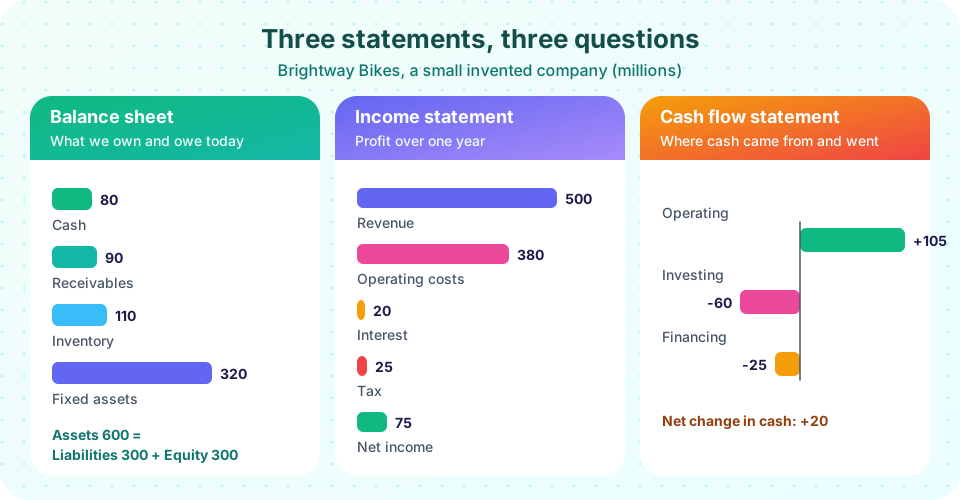
Brightway's balance sheet at the end of the year:
| Assets | $m | Liabilities and equity | $m |
|---|---|---|---|
| Cash | 80 | Accounts payable | 70 |
| Accounts receivable | 90 | Long-term debt | 230 |
| Inventory | 110 | Equity | 300 |
| Fixed assets (net) | 320 | ||
| Total | 600 | Total | 600 |
Cash, receivables and inventory are current assets (expected to turn into cash within a year); their total is 280. Payables are a current liability. Fixed assets are shown at cost less accumulated depreciation, which is called book value, and it can be very different from what the assets would sell for. This is one reason finance uses market values for valuation rather than accounting values.
The income statement: a period
The income statement measures performance over a period, usually a year, by subtracting costs from revenue:
| Line | $m |
|---|---|
| Revenue | 500 |
| Operating costs (including 40 of depreciation) | -380 |
| EBIT | 120 |
| Interest expense | -20 |
| Profit before tax | 100 |
| Tax at 25% | -25 |
| Net income | 75 |
Notice that interest comes out before tax, so debt financing produces a tax shield: the 20 of interest saves 5 of tax (25% of 20). Dividends, by contrast, are paid from net income and are not deductible. This is one reason firms like debt, and it returns in chapter 7.
Accounting follows the accrual principle: revenue is recorded when it is earned, not when the customer pays, and costs are recorded when they are incurred. A sale on credit raises revenue and receivables immediately even though no cash has arrived.
The cash flow statement: where cash came from and went
The third statement converts accrual profit back into cash and sorts the cash into three groups:
| Group | What is in it | Brightway ($m) |
|---|---|---|
| Operating | Net income, plus depreciation, minus rises in receivables and inventory, plus rises in payables | +105 |
| Investing | Buying and selling long-term assets | -60 |
| Financing | Debt raised or repaid, shares issued, dividends paid | -25 |
| Net change in cash | +20 |
Operating cash flow works like this: net income 75, plus depreciation 40 (an expense that cost no cash), minus a 10 rise in working capital (more stock and receivables tie up cash), gives 75 + 40 - 10 = 105. In financing, Brightway paid dividends of 30 and borrowed 5 more, for -30 + 5 = -25. The net change in cash is 105 - 60 - 25 = +20.
The three statements link up. Net income flows into equity (less dividends), the cash change explains the change in the cash line of the balance sheet, and capital spending and depreciation explain the change in fixed assets.
Why cash flow differs from profit
Three common reasons: depreciation (a cost with no cash), working capital (profit that sits in unpaid invoices or unsold stock), and capital spending (cash out that is not an expense in one year). A fast-growing company can show healthy profit and run out of cash, because growth needs stock, customers' credit and equipment. This is why lenders and investors look at cash flow so closely.
Four numbers finance uses all the time
- Net profit margin = net income / revenue = 75 / 500 = 15%.
- Return on equity (ROE) = net income / equity = 75 / 300 = 25%.
- Current ratio = current assets / current liabilities = 280 / 70 = 4.0: a measure of short-term safety.
- Debt-to-equity = 230 / 300 = 0.77.
Ratios are only useful in comparison: with the same firm in earlier years, with competitors, or with a benchmark. A current ratio of 4.0 looks safe, but it may also mean the firm holds too much idle cash and stock.
Free cash flow
Valuation needs the cash that the business frees up for its investors every year. The usual definition is
Free cash flow (FCF) = EBIT x (1 - tax rate) + depreciation - capital spending - increase in working capital
For Brightway: 120 x 0.75 = 90, plus 40 of depreciation, minus 60 of capital spending, minus 10 of working capital increase, which is 90 + 40 - 60 - 10 = 60. Brightway generated 60 of free cash flow, available to pay lenders and owners. We use EBIT times one minus tax rather than net income because we want the cash from operations, before any financing choices. This is the number chapter 4 will discount.
Common misconceptions
"Net income is the cash the firm made." Net income is an accrual figure. It includes non-cash charges such as depreciation and ignores cash tied up in working capital.
"Book value is what the firm is worth." Book value records historical cost less depreciation. Market value looks forward to cash flows, which is why a successful company can be worth many times its equity on the balance sheet.
"Depreciation is a cash cost." The cash for an asset leaves when you buy it. Depreciation is the later accounting allocation, though it reduces tax and so does affect cash indirectly.
Try it
The first program rebuilds Brightway's key results from the raw lines, including the profit-versus-cash gap and free cash flow.
Press Run (or Ctrl + Enter) to see the result here.
Program input · what you'd type while the program runs
Type the answers before you press Run, one per line. Each time the program reads a line (with input()), it gets the next line from this box.
The second tool checks the accounting equation. Enter assets and liabilities, and it computes the equity that must exist. This is a demonstration of the identity, nothing more.
Check your understanding
Quick check · 5 questions
of 5 answered You scored / 5 · perfect!
-
1. A balance sheet shows assets of 800 and liabilities of 500. Equity is:
Equity = assets - liabilities = 800 - 500 = 300. -
2. Which statement covers a whole period and ends with net income?
The income statement runs from revenue to net income over a period. The balance sheet is a snapshot at one date. -
3. Why can a growing, profitable company run out of cash?
Accounting profit is not cash. Stock, unpaid invoices and equipment purchases use cash before profit arrives. -
4. Net income 75, depreciation 40 and a 10 increase in working capital give operating cash flow of:
75 + 40 - 10 = 105. Depreciation is added back because it costs no cash; the working capital increase uses cash. -
5. Free cash flow is computed from EBIT x (1 - tax rate) rather than net income because:
FCF belongs to all investors, lenders and owners together, so it is computed before interest.
Summary
- The balance sheet is a snapshot (assets = liabilities + equity); the income statement covers a period; the cash flow statement explains the change in cash.
- Accrual profit is not cash: depreciation, working capital and capital spending drive the gap.
- Interest is tax-deductible, creating a tax shield; dividends are not.
- Useful ratios: net margin, ROE, current ratio and debt-to-equity, always read in comparison.
- FCF = EBIT(1 - T) + depreciation - capital spending - increase in working capital; this is the cash finance discounts.
Next: Chapter 1 review
Track your progress
Create a free account to tick off lessons and pick up where you left off on any device.
of Corporate Finance lessons completed