


















Lesson 6 of 45 · Time Value of Money
Time value of money: the big picture
Chapter 2 overview: why money has a time value, how interest and discount rates work, and a map of the four lessons on present value, annuities and loans.
Would you rather have $1,000 today or $1,000 in a year? Almost everyone says today, and they are right. Today's money can be spent, or put in a bank to earn interest, so it is worth more than the same amount later. This idea, the time value of money, is the most important in finance. Every valuation in this course, from a bond to a factory to a whole company, uses it.
Chapter 2 gives you the tools: moving a sum forward in time (compounding), moving it back (discounting), handling regular payments (annuities), and reading interest rates correctly. These tools take a few formulas, but they all come from one simple fact about interest.
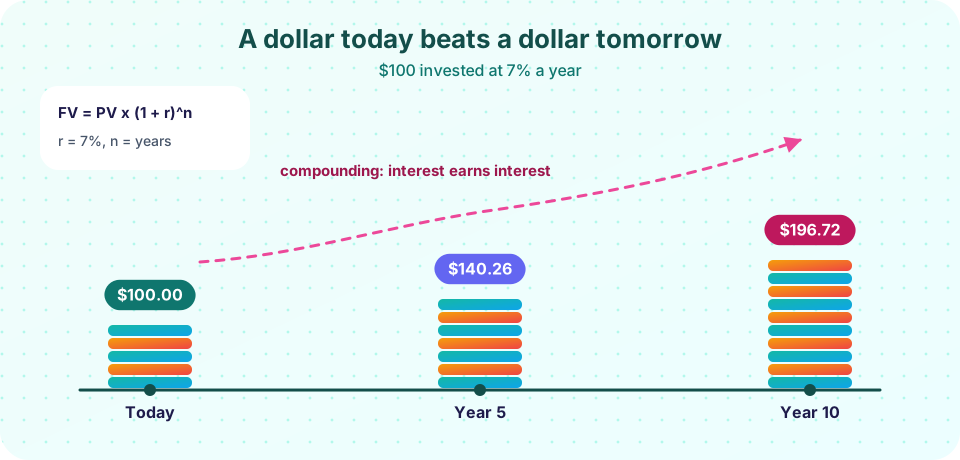
Why money has a time value
Three forces make a dollar today worth more than a dollar later:
- Opportunity. Money today can earn a return. If a bank pays 5%, $100 becomes $105 in a year, so $100 today is worth $105 a year from now.
- Inflation. Prices usually rise, so the same dollar buys less in the future.
- Risk. A promise of future money might not be kept, and the further away it is, the more can go wrong.
Finance combines these into one number: the discount rate (also called the required return or the opportunity cost of capital). The rate says how much more you need to receive later to be as well off as having money now.
Compounding
FV = PV x (1 + r)^n
Discounting
PV = FV / (1 + r)^n
Streams
Add up the present values.
Real rates
Always match the rate to the period.
What is in this chapter
| Lesson | You will be able to |
|---|---|
| Future value and present value | Move a single sum along a timeline, solve for the rate or the number of periods |
| Annuities and perpetuities | Value regular payments, including growing ones and payments that last forever |
| Rates, compounding and loans | Convert APR to the effective annual rate and build a loan payment schedule |
| Chapter 2 review | Put the formulas on one page and test yourself with ten questions |
The one habit that prevents most mistakes
Before you use any formula, draw a timeline: a horizontal line with dots for each date (t = 0, 1, 2, ...) and amounts written above them. Mark which amounts are cash in and which are cash out. Then ask three questions:
- Are all the amounts at the same date? If not, you cannot add them yet.
- Does the rate match the period? A monthly rate is for monthly periods.
- Does the timeline start now? The present value formulas assume the first payment comes one period after the date you value it.
Most errors in finance exams and in real spreadsheets are mismatched rates and periods, or payments placed on the wrong date. A timeline makes both visible.
A first taste
How fast does money double? A well-known shortcut, the rule of 72, says that at r percent a year it takes about 72 / r years. At 8% that is 9 years. The exact calculation uses the formula you will learn in the next lesson; the program below compares the two.
Press Run (or Ctrl + Enter) to see the result here.
Program input · what you'd type while the program runs
Type the answers before you press Run, one per line. Each time the program reads a line (with input()), it gets the next line from this box.
The exact column is ln(2) / ln(1 + r). The rule is quite accurate for ordinary rates (roughly 6% to 10%), and it is useful for quick mental checks.
Next, an interactive demonstration: drag the rate and the number of years and watch $1,000 grow. Compare 3% with 9% over 30 years.
Check your understanding
Quick check · 4 questions
of 4 answered You scored / 4 · perfect!
-
1. Which is NOT a reason money has a time value?
The three reasons are opportunity (return), inflation and risk. -
2. Compounding means:
Compounding is interest on interest, which is why growth accelerates. -
3. At 9% a year, about how long does money take to double (rule of 72)?
72 / 9 = 8 years. -
4. Why draw a timeline before using a formula?
A timeline shows when each amount occurs and what period the rate refers to.
Summary
- Money has a time value because of opportunity, inflation and risk.
- The discount rate converts between money now and money later.
- Compounding moves values forward; discounting moves them back.
- Draw a timeline first; match the rate to the period.
- The next lessons cover single sums, annuities and perpetuities, and loans and rates.
Track your progress
Create a free account to tick off lessons and pick up where you left off on any device.
of Corporate Finance lessons completed