


















Lesson 8 of 45 · Time Value of Money
Annuities and perpetuities
Value level streams of payments: ordinary annuities, annuities due, perpetuities and growing perpetuities, with formulas, worked examples and code.
Few things in finance come as a single payment. A bond pays interest every six months. A lease is paid monthly. A pension pays for decades. A stream of equal payments at regular intervals is called an annuity, and valuing it by discounting each payment separately would be slow. Fortunately, the sum has a neat closed form, and that formula is the most-used shortcut in finance.
This lesson builds the annuity formula from what you already know, shows when to use the "due" variation, handles payments that last forever (perpetuities), and ends with growing streams. By the end, you will be able to value a loan, a lottery payout, a savings plan and, in chapter 3, a bond.
What you will learn
- Value an ordinary annuity and an annuity due.
- Find the future value of regular savings.
- Solve for the payment that reaches a goal or repays a loan.
- Value a perpetuity and a growing perpetuity.
- Value an annuity that starts later than the next period.
Key terms
Annuity: a series of equal payments at equal intervals for a fixed number of periods.
Ordinary annuity: payments at the end of each period (the usual default).
Annuity due: payments at the start of each period, such as rent paid in advance.
Perpetuity: an annuity that never ends.
Annuity factor: [1 - (1 + r)^-n] / r, the number that converts a payment into the present value of the stream.
The ordinary annuity
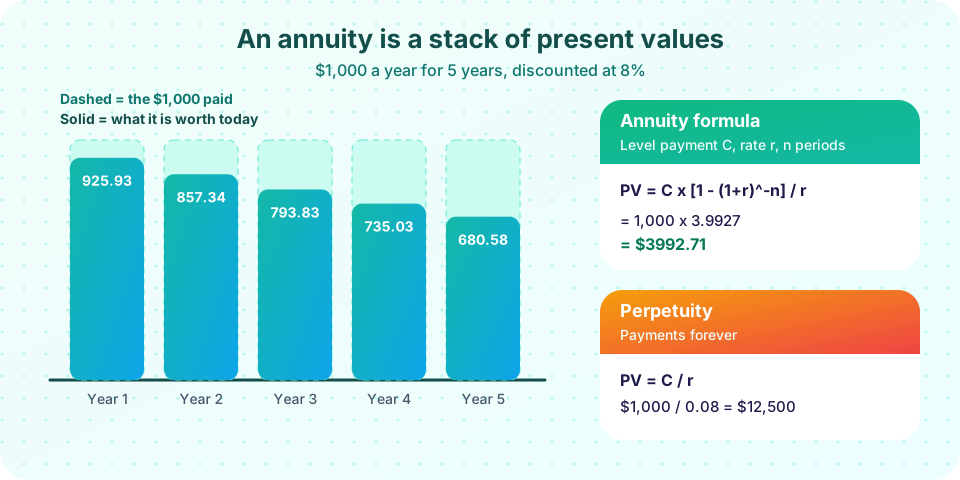
Take $1,000 paid at the end of each year for 5 years, with a discount rate of 8%. Discount each payment separately and add:
| Year | Payment | Discount factor | Present value |
|---|---|---|---|
| 1 | 1,000 | 0.9259 | 925.93 |
| 2 | 1,000 | 0.8573 | 857.34 |
| 3 | 1,000 | 0.7938 | 793.83 |
| 4 | 1,000 | 0.7350 | 735.03 |
| 5 | 1,000 | 0.6806 | 680.58 |
| Total | 3,992.71 |
That is what the picture shows. A shortcut exists because the discount factors form a geometric series, whose sum is a simple fraction:
PV = C x [1 - (1 + r)^-n] / r
With C = 1,000, r = 0.08, n = 5: (1 - 1.08^-5) / 0.08 = (1 - 0.68058) / 0.08 = 3.99271, so PV = $3,992.71. Same answer, one step.
How to remember the factor: the stream is worth less than n x C because later payments are discounted; with a high rate the factor approaches 1 / r; with a rate of zero, it is exactly n.
Future value of an annuity
If you save $1,000 at the end of each year, how much will you have after 5 years at 8%? Each deposit earns interest for a different time (the last earns none). Multiply the present value by (1 + r)^n, or use
FV = C x [(1 + r)^n - 1] / r
which gives 1,000 x (1.46933 - 1) / 0.08 = $5,866.60. Total deposits are 5,000, so interest is 866.60.
Solving for the payment
How much must you save each year to have $20,000 in 5 years at 6%? Rearrange the future value formula: C = FV x r / [(1 + r)^n - 1] = 20,000 x 0.06 / 0.33823 = $3,547.93. For a loan, solve the present value formula instead: C = PV x r / [1 - (1 + r)^-n]. This is how loan payments are calculated, which is the topic of the lesson on rates, compounding and loans.
Annuity due
If payments come at the start of each period (rent paid in advance), each is one period closer, so the whole stream is worth one more period of interest:
PV(due) = PV(ordinary) x (1 + r)
For the example above: 3,992.71 x 1.08 = $4,312.13. The same adjustment applies to the future value. The most common mistake with annuities is using the ordinary formula when payments are at the start of the period; always read the timing in the problem.
Perpetuities
What if the payments never stop? Let n grow without bound in the annuity formula: (1 + r)^-n shrinks to zero, leaving
PV = C / r
A perpetuity paying $1,000 a year at 8% is worth 1,000 / 0.08 = $12,500. That sounds odd: endless payments, finite value? The reason is discounting: payments a century away are worth almost nothing today. Notice in the picture of the annuity that even 5 years of 1,000 are worth 3,993 and the infinite stream is worth 12,500, only about three times as much.
Real examples are rare but useful as approximations. The UK once issued government bonds called consols that paid interest forever, and preferred stock in many countries pays a fixed dividend indefinitely. A share of preferred stock paying $5 a year when the market requires 10% is worth 5 / 0.10 = $50.
Growing perpetuity
If the payment grows at a constant rate g forever (with g < r), the first payment arrives next period, and the value is
PV = C1 / (r - g)
A rent of $100 next year, growing 3% a year forever, discounted at 8%: 100 / (0.08 - 0.03) = $2,000. This is the same structure as the stock valuation formula in chapter 3 (the Gordon growth model). It only works when r > g; otherwise the value is infinite, which says your assumptions are unrealistic, since nothing can outgrow the economy forever.
A delayed annuity
What if the first payment starts later? Value the annuity at the date just before the first payment, then discount that value back to today. For $1,000 a year for 5 years with the first payment at the end of year 4 (so payments in years 4 to 8), the annuity is worth 3,992.71 at t = 3. Discount three years: 3,992.71 / 1.08^3 = $3,169.5.
A practical case: lump sum or annuity?
A prize offers either $500,000 now or $50,000 a year for 20 years. Which is better at a discount rate of 7%? The stream is worth 50,000 x (1 - 1.07^-20) / 0.07 = 50,000 x 10.594 = $529,700. At 7%, the annuity wins by about 29,700. At 10%, the factor is 8.5136, the annuity is worth $425,700, and the lump sum wins. The best choice depends on your discount rate, and that is a pattern to remember: the decision flips at some rate, which is the idea behind the IRR in chapter 4.
Common misconceptions
"The annuity formula works for payments that change." It needs equal payments. Uneven streams must be discounted one at a time, or split into pieces that are annuities.
"A perpetuity has an infinite value." Because of discounting, its value is finite: C / r.
"Timing does not matter." Paying at the start versus the end of the period changes value by a full factor of 1 + r.
Try it
The first program is a complete annuity toolbox: present value, future value, annuity due, perpetuities, growing perpetuity, required payment and the lump-sum comparison.
Press Run (or Ctrl + Enter) to see the result here.
Program input · what you'd type while the program runs
Type the answers before you press Run, one per line. Each time the program reads a line (with input()), it gets the next line from this box.
The second program plots the present value of a $1,000-a-year annuity as the number of years grows, and shows how it approaches the perpetuity value.
Press Run (or Ctrl + Enter) to see the result here.
Program input · what you'd type while the program runs
Type the answers before you press Run, one per line. Each time the program reads a line (with input()), it gets the next line from this box.
Check your understanding
Quick check · 5 questions
of 5 answered You scored / 5 · perfect!
-
1. What is the present value of $500 a year for 4 years at 10% (ordinary annuity)?
The annuity factor is (1 - 1.10^-4) / 0.10 = 3.16987, and 500 x 3.16987 = 1,584.93. -
2. A perpetuity pays $300 a year and the discount rate is 6%. Its present value is:
PV = C / r = 300 / 0.06 = 5,000. -
3. Rent is paid at the start of each month. Compared with the same payments at month end, the present value of the stream is:
Each payment is one period closer, so the whole stream is worth (1 + r) times as much. -
4. The first dividend is $50, growing 4% a year forever, and the required return is 9%. The value is:
PV = C1 / (r - g) = 50 / (0.09 - 0.04) = 1,000. -
5. You want $10,000 in 4 years and can earn 5% a year, depositing at each year end. The yearly deposit is closest to:
C = FV x r / ((1 + r)^n - 1) = 10,000 x 0.05 / 0.21551 = 2,320.12.
Summary
- Ordinary annuity:
PV = C x [1 - (1+r)^-n] / r; future value:FV = C x [(1+r)^n - 1] / r. - Annuity due: multiply the ordinary value by
1 + r. - Perpetuity:
PV = C / r; growing perpetuity:PV = C1 / (r - g), requiringr > g. - Delayed annuity: value it just before the first payment, then discount back.
- Solve the same formulas for the payment: savings goals and loan payments.
Track your progress
Create a free account to tick off lessons and pick up where you left off on any device.
of Corporate Finance lessons completed