


















Lesson 1 of 45 · Getting Started
Course map: how this Corporate Finance course works
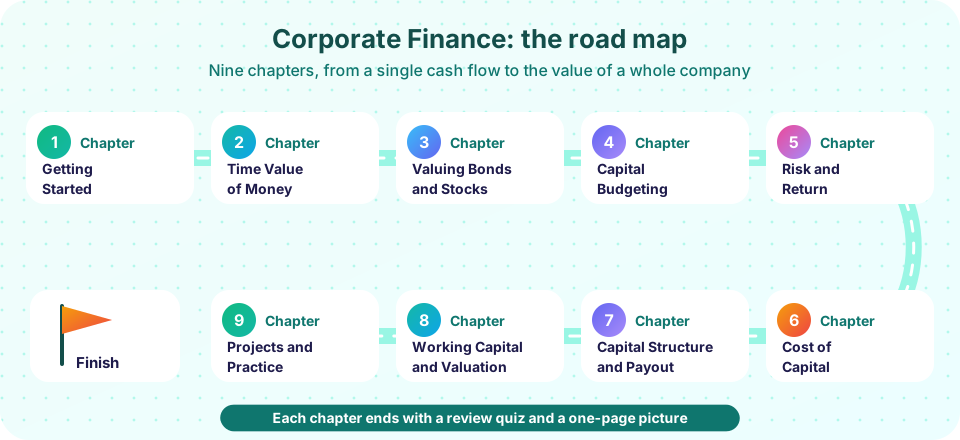
See the whole Corporate Finance course at a glance: who it is for, what you need first, nine chapters, and a simple weekly plan for studying it.
Corporate finance is the part of finance that answers three practical questions for a company: which projects should we invest in, where should the money come from, and what should we do with the cash we earn? Every business, from a corner bakery to a global airline, answers these questions whether or not anyone uses the word "finance". This course teaches you how to answer them well, using clear formulas, small worked examples and short programs you can run in your browser.
You do not need a business degree. You need to be comfortable with percentages, basic algebra and powers such as 1.05^3. We will build everything else step by step, and we will always explain why a formula works before we ask you to use it.
Educational information only. This course explains how finance works. It is not personal investment, tax or legal advice, and the companies and numbers in the examples are invented. Real decisions need real data and, often, a qualified professional.
Who this course is for
This course is written for learners aged about 16 and up, and for adults who want to understand how companies make money decisions. It follows the common core of university introductory corporate finance courses and the finance parts of business programs such as the IB, A Level business and economics, and first-year business degrees in many countries. It works for:
- students preparing for business, economics or accounting exams;
- people who work in a company and want to understand the numbers their managers use;
- founders and small-business owners who want a sound way to judge investments;
- programmers and analysts who build financial models and want to know what the formulas mean.
The language is plain English with US spelling, and amounts are in dollars so we do not have to convert currencies. The ideas are the same in every currency. Where laws differ by country, such as tax rules, we will say so.
What you should know first
You will get more from the course if you can do the following. If one item feels shaky, review it quickly and come back.
| Skill | A quick test |
|---|---|
| Percentages | What is 8% of 2,500? (200) |
| Powers | What is 1.1 to the power 3? (1.331) |
| Simple algebra | Solve x / 1.05 = 100. (105) |
| Reading a table | Find the total of a column of numbers |
You do not need to know accounting, but chapter 1 gives you a brief tour of the three financial statements, and the separate Financial Accounting track on this site goes much deeper. You do not need to know programming either. The Python examples are short and every one is explained, but you can also treat them as calculators: press Run and change a number.
The nine chapters
Here is the plan. Slide through it once now, and come back whenever you want to see where you are.
Foundations
- Getting Started
- Time Value of Money
- Bonds and Stocks
Chapters 1 to 3 give you the language and the core formulas.
Decisions
- Capital Budgeting
- Risk and Return
- Cost of Capital
Chapters 4 to 6 turn formulas into investment decisions.
The whole firm
- Capital Structure
- Working Capital
- Projects
Chapters 7 to 9 look at the company as a whole and finish with projects.
Chapters 1 to 4 are this first half of the course: the field, the mathematics of time, the valuation of bonds and stocks, and the evaluation of projects. Chapters 5 to 9 add risk, the cost of capital, how companies are financed and paid out, day-to-day cash management and complete valuation projects.
How to study each lesson
Every content lesson has the same shape so you always know where you are:
- What you will learn lists the outcomes. Read it first and check it again at the end.
- Key terms gives short definitions. Say each one in your own words.
- The body has worked examples with real numbers and a picture near the top. Work the example by hand before you read the answer.
- Common misconceptions warns about mistakes that catch many learners.
- Try it has runnable code. Change the numbers and predict the result before you press Run.
- Check your understanding is a short quiz. Wrong answers come with an explanation; read it even when you are right.
- Summary is what to remember.
Each chapter opens with an overview lesson and closes with a review lesson that has a one-page picture and a longer quiz. A reasonable plan is two lessons per week: about 30 to 45 minutes of reading and about 30 minutes of experimenting with the code. At that pace, the first four chapters take roughly ten weeks.
Try it
The first program shows the idea at the heart of the whole course: money has a time dimension. It compares $1,000 today with $1,000 you will receive in 5 years, for a few different "required returns".
Press Run (or Ctrl + Enter) to see the result here.
Program input · what you'd type while the program runs
Type the answers before you press Run, one per line. Each time the program reads a line (with input()), it gets the next line from this box.
Change years to 10 and run it again. The numbers shrink, and the higher the rate, the faster they shrink. That is the time value of money, and chapter 2 explains it fully.
The second tool is a small planner. It is only a demonstration of arithmetic, but it helps you pick a realistic pace.
Check your understanding
Quick check · 4 questions
of 4 answered You scored / 4 · perfect!
-
1. Which question is NOT one of the three big questions of corporate finance?
The three questions are investing, financing and payout. A slogan is a marketing decision, although marketing choices do affect cash flows. -
2. Why does the course use invented companies and numbers?
Small invented examples let you verify every step by hand. The formulas are the same ones used with real company data. -
3. In which chapter do you learn to decide which projects to accept?
Chapter 4, Capital Budgeting, covers net present value, internal rate of return and payback. -
4. What is the best way to use a Try it example?
Predicting before you run builds understanding. A wrong prediction is useful: it shows you what to study.
Summary
- Corporate finance answers three questions: what to invest in, how to finance it, and how to pay out cash.
- The course has nine chapters; the first four build the tools (time value, valuation, capital budgeting).
- Every lesson follows one shape: outcomes, terms, examples, misconceptions, code, quiz, summary.
- The examples use invented companies and numbers. This is education, not investment advice.
Track your progress
Create a free account to tick off lessons and pick up where you left off on any device.
of Corporate Finance lessons completed