


















Lesson 7 of 45 · Time Value of Money
Future value and present value
Learn compounding and discounting with worked examples: future value, present value, solving for the interest rate and the number of periods.
Two formulas carry most of finance. The first tells you what money today becomes in the future (future value). The second tells you what future money is worth today (present value). They are the same formula turned around, and once you can use them fluently, annuities, bonds, stocks and projects all become variations on a theme.
This lesson derives both formulas from the idea of interest earning interest, works through six examples with real numbers, and shows how to solve for an unknown rate or number of years. Every calculation is also available as runnable code so you can check your arithmetic.
What you will learn
- Compute the future value of a single sum with compound interest.
- Compute the present value of a single future amount.
- Solve for the interest rate and for the number of periods.
- Find the present value or future value of several cash flows.
- Explain the difference between simple and compound interest.
Key terms
Present value (PV): the value today of a cash flow that will arrive later.
Future value (FV): the value at a later date of a sum invested today.
Interest rate (r): the return earned per period, written as a decimal (8% = 0.08).
Compounding: earning interest on interest as well as on the original sum.
Discount factor: 1 / (1 + r)^n, the number you multiply a future amount by to get its present value.
Compounding: from now to later
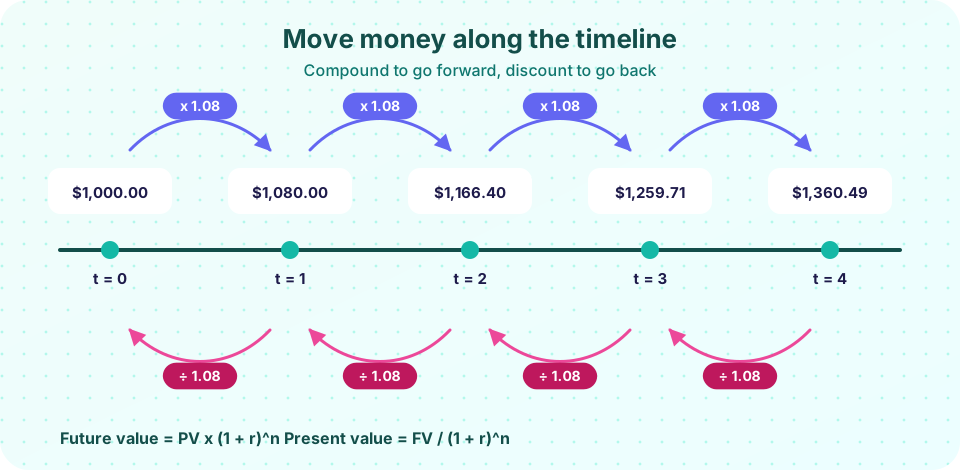
Put $1,000 in an account paying 8% a year. After one year you have 1,000 x 1.08 = 1,080. In the second year the 8% is earned on 1,080, not on 1,000: 1,080 x 1.08 = 1,166.40. Each year you multiply by 1.08 again. After n years:
FV = PV x (1 + r)^n
Four years gives 1,000 x 1.08^4 = 1,000 x 1.36049 = $1,360.49. The picture at the top of the lesson shows this: each arrow multiplies by 1.08.
Simple interest would pay 8% of the original 1,000 each year, which is 80, for a total of 1,000 + 4 x 80 = 1,320. The extra 40.49 under compound interest is interest earned on earlier interest. The gap grows quickly with time: after 30 years at 8%, compound interest turns 1,000 into about 10,063, while simple interest gives only 3,400. Albert Einstein is often quoted calling compounding the most powerful force; whether or not he said it, the arithmetic is striking.
Discounting: from later to now
Present value runs the same arrow backwards. If FV = PV x (1 + r)^n, then dividing both sides gives
PV = FV / (1 + r)^n
Example. A customer will pay $5,000 in 6 years. You can earn 10% elsewhere. The present value is 5,000 / 1.10^6 = 5,000 / 1.771561 = $2,822.37. You would be equally happy with $2,822.37 today, because invested at 10% it would grow to $5,000 in six years.
The term 1 / (1 + r)^n is the discount factor. At 10%, the factors for years 1 to 4 are 0.9091, 0.8264, 0.7513 and 0.6830. The further away the cash, and the higher the rate, the smaller the factor, so the less the cash is worth today.
Several cash flows
Present values of different dates can be added, because once everything is measured at date 0 it is in the same "units". Suppose a project pays $300 in year 1 and $500 in year 2, and the rate is 10%:
PV = 300 / 1.10 + 500 / 1.10^2 = 272.73 + 413.22 = $685.95
This idea of adding discounted cash flows is the engine of every valuation. In chapter 4 we call the result, less the initial cost, the net present value.
Solving for the rate
Often the unknown is the rate. You invest $2,000 and it grows to $3,000 in 5 years. What was the annual return? Rearrange FV = PV (1 + r)^n:
r = (FV / PV)^(1/n) - 1
Here r = (3,000 / 2,000)^(1/5) - 1 = 1.5^0.2 - 1 = 1.0845 - 1 = 8.45% per year. This is the compound annual growth rate (CAGR). It is not the same as dividing the total growth (50%) by 5 (10%), because the return compounded.
Solving for the number of periods
How long does $10,000 take to reach $25,000 at 6%? Use logarithms:
n = ln(FV / PV) / ln(1 + r)
So n = ln(2.5) / ln(1.06) = 0.9163 / 0.0583 = 15.7 years. The rule of 72 from the last lesson is just a convenient approximation of this formula for doubling.
A checklist for any single-sum problem
- Draw the timeline and mark the known amounts and dates.
- Decide the direction: forward (multiply) or back (divide).
- Check the rate is for the same period as the count
n. - Plug in, and sanity-check: a future value must be larger than the present value when the rate is positive.
Common misconceptions
"Total growth divided by years is the annual return." Returns compound, so 50% over 5 years is 8.45% a year, not 10%.
"Discounting at a higher rate makes the present value larger." The opposite: a higher discount rate makes future cash worth less today.
"You can add cash flows from different dates." Not until you move them to the same date. 300 in year 1 plus 500 in year 2 is not 800 of present value.
Three real uses
These two formulas look abstract, but you will meet them in daily business.
Growth reporting. A company's sales were $40 million five years ago and are $62 million today. The annual growth is (62 / 40)^(1/5) - 1 = 9.2%. Saying "55% growth in five years" is true but hard to compare; the compound annual growth rate lets you set it beside a competitor that grew from $10 million to $14 million in three years (a CAGR of 11.9%, which is faster even though the dollars are smaller).
Settling a claim. A court awards $50,000 payable in 4 years. The defendant offers to pay now. A fair lump sum is the present value of the award at a rate that reflects the risk of waiting. At 6%, that is 50,000 / 1.06^4 = $39,605. Both sides can now argue about the rate, which is exactly where the real negotiation happens.
Pricing a promise. A government sells a savings bond that pays $1,000 in 10 years and no interest before then. If investors want 4% a year, the price is 1,000 / 1.04^10 = $675.56. You have just priced a zero-coupon bond, and in chapter 3 we will do it again with coupons.
In every case the work is the same: find the right date, find the right rate, move the money.
Try it
The first program is a toolbox for single sums: future value, present value, the rate and the number of years. Change the inputs and compare with the worked examples above.
Press Run (or Ctrl + Enter) to see the result here.
Program input · what you'd type while the program runs
Type the answers before you press Run, one per line. Each time the program reads a line (with input()), it gets the next line from this box.
The second program draws how $1,000 grows at four different rates, which makes the effect of the rate and of time visible at once.
Press Run (or Ctrl + Enter) to see the result here.
Program input · what you'd type while the program runs
Type the answers before you press Run, one per line. Each time the program reads a line (with input()), it gets the next line from this box.
Check your understanding
Quick check · 5 questions
of 5 answered You scored / 5 · perfect!
-
1. What is $1,000 worth in 3 years at 10% a year (compound)?
1,000 x 1.10^3 = 1,331. Simple interest would give 1,300. -
2. What is the present value of $2,000 due in 2 years at 5%?
2,000 / 1.05^2 = 2,000 / 1.1025 = 1,814.06. -
3. An investment grows from $4,000 to $6,000 in 4 years. The annual compound growth rate is closest to:
(6,000 / 4,000)^(1/4) - 1 = 1.5^0.25 - 1 = 1.1067 - 1, about 10.7%. Dividing the 50% total growth by 4 would wrongly give 12.5%. -
4. If the discount rate rises, the present value of a future cash flow:
A higher rate means a smaller discount factor, so the cash is worth less today. -
5. Why is 300 in year 1 plus 500 in year 2 not simply 800 today?
Amounts at different dates are in different units of value. Discount each to date 0, then add.
Summary
- Future value:
FV = PV x (1 + r)^n; present value:PV = FV / (1 + r)^n. - Compounding earns interest on interest; simple interest does not.
- Solve for the rate with
r = (FV/PV)^(1/n) - 1and for time withn = ln(FV/PV) / ln(1+r). - Add cash flows only after moving them to the same date.
- A higher discount rate or a longer wait lowers the present value.
Track your progress
Create a free account to tick off lessons and pick up where you left off on any device.
of Corporate Finance lessons completed