


















Lesson 44 of 45 · Projects and Practice
Cheat sheet: formulas and rules of thumb
A one-page corporate finance cheat sheet: risk and return, CAPM, WACC, capital structure, cash conversion cycle and DCF formulas, with sanity checks and a Python toolbox.
Formulas are easiest to remember when you see how they fit together. This page puts the key results of the second half of the course in one place, with the checks that catch typical mistakes. Print it, copy it into your notes or bookmark it before an exam or an interview.
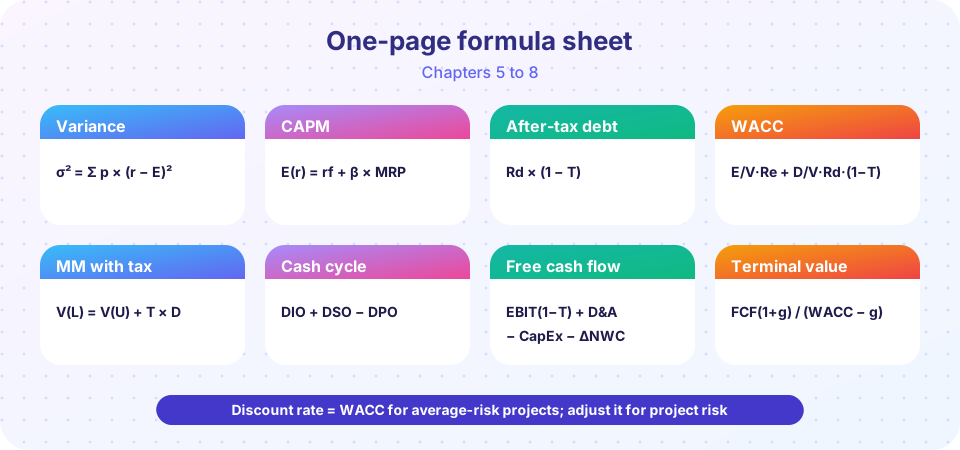
The formulas in sentences
Risk and return. The holding-period return is (P1 − P0 + D) / P0. Expected return is the probability-weighted average, variance is Σ p (R − E)² and standard deviation is its square root. A two-asset portfolio has variance wA²σA² + wB²σB² + 2wAwBρσAσB. With many assets, only market risk remains. Beta is Cov(i, m) / Var(m), and the CAPM says the required return is rf + β × MRP.
Cost of capital. Cost of equity comes from CAPM, from D1/P0 + g, or from bond yield plus a premium of three to five points. Cost of debt is the market yield to maturity, and after tax it is Rd × (1 − T). Weight them by market values to get WACC = E/V × Re + D/V × Rd × (1 − T). For a project in a different business, unlever a comparable's beta with βu = βL / [1 + (1 − T) D/E], relever it for your own mix and rebuild the WACC.
Capital structure and payout. With no taxes, value is independent of structure, and Re = R0 + (R0 − Rd) D/E. With taxes and permanent debt, V_L = V_U + T × D. Trade-off theory subtracts expected distress and agency costs. EBIT-EPS break-even: set EBIT/shares_A = (EBIT − I)/shares_B. At fair prices, a dividend and a buyback leave a shareholder equally wealthy; taxes, signals and flexibility decide which a firm prefers.
Working capital. DIO = Inventory / COGS × 365, DSO = Receivables / Sales × 365, DPO = Payables / COGS × 365, and CCC = DIO + DSO − DPO. Skipping a d/(N − t) discount costs (1 + d/(1 − d))^(365/(N − t)) − 1. The order size that minimizes ordering and holding cost is √(2DS/H).
Valuation. FCFF = EBIT(1 − T) + D&A − CapEx − ΔNWC. Terminal value is FCFF × (1 + g) / (WACC − g) at the end of the forecast, discounted by the same number of years. Equity value is enterprise value minus net debt (and other senior claims), divided by diluted shares. Cross-check with multiples (EV/EBITDA, P/E) and sensitivity grids.
Sanity checks
| Question | What a plausible answer looks like |
|---|---|
| Is the WACC between the after-tax cost of debt and the cost of equity? | It must be. |
| Is portfolio risk below the weighted average risk? | Yes unless ρ = +1. |
| Is the beta within about 0 to 2.5 for most listed firms? | Much outside that range suggests an error. |
| Is terminal growth below long-run nominal economic growth and below WACC? | It must be both. |
| Does the terminal value make up over 90% of EV? | Re-examine the forecast horizon. |
| Does the DCF-implied EV/EBITDA fall in the peer range? | If not, find out why. |
| Do units agree (percent versus decimals, millions versus units)? | Check this first when something looks off. |
Decision rules
- Accept a project if NPV > 0 at a discount rate that matches its risk.
- Use WACC only for projects whose risk resembles the firm's average business.
- Borrow while the marginal tax benefit exceeds the marginal distress and agency cost; the answer is a range.
- Pay out cash that cannot earn the cost of capital inside the firm; choose the form by tax, signal and flexibility.
- Shorten the cash cycle when the saving in financing costs exceeds the margin lost.
- Report ranges, not single numbers, for any valuation.
Press Run (or Ctrl + Enter) to see the result here.
Program input · what you'd type while the program runs
Type the answers before you press Run, one per line. Each time the program reads a line (with input()), it gets the next line from this box.
Check your understanding
Quick check · 4 questions
of 4 answered You scored / 4 · perfect!
-
1. A WACC calculation gives 12% when the cost of equity is 10% and the after-tax cost of debt is 5%. What should you conclude?
A weighted average of 10% and 5% must fall between 5% and 10%. -
2. Which formula gives the terminal value at the end of the forecast?
This is the growing-perpetuity formula, applied to the first cash flow after the forecast. -
3. Which pairing is correct?
Receivables are measured against sales; inventory and payables against COGS. -
4. When does diversification give no benefit between two assets?
At perfect positive correlation, portfolio risk is the weighted average of the two risks.
Summary
- Eight formulas carry most of the course: variance, CAPM, after-tax debt, WACC, MM with tax, the cash cycle, FCFF and terminal value.
- Sanity checks catch most errors before they matter.
- Match the discount rate to project risk and report valuation ranges.
Next: Further study
Track your progress
Create a free account to tick off lessons and pick up where you left off on any device.
of Corporate Finance lessons completed