


















Lesson 28 of 45 · Cost of Capital
WACC and project-specific discount rates
Compute the weighted average cost of capital with market-value weights, adjust it for project risk with unlevered and relevered betas, and account for flotation costs.
You now have a cost of equity and an after-tax cost of debt. A company uses both kinds of money, so its overall cost of capital is a weighted average. This lesson builds that average step by step, shows the mistakes that spoil it, and then asks the harder question: what if a project is not like the rest of the company? The answer is a toolkit of pure-play comparisons and beta adjustments that analysts use every day.
What you will learn
- Write and apply the WACC formula with market-value weights.
- Explain why market weights beat book weights.
- Unlever and relever a beta to get a rate for a different business or capital structure.
- Use a pure-play company to price a project in a new line of business.
- Treat flotation costs correctly.
Key terms
WACC: the weighted average of the after-tax costs of a firm's funding sources. Capital structure weights: the share of each source in total funding value. Unlevered (asset) beta: the beta a firm would have with no debt. Pure play: a listed company that operates almost entirely in the business you want to value. Flotation cost: the fees paid to issue new securities.
The formula
With equity E, debt D and total value V = E + D:
WACC = (E/V) × Re + (D/V) × Rd × (1 − T)
(Add a term (P/V) × Rp if the company has preferred stock.) The weights should reflect the capital structure the firm will use over the life of the project, which is usually its target mix.
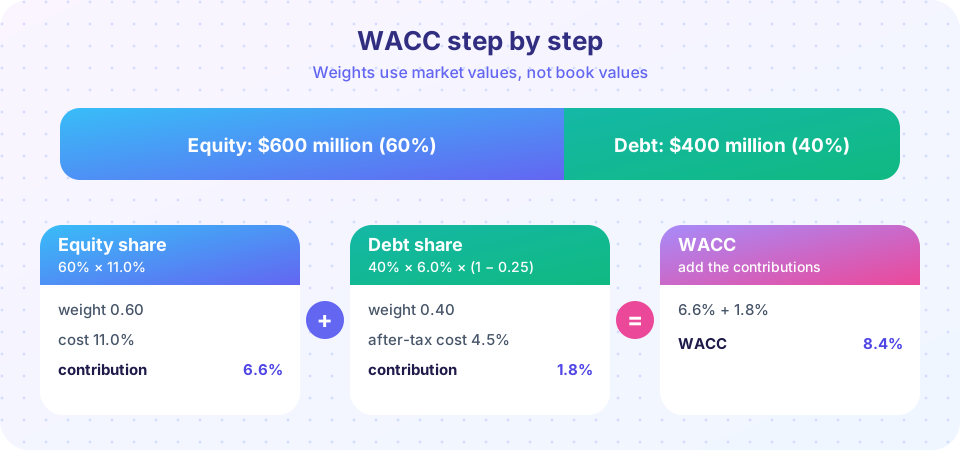
Worked example. Halden Foods (invented) has 100 million shares at $6 each, so equity is worth $600 million. Its debt trades at a market value of about $400 million. Estimated costs: Re = 11.0%, pre-tax Rd = 6.0%, tax rate T = 25%.
- Total value
V = 600 + 400 = 1,000; weights areE/V = 0.60andD/V = 0.40. - Equity contribution:
0.60 × 11.0% = 6.6%. - Debt contribution:
0.40 × 6.0% × 0.75 = 1.8%. WACC = 6.6% + 1.8% = 8.4%.
So Halden should accept an average-risk project only if it earns more than 8.4%.
Press Run (or Ctrl + Enter) to see the result here.
Program input · what you'd type while the program runs
Type the answers before you press Run, one per line. Each time the program reads a line (with input()), it gets the next line from this box.
Why market values?
Book equity is an accounting leftover: past capital raised plus retained profits, minus buybacks. It says little about what shareholders' claims are worth today. WACC is a forward-looking opportunity cost, so the weights must match the value of each claim in the market. The example shows the error: with book weights, equity looks like 38% of funding instead of 60%, which understates WACC because cheap debt gets too much weight. For debt, market value is usually close to book value for a company whose credit quality has not changed, so book debt is an acceptable stand-in when bond prices are not available.
A related point: weights should reflect the target structure if the firm plans to move toward it. If Halden intends to hold 40% debt for years, use 40% even if a temporary share-price jump has made current equity weight higher.
One rate does not fit every project
WACC describes the average risk of the firm's existing business. Applying it to every project causes two errors. A low-risk project (say, renewing a store lease) gets rejected if it earns 7% against an 8.4% hurdle, even though 7% might be generous for its risk. A high-risk project (a speculative new product) gets accepted at 9% even though its risk deserves 13%. Over time the firm drifts toward riskier businesses while telling itself every decision cleared the hurdle.
The fix is to discount each project at a rate matching its own risk. Divisions or projects with clearly different risk deserve their own rates.
Pure-play betas: unlevering and relevering
Suppose Halden wants to enter packaged snacks, where it has no history. It finds a listed pure-play snack maker with an equity beta of 1.5, debt-to-equity of 0.5 and tax rate of 25%. That equity beta mixes two things: the business risk of snacks, and the extra financial risk from the company's debt. To isolate business risk, unlever the beta using the Hamada formula:
βu = βL / [1 + (1 − T) × D/E] = 1.5 / (1 + 0.75 × 0.5) = 1.5 / 1.375 ≈ 1.09
The unlevered beta, 1.09, is the beta of snacks with no debt. Halden plans to finance the snack project with a debt-to-equity ratio of 0.25. Relever to that structure:
βL = βu × [1 + (1 − T) × D/E] = 1.09 × (1 + 0.75 × 0.25) ≈ 1.30
Now apply the CAPM with rf = 4% and MRP = 6%: Re = 4% + 1.30 × 6% ≈ 11.8%. With D/V = 0.20 and Rd = 6%: WACC ≈ 0.8 × 11.8% + 0.2 × 6% × 0.75 ≈ 10.3%. The snack project must earn about 10.3%, noticeably more than the 8.4% for Halden's core business. When you average several comparables, unlever each one first and then average the unlevered betas; the code below does this for three comparables and lands at 10.26%, close to the single-comparable result.
This procedure assumes debt itself carries no market risk (debt beta of zero) and a constant tax shield. Those are simplifications, but good enough for most budgeting.
Press Run (or Ctrl + Enter) to see the result here.
Program input · what you'd type while the program runs
Type the answers before you press Run, one per line. Each time the program reads a line (with input()), it gets the next line from this box.
Flotation costs
Raising new money costs fees: underwriters, legal, listing. A tempting shortcut is to add the fee to the WACC. The cleaner approach is to treat it as part of the project's initial cost. If a project needs $10 million of new equity and the issuer pays 5% of the funds raised in fees, the firm must raise 10 / (1 − 0.05) ≈ $10.53 million so that $10 million remains after fees. The extra $0.53 million raises the initial outlay and lowers NPV directly. Flotation costs matter more for small issues and for equity (typically a few percent of proceeds, often higher for small companies) than for large bond issues. They apply only when the firm actually raises outside funds; projects financed from retained cash have none.
Common mistakes
- Mixing nominal and real: a nominal WACC must discount nominal cash flows.
- Using last year's coupon for the cost of debt (see the previous lesson).
- Ignoring the capital structure the project actually brings: relever to the target mix.
- Using WACC for financing-side effects: WACC already includes the debt tax shield; do not add it again to cash flows.
Common misconceptions
"The lowest WACC is always the best." The mechanical WACC above falls as you add debt only because we held Re fixed. In reality, more debt raises the cost of equity. The next chapter studies that trade-off.
"WACC is the return on the company's existing assets." It is the required return for projects of average risk, not what past investments earned.
"Any project beating WACC is good." Only if its risk matches the firm's average. A riskier project must beat a higher rate.
Check your understanding
Quick check · 5 questions
of 5 answered You scored / 5 · perfect!
-
1. E = $300m, D = $200m, Re = 12%, Rd = 7%, T = 20%. What is WACC?
0.6 × 12% = 7.2%; 0.4 × 7% × 0.8 = 2.24%; total 9.44%. -
2. Why use market values for the WACC weights?
WACC is forward-looking; book values reflect past accounting. -
3. A comparable has βL = 1.2, D/E = 0.4, T = 25%. What is its unlevered beta?
βu = 1.2 / (1 + 0.75 × 0.4) = 1.2 / 1.3 ≈ 0.92. -
4. Where should flotation costs be placed in an NPV analysis?
Fees are a cash cost incurred when the project is funded, so they belong in the initial investment. -
5. A firm has one business but considers a project in a much riskier industry. What should it do?
The hurdle rate must match the project's risk, not the firm's average.
Summary
WACC = E/V × Re + D/V × Rd × (1 − T)with market-value, target-structure weights.- Book weights misstate WACC; use market values.
- Price a new business with a pure-play beta: unlever, average, relever at your target mix, then apply the CAPM and WACC.
- Flotation costs raise the initial outlay; they are not added to the discount rate.
Next: Chapter review
Track your progress
Create a free account to tick off lessons and pick up where you left off on any device.
of Corporate Finance lessons completed