


















Lesson 10 of 45 · Time Value of Money
Chapter 2 review: Time Value of Money
Review chapter 2: future and present value, annuities, perpetuities, EAR, loan payments and real rates, with a one-page formula sheet and a ten-question quiz.
Chapter 2 gave you the mathematics that every later chapter uses. Valuing a bond, a stock or a project means moving cash flows along a timeline and adding them up. If these formulas feel automatic, the rest of the course will feel natural. If they do not, spend an extra hour here; it will repay you many times.
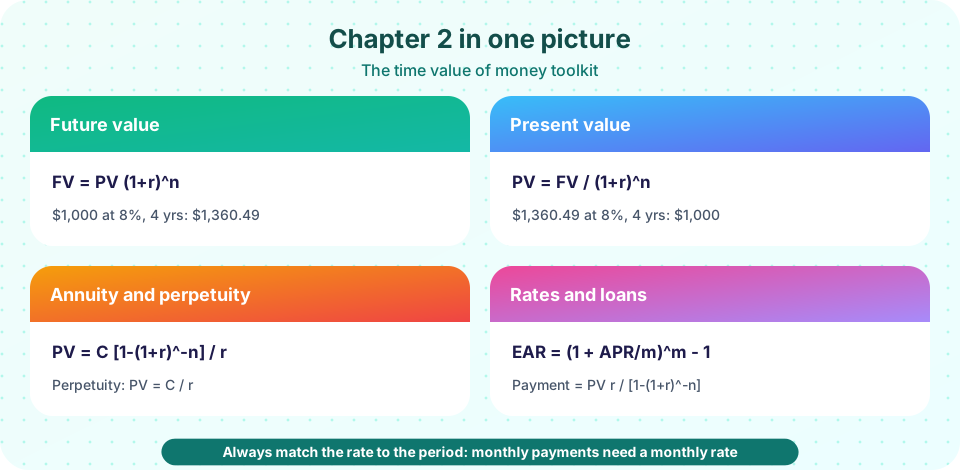
The chapter in a table
| Topic | Formula | Typical use |
|---|---|---|
| Future value | FV = PV (1 + r)^n |
What will my savings be worth? |
| Present value | PV = FV / (1 + r)^n |
What is a future payment worth today? |
| Annuity PV | C [1 - (1 + r)^-n] / r |
Loans, bond coupons, leases |
| Annuity FV | C [(1 + r)^n - 1] / r |
Savings plans |
| Perpetuity | C / r |
Preferred stock, rough valuations |
| Growing perpetuity | C1 / (r - g) |
Stock valuation, with r > g |
| Loan payment | PV r / [1 - (1 + r)^-n] |
Mortgages, car loans |
| EAR | (1 + APR/m)^m - 1 |
Comparing quoted rates |
| Real rate | (1 + nominal) / (1 + inflation) - 1 |
Inflation-adjusted analysis |
A five-step method for any problem
- Timeline. Draw dots for each date and write the cash flows.
- Units. Convert the rate so that it matches the period.
- Shape. Is it a single amount, a level annuity, a perpetuity or a mix?
- Compute. Use the formula, or split the problem into parts (an annuity plus a lump sum, for example).
- Check. Does the answer make sense? Future values exceed present values; a longer stream has a bigger present value; a higher rate lowers present values.
Worked mixed problems
Problem 1: choosing a payment plan. A shop sells a $3,000 laptop either for cash or for 12 monthly payments of $270 starting next month. Your own opportunity cost is 1% per month. The present value of the payments is 270 x (1 - 1.01^-12) / 0.01 = 270 x 11.2551 = $3,038.87. The installment plan costs more than the cash price in present value terms, so pay cash if you can. The monthly rate that exactly equates the two is about 1.2%, an effective annual rate near 15%: that is the price of the shop's credit.
Problem 2: retirement saving. You will save $4,000 at the end of each year for 30 years and earn 7%. The future value is 4,000 x (1.07^30 - 1) / 0.07 = 4,000 x 94.461 = $377,843. Your deposits total only $120,000; most of the final amount is interest on interest. Starting ten years later (20 years of saving) gives about $163,982, less than half.
Problem 3: a bonus at the end. A project pays $100 a year for 5 years and a final $1,000. At 8%: the annuity part is worth 100 x 3.99271 = 399.27 and the lump sum is worth 1,000 / 1.08^5 = 680.58, for a total of $1,079.85. Splitting a stream into an annuity and a single sum is the most useful trick of the chapter.
Exam traps
- Using the annual rate with monthly payments.
- Forgetting that the annuity formula values the stream one period before the first payment.
- Mixing nominal cash flows with a real rate.
- Using the APR as if it were an EAR when comparing offers.
- Adding cash flows from different dates before discounting.
Try it
The first program is a "formula-check" tool for the chapter: it solves a set of standard problems, so you can compare your hand answers with it.
Press Run (or Ctrl + Enter) to see the result here.
Program input · what you'd type while the program runs
Type the answers before you press Run, one per line. Each time the program reads a line (with input()), it gets the next line from this box.
The second program shows the most important trade-off of the chapter: how the present value of a fixed payment shrinks when the rate or the waiting time rises. Look at the heat-map style table and find where $1,000 is worth less than half.
Press Run (or Ctrl + Enter) to see the result here.
Program input · what you'd type while the program runs
Type the answers before you press Run, one per line. Each time the program reads a line (with input()), it gets the next line from this box.
Check your understanding
Quick check · 10 questions
of 10 answered You scored / 10 · perfect!
-
1. What is $2,500 worth in 3 years at 6% a year, compounded yearly?
2,500 x 1.06^3 = 2,500 x 1.191016 = 2,977.54. -
2. What is the present value of $10,000 due in 5 years at 8%?
10,000 / 1.08^5 = 10,000 / 1.469328 = 6,805.83. -
3. Present value of $800 a year for 6 years at 5% (ordinary annuity)?
800 x (1 - 1.05^-6) / 0.05 = 800 x 5.0757 = 4,060.55. -
4. A perpetuity pays $120 a year at a 4% discount rate. Its value is:
120 / 0.04 = 3,000. -
5. The EAR of a 10% APR compounded monthly is closest to:
(1 + 0.10/12)^12 - 1 = 10.47%. -
6. A 3-year, $5,000 loan at 10% a year is repaid with equal yearly payments. The payment is:
5,000 x 0.10 / (1 - 1.10^-3) = 500 / 0.248685 = 2,010.57. -
7. A deposit pays 7% nominal and inflation is 4%. The real rate is:
1.07 / 1.04 - 1 = 2.88%. Subtracting (3%) is only an approximation. -
8. Payments are made at the START of each period. Compared with the ordinary annuity, the present value is:
Each payment is one period earlier, so it is discounted one period less. -
9. A growing perpetuity has C1 = 60, r = 10% and g = 2%. Its value is:
60 / (0.10 - 0.02) = 750. -
10. Which statement about discounting is TRUE?
The discount factor (1 + r)^-n falls faster when both r and n are large, so distant cash flows are hit hardest.
Summary
- Match the rate to the period; draw a timeline first.
- Single sums use
(1 + r)^n; level streams use the annuity factor; endless streams useC / r. - Quoted rates (APR) must be converted to effective rates before comparing.
- Loan payments are the annuity formula solved for the payment; the interest share starts high and falls.
- Keep nominal cash flows with nominal rates, and real with real.
Track your progress
Create a free account to tick off lessons and pick up where you left off on any device.
of Corporate Finance lessons completed