


















Lesson 11 of 45 · Valuing Bonds and Stocks
Valuing bonds and stocks: the big picture
Chapter 3 overview: how bonds and stocks differ, why every security is worth the present value of its cash flows, and a map of the lessons on pricing each.
When a company needs money for a new factory, it can borrow from lenders or sell ownership to investors. The first path creates bonds, the second creates stocks (shares). Both are financial assets, and both are valued with the same idea from chapter 2: a security is worth the present value of the cash it will pay its owner.
This chapter applies that single idea twice. A bond promises fixed cash flows, so valuing one is mostly arithmetic. A stock promises nothing fixed, so valuing one needs forecasts. Along the way you will learn why bond prices fall when interest rates rise, why long bonds swing more than short ones, and how a few assumptions about growth turn the infinite sum of dividends into a simple formula.
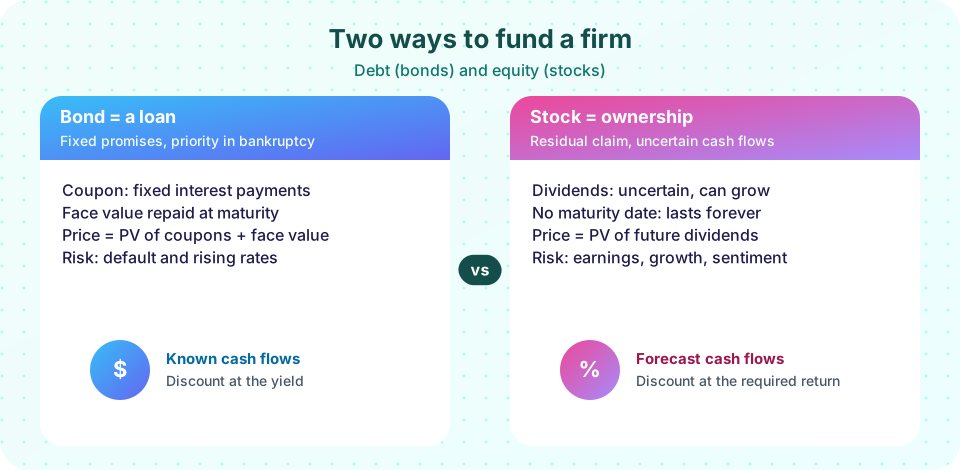
Two kinds of claim
A bond is a loan
Cash flows are promised, so we discount them at the market yield.
A stock is ownership
Cash flows are forecast, so we discount them at the required return.
One idea
The discount rate reflects the risk of the cash flows.
The difference in risk is easy to see in a bankruptcy. The firm's assets are sold, and the money goes first to secured lenders, then to other creditors, and only if anything is left to shareholders. Because bondholders are paid first, they accept a lower return; because shareholders take the risk, they demand a higher one. That ordering is why the required return on stock is, on average, higher than on the same company's bonds.
What is in this chapter
| Lesson | You will be able to |
|---|---|
| Bond valuation | Price a coupon bond, tell premium from discount bonds, and value a zero-coupon bond |
| Bond yields and interest rate risk | Compute yield to maturity, current yield, and explain why prices and yields move in opposite directions |
| Stock valuation and dividends | Value shares with zero-growth, constant-growth and two-stage dividend models |
| Chapter 3 review | Combine the models and test yourself with ten questions |
The valuation recipe
All three lessons follow the same four steps. Keep them in mind:
- List the cash flows the owner will receive and the dates.
- Choose a discount rate that fits the risk of those cash flows. For a bond it is the market yield for similar bonds; for a stock it is the required return, which chapter 5 will explain.
- Discount and add. Use the single-sum and annuity formulas from chapter 2.
- Compare with the market price. If your value is higher than the price, the security looks cheap; if lower, expensive. Remember that the market price is itself an informed estimate, so a large gap usually means your assumptions deserve a second look.
A first try
The program below is a generic pricing machine. Give it any list of cash flows and a discount rate, and it returns the present value. Use it for a bond (coupons plus face value) or a stock (a few forecast dividends plus a final price).
Press Run (or Ctrl + Enter) to see the result here.
Program input · what you'd type while the program runs
Type the answers before you press Run, one per line. Each time the program reads a line (with input()), it gets the next line from this box.
Look at the bond result at 5%: when the market yield equals the coupon rate, the price equals the face value of 1,000. At 6% the same bond is worth less. The next lesson explains why.
Now an interactive demonstration. Move the discount rate and watch what happens to the price of a 5-year bond and a 20-year bond with the same 5% coupon.
Check your understanding
Quick check · 4 questions
of 4 answered You scored / 4 · perfect!
-
1. Which security has a promised, fixed set of cash flows?
A bond promises coupons and a face value. Stock cash flows are uncertain. -
2. In a bankruptcy, who is paid first?
Creditors rank ahead of shareholders, who receive the residual. -
3. Why is the required return on stock usually higher than on the same firm's bonds?
Higher risk needs a higher expected return as compensation. -
4. The common valuation method for both bonds and stocks is:
Price equals the present value of the cash the owner will receive, discounted for risk.
Summary
- Bonds are loans with fixed promises; stocks are ownership with uncertain residual cash flows.
- Creditors are paid before shareholders, so stock must offer a higher expected return.
- Every security is worth the present value of its expected cash flows at a risk-appropriate rate.
- Next lessons: bond pricing, yields and interest rate risk, then stock valuation.
Next: Bond valuation
Track your progress
Create a free account to tick off lessons and pick up where you left off on any device.
of Corporate Finance lessons completed