


















Lesson 33 of 45 · Capital Structure and Payout
Dividends, buybacks and payout policy
Learn how dividends and buybacks work, why payout policy is irrelevant in a perfect market, how taxes and signalling change that, and how the residual dividend model works.
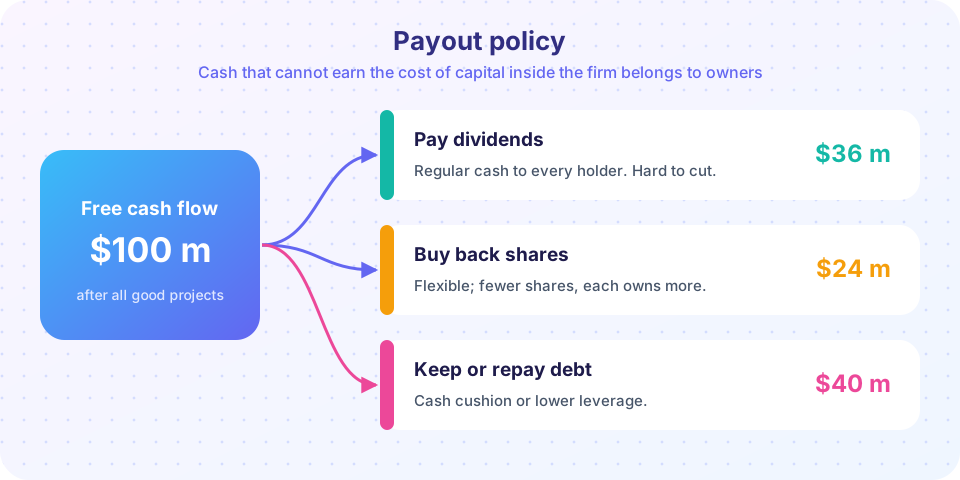
A profitable company ends each year with cash. It can reinvest it in new projects, pay down debt, hand it to shareholders as a dividend, or use it to buy back its own shares. The first two are investment and financing decisions you have already studied. This lesson is about the last two: how to return cash to owners, and whether the choice between them, or the decision to pay at all, makes shareholders richer. As with capital structure, the best way in is to start with a world where it does not matter.
What you will learn
- Describe how cash dividends work, including the ex-dividend date.
- Explain how buybacks work and show that a buyback and a dividend can be worth the same to a shareholder.
- State dividend irrelevance and name the frictions that break it.
- Use the residual dividend model.
- Explain stock splits and stock dividends.
Key terms
Dividend payout ratio: dividends divided by net income. Dividend yield: annual dividend divided by share price. Ex-dividend date: the first day the share trades without the right to the declared dividend. Share repurchase (buyback): a company buys its own shares, reducing the number outstanding. Signalling: conveying private information through an observable action.
Cash dividends
A board declares a dividend, say $0.80 per share, and fixes a record date: holders of record on that date receive it. Because settlement takes time, shares begin trading ex-dividend one business day (in many markets) before the record date. A buyer on or after the ex-date does not receive the payment, so the price drops by roughly the dividend on that morning. The payment itself comes weeks later. Nothing magical happens: the company hands over cash, the shares become claims on a smaller firm, and the total wealth of a shareholder (shares plus cash) is unchanged before taxes.
Two ratios describe a dividend policy: the payout ratio (dividends over earnings, often 30% to 60% for mature companies) and the dividend yield (dividend over price). John Lintner found in the 1950s that managers treat dividends as sticky: they raise them only when confident the higher level is sustainable, and cut them reluctantly. As a result, dividends move more smoothly than earnings.
Share repurchases
In a buyback, the company spends cash to purchase its own shares, usually in the open market over months, sometimes via a tender offer at a stated price. Shares bought back reduce the number outstanding; remaining shareholders own a larger slice of the firm. Since the 1980s buybacks have grown from rare to a main channel of payout in countries such as the United States, rivalling dividends in total dollars, though policies and tax treatment differ widely worldwide.
A worked comparison. Beaumont Tools (invented) has 50 million shares at $40, so equity is $2,000 million, and wants to return $40 million.
Option 1: dividend. $40m / 50m = $0.80 per share. After paying, the firm is worth $1,960m, and each share is worth 1,960 / 50 = $39.20. A shareholder holds a $39.20 share plus $0.80 cash = $40.00.
Option 2: buyback. The firm buys 40 / 40 = 1 million shares. Value is again $1,960m, now spread over 49 million shares: 1,960 / 49 = $40.00 per share. A shareholder who keeps the shares holds $40.00; one who sold into the buyback holds $40.00 in cash.
Both options leave a shareholder with $40.00 of wealth per share. The choice moves the form (cash now versus shares worth more) but not the total.
Press Run (or Ctrl + Enter) to see the result here.
Program input · what you'd type while the program runs
Type the answers before you press Run, one per line. Each time the program reads a line (with input()), it gets the next line from this box.
Dividend irrelevance (Modigliani-Miller again)
The same logic as in the capital structure argument applies. Fix the firm's investment policy. Then, in a perfect market, how much it pays out now does not alter its total value, because paying less today means more cash (or less borrowing) inside the firm, worth exactly what was not paid. A shareholder who wants more cash can sell a few shares ("homemade dividends"); one who wants less can reinvest the dividend. Value comes from the firm's investment and operating decisions, not from how profits are packaged.
Why it matters in practice
Frictions give payout policy texture:
- Taxes. In many countries dividends and capital gains are taxed differently, and gains are taxed only when realized. Where dividends are taxed more heavily, investors prefer buybacks; where the reverse is true, they prefer dividends. Rules vary by country and change over time, so check local law.
- Signalling. Managers know more than outsiders. A dividend initiation or increase is a costly, credible signal that they expect sustained cash flow; a cut is a warning. Research finds that prices tend to move in the direction of surprise dividend changes, though it is debated how much is signalling versus other effects.
- Flexibility. A dividend, once set, is hard to cut. A buyback can be paused. Firms with uncertain earnings often prefer a lower regular dividend plus occasional buybacks.
- Agency. Paying out cash keeps managers from squandering it (Jensen's free cash flow argument). Dividends also prompt firms to return to capital markets for money, where they face scrutiny.
- Clienteles. Retirees seeking income may favour dividend payers, high-bracket investors may favour low payers. Investors sort themselves, which can blunt the effect of any one firm's policy.
- Legal and contractual limits. Dividends may be restricted by company law (capital maintenance) or loan covenants.
The residual dividend model
A theory of how much to pay, if you want to avoid issuing new shares: (1) pick the target capital structure; (2) fund every positive-NPV project using that mix, with equity coming from retained earnings first; (3) pay whatever is left as a dividend. Example: net income $100m, target 40% debt and 60% equity, and projects costing $120m. Equity needed is 0.6 × 120 = $72m. So the dividend is 100 − 72 = $28m. In a year with $200m of good projects, equity needed is $120m, above earnings, so the dividend is zero. The model implies lumpy payouts, which firms dislike, so in practice they smooth dividends and treat the residual logic as a long-run guide.
Press Run (or Ctrl + Enter) to see the result here.
Program input · what you'd type while the program runs
Type the answers before you press Run, one per line. Each time the program reads a line (with input()), it gets the next line from this box.
Stock splits and stock dividends
A stock split exchanges each share for several (a 2-for-1 split doubles the number and halves the price). A stock dividend gives holders extra shares (a 10% stock dividend gives one new share per ten held). Neither moves cash, so neither changes firm value: each shareholder owns the same slice of the same firm. Companies use splits to keep the price within a convenient range and they may modestly raise liquidity or signal confidence. Do not confuse them with cash dividends.
Common misconceptions
"Buybacks create value by raising EPS." EPS rises because there are fewer shares, but the firm also lost the cash that was earning something. If shares are bought at a fair price, wealth does not change. (If management buys at a price above intrinsic value, existing holders who stay lose.)
"Companies that pay no dividends are not rewarding shareholders." Retaining cash to fund projects with returns above the cost of capital creates more value than paying it out.
"A high dividend yield is always good." A yield can be high because the price has collapsed. And a payout that forces the firm to skip good projects or borrow heavily may destroy value.
Check your understanding
Quick check · 6 questions
of 6 answered You scored / 6 · perfect!
-
1. A firm with 20 million shares at $50 pays a $1.00 dividend per share. Ignoring taxes, what is the approximate ex-dividend price?
The firm gave away $1 per share of value, so the shares trade near $49 ex-dividend. -
2. Which buyback outcome is correct for 50 million shares at $40 when $40m is used to buy shares at $40?
40 / 40 = 1 million shares are retired, leaving 49 million. -
3. What does dividend irrelevance say?
Investors can create homemade dividends or reinvest, so the packaging of payout does not change value. -
4. Net income $80m; target equity weight 50%; projects $100m. What is the residual dividend?
Equity needed = 0.5 × 100 = $50m; dividend = 80 − 50 = $30m. -
5. A 2-for-1 stock split changes which of the following?
Shares double and the price halves; value and cash are unchanged. -
6. Why might a firm with volatile earnings prefer buybacks?
Repurchases can be paused or scaled at will, while dividends are expected to be maintained.
Summary
- Dividends and buybacks both return cash; at fair prices a shareholder's total wealth is unchanged.
- In a perfect market payout policy is irrelevant; taxes, signalling, flexibility and agency effects give it substance.
- Residual dividend model: fund good projects first, pay out the leftover.
- Splits and stock dividends change the share count, not value.
Next: Chapter review
Track your progress
Create a free account to tick off lessons and pick up where you left off on any device.
of Corporate Finance lessons completed