


















Lesson 20 of 45 · Capital Budgeting
Chapter 4 review: Capital Budgeting
Review chapter 4: the capital budgeting process, NPV, IRR, payback, profitability index and project cash flows, with a one-page sheet and a ten-question quiz.
You now have a complete method for deciding whether a project is worth doing: estimate incremental after-tax cash flows, discount them at the right rate, and accept projects with a positive NPV. You have also seen the alternatives (IRR, payback, the profitability index) and know where each one can go wrong. This review pulls the chapter onto one page and tests you.
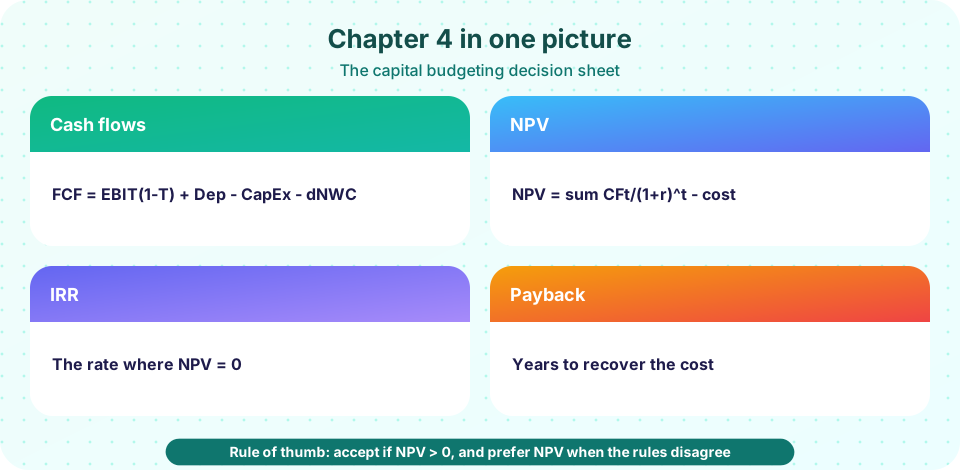
The chapter in a table
| Lesson | Big idea | Remember |
|---|---|---|
| Capital budgeting overview | Capital budgeting selects value-creating projects | Independent versus mutually exclusive projects |
| The NPV rule | Accept if NPV > 0 | NPV adds up; use EAC for unequal lives |
| IRR and payback | IRR is the rate where NPV = 0 | IRR can mislead; payback ignores later cash |
| Project cash flows | Use incremental, after-tax cash flows | Ignore sunk costs; include working capital and salvage |
A checklist for evaluating any project
- List the incremental cash flows. Did you include opportunity costs, side effects, working capital and the end-of-life values? Did you leave out sunk costs and interest?
- Pick a discount rate that matches the risk (chapter 6 will show how).
- Compute the NPV. Is it positive?
- Cross-check: IRR above the required return, a payback you can live with.
- Stress-test: what shortfall in sales or rise in costs makes the NPV zero?
- If projects are mutually exclusive, choose the highest NPV. If money is limited, rank by profitability index.
A worked mixed problem
Compare two mutually exclusive projects for a food truck company, with a discount rate of 10%. Truck A costs 60,000 and brings 25,000 a year for 3 years. Truck B costs 40,000 and brings 17,000 a year for 3 years. Assume a flat 3-year life with no salvage and ignore tax to keep the arithmetic clear.
- Annuity factor at 10% for 3 years = 2.48685.
- NPV of A = 25,000 x 2.48685 - 60,000 = 62,171 - 60,000 = 2,171.
- NPV of B = 17,000 x 2.48685 - 40,000 = 42,276 - 40,000 = 2,276.
- Profitability index: A = 62,171 / 60,000 = 1.04; B = 42,276 / 40,000 = 1.06.
B has the higher NPV and a higher PI, and it needs 20,000 less cash, so B is the better choice here. The two NPVs are very close and both are small relative to the investment: a 3.5% shortfall in A's annual cash flow would erase its NPV. This is the kind of project where a careful sensitivity analysis is worth more than a more precise formula.
Exam traps
- Including a sunk cost or leaving out the recovery of working capital.
- Choosing between mutually exclusive projects by IRR alone.
- Reading Excel's NPV function as if it started at time 0.
- Counting interest in the cash flows and discounting at the cost of capital too.
- Reporting payback as if it said something about value.
Try it
The first program is a complete project evaluator. It takes cash flows and a rate, and prints NPV, IRR, profitability index, payback and the break-even shortfall in inflows. Replace the invented flows with your own.
Press Run (or Ctrl + Enter) to see the result here.
Program input · what you'd type while the program runs
Type the answers before you press Run, one per line. Each time the program reads a line (with input()), it gets the next line from this box.
The second program draws the NPV profile of that project with the required return marked, and shows how much room there is between the hurdle rate and the IRR.
Press Run (or Ctrl + Enter) to see the result here.
Program input · what you'd type while the program runs
Type the answers before you press Run, one per line. Each time the program reads a line (with input()), it gets the next line from this box.
Check your understanding
Quick check · 10 questions
of 10 answered You scored / 10 · perfect!
-
1. A project costs $1,000 and pays $600 at the end of each of the next 2 years. At 10%, the NPV is:
600 / 1.10 + 600 / 1.21 = 545.45 + 495.87 = 1,041.32; NPV = 41.32. -
2. The present value of a project's inflows is 1,200 and its cost is 1,000. The profitability index is:
PI = PV of inflows / cost = 1,200 / 1,000 = 1.20, equivalent to an NPV of +200. -
3. A conventional project has an NPV of zero at a discount rate of 14%. Its IRR is:
The IRR is by definition the rate that makes NPV zero. -
4. Cost 800, then 300 a year for 4 years. The payback period is about:
After 2 years 600 is recovered; the remaining 200 takes 200 / 300 of the third year: 2.67 years. -
5. Revenue 900, cash costs 500, depreciation 100, tax rate 30%. Operating cash flow is:
EBIT = 300, tax = 90, NOPAT = 210, plus depreciation 100 = 310. -
6. An asset with book value 20 is sold for 50 at a 40% tax rate. The after-tax cash received is:
Gain = 30, tax = 12, so cash = 50 - 12 = 38. -
7. A market study paid last year for 60 should be treated as:
It is already spent whatever you decide, so it does not affect incremental cash flows. -
8. Project A has the higher IRR, project B has the higher NPV at the firm's discount rate. They are mutually exclusive. Choose:
NPV measures the value added, so it decides among mutually exclusive projects. -
9. A machine's costs have a present value of 5,000 over 4 years at 10%. The equivalent annual cost is closest to:
The annuity factor is 3.16987, and 5,000 / 3.16987 = 1,577.35. -
10. If the discount rate rises, the NPV of a conventional project:
The NPV profile slopes downward for a conventional project.
Summary
- Build incremental after-tax cash flows: include opportunity costs, side effects, working capital and salvage; exclude sunk costs and interest.
- Accept projects with NPV > 0; NPV is the value added in today's dollars.
- IRR is intuitive but can mislead; payback ignores the time value and later cash.
- Among mutually exclusive projects, choose by NPV; under a budget, rank by profitability index.
- Always stress-test the forecast.
Track your progress
Create a free account to tick off lessons and pick up where you left off on any device.
of Corporate Finance lessons completed