


















Lesson 5 of 45 · Getting Started
Chapter 1 review: Getting Started
Review chapter 1 of Corporate Finance: the three decisions, the goal of value maximization, agency, financial markets and the three financial statements.
You have finished the first chapter. You now know what corporate finance is for, what goal it pursues, what gets in the way, and which reports hold the raw numbers. This review ties the lessons together with one picture, a recap table and a longer quiz. If you miss a question, the explanation tells you which lesson to reread.
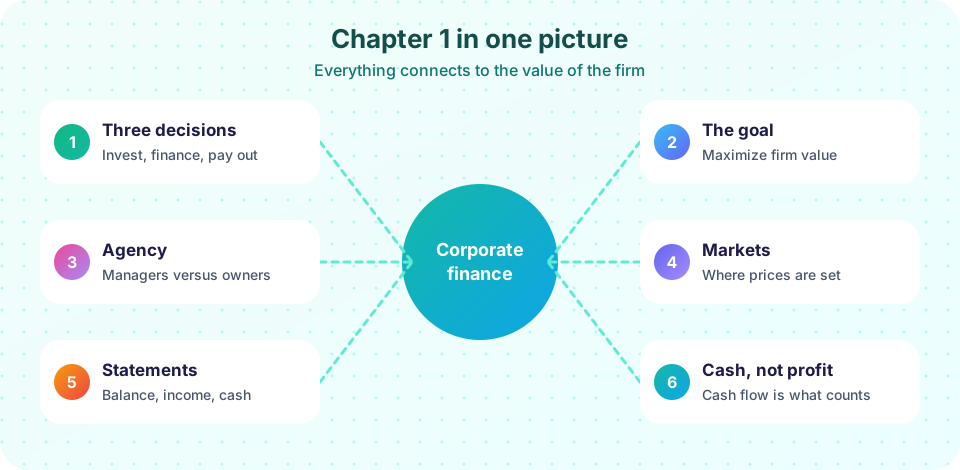
The chapter in a table
| Lesson | Big idea | One thing to remember |
|---|---|---|
| What corporate finance is | Three decisions: invest, finance, pay out | Value = present value of future cash flows |
| Goals, agency and markets | Maximize firm value; managers are agents | Agency costs are normal; incentives matter |
| Financial statements for finance | Balance sheet, income statement, cash flow | Finance follows cash, not accounting profit |
Five ideas to carry forward
- Cash arrives in the future. Every project in this course is a stream of cash flows over time. Chapter 2 gives you the arithmetic for comparing cash at different dates.
- Value is the target. When two options look similar, the better one has the higher present value of cash flows after allowing for risk.
- Incentives shape behavior. Whenever someone makes a decision on someone else's behalf, ask whether their interest matches the owner's.
- Markets give prices. A market price is an estimate made by many investors at once; it is usually a hard benchmark to beat.
- Free cash flow is the raw material.
FCF = EBIT(1 - T) + depreciation - capital spending - increase in working capitalreturns in chapters 4 and 8.
A worked mixed problem
Put the chapter together with one question. Maple Street Bakery has revenue of 400, operating costs of 310 (including depreciation of 30), interest of 10 and pays tax at 30%. It spent 25 on new ovens and its working capital rose by 5.
- EBIT = 400 - 310 = 90.
- Profit before tax = 90 - 10 = 80. Tax = 24. Net income = 56.
- Operating cash flow = net income + depreciation - increase in working capital = 56 + 30 - 5 = 81.
- Free cash flow = EBIT x (1 - tax rate) + depreciation - capital spending - increase in working capital = 63 + 30 - 25 - 5 = 63.
Notice what the numbers say. Profit is 56, but the owners and lenders can take out 63 of free cash flow, because the 30 of depreciation is not cash and only 25 went into new ovens. If the bakery's equity is 200, the return on equity is 56 / 200 = 28%. A manager who pursues the goal of this chapter, a higher firm value, asks which of these numbers will rise in the future, and whether the projects behind them earn more than they cost.
Questions to ask yourself
- Can I say the three decisions in my own words and give a business example of each?
- Can I explain why profit maximization is a weaker goal than value maximization?
- Can I describe an agency problem I have seen in a school, a club or a workplace?
- Can I move from net income to free cash flow without looking at the formula?
If you hesitate on any of them, reread the matching lesson before starting chapter 2.
Try it
This program is a self-check tool for the financial statements. Fill in the numbers for any invented company and it computes the quantities from this chapter, so you can test your hand calculations.
Press Run (or Ctrl + Enter) to see the result here.
Program input · what you'd type while the program runs
Type the answers before you press Run, one per line. Each time the program reads a line (with input()), it gets the next line from this box.
Check your understanding
Quick check · 10 questions
of 10 answered You scored / 10 · perfect!
-
1. Which pair lists two of the three main decisions of corporate finance?
The three decisions are investing, financing and payout (with working capital management). -
2. The value of a firm is best described as:
Value is forward-looking: cash flows, timing and risk. -
3. A manager rejects a risky project that would help shareholders because his bonus would suffer if it failed. This is an example of:
The manager's incentive differs from the owners' interest, which is the agency problem. -
4. Which of these is NOT a way to align manager and owner interests?
Hiding information increases agency costs. The other three tools reduce them. -
5. When shares are traded between two investors on an exchange, which market is this?
Trading existing securities between investors happens in the secondary market; the firm gets no cash. -
6. Assets are 900 and equity is 350. What are liabilities?
Liabilities = assets - equity = 900 - 350 = 550. -
7. Net income 60, depreciation 25, increase in working capital 15. Operating cash flow is:
60 + 25 - 15 = 70. -
8. Interest of 40 is paid at a 25% tax rate. The tax shield is:
Interest is deductible: tax shield = 40 x 0.25 = 10. -
9. EBIT 200, tax rate 20%, depreciation 30, capital spending 50, working capital increase 10. Free cash flow is:
200 x 0.8 = 160; plus 30 = 190; minus 50 = 140; minus 10 = 130. -
10. Why do finance people prefer cash flow to accounting profit when valuing a project?
Cash is what investors can actually spend, so value is built from cash flows.
Summary
- Corporate finance = investing, financing and payout decisions, aimed at maximizing firm value.
- Agency costs arise when managers are not the owners; incentives, boards, takeovers and debt reduce them.
- Primary markets raise cash; secondary markets provide liquidity and prices.
- Balance sheet (snapshot), income statement (period) and cash flow statement (cash movements) fit together.
- Free cash flow is the cash that matters for valuation.
Track your progress
Create a free account to tick off lessons and pick up where you left off on any device.
of Corporate Finance lessons completed