


















Lesson 36 of 45 · Working Capital and Valuation
The cash conversion cycle and working capital management
Compute inventory, receivable and payable days, the cash conversion cycle and the funding it implies. Covers financing policy, trade credit cost and the economic order quantity.
Imagine a bakery that buys flour on the first of the month, bakes, sells to cafes on credit and is paid six weeks later. In the meantime it pays wages and rent from its own pocket. The longer the gap between paying out and getting paid, the more money the bakery must find from somewhere. That gap, measured in days, is the cash conversion cycle. Shrinking it is one of the cheapest ways to raise cash, because it needs no bank and no shareholder.
What you will learn
- Compute DIO, DSO, DPO and the cash conversion cycle from financial statements.
- Convert days of cycle into dollars of funding.
- Distinguish aggressive, matching and conservative financing policies.
- Calculate the effective cost of forgoing a cash discount.
- Use the economic order quantity (EOQ) to balance ordering and holding costs.
Key terms
Net working capital (NWC): operating current assets minus operating current liabilities. DIO: days inventory outstanding. DSO: days sales outstanding. DPO: days payables outstanding. Cash conversion cycle (CCC): DIO + DSO − DPO. Trade credit: supplier credit for goods bought.
From profit to cash: the three days
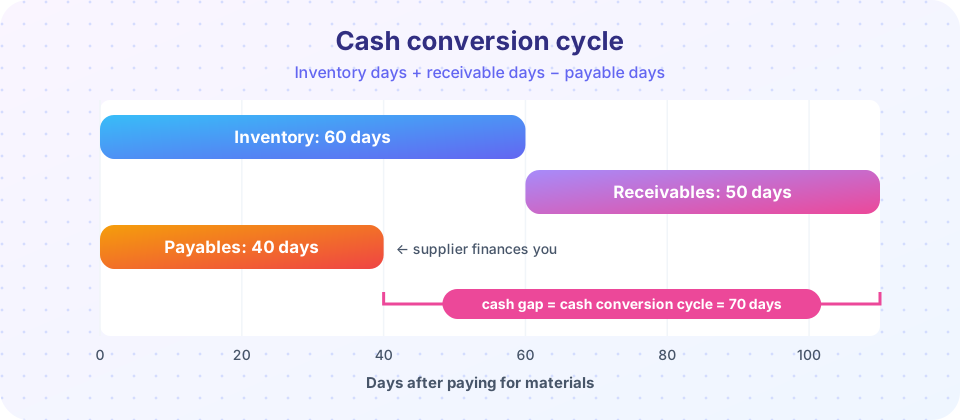
Take an invented manufacturer, Orchard Gear, over one year. Sales were $1,095 million (that is $3 million a day) and cost of goods sold was $730 million ($2 million a day). Year-end balances: inventory $120 million, accounts receivable $150 million, accounts payable $80 million.
- Days inventory (DIO) = Inventory / COGS × 365 = 120 / 730 × 365 = 60 days. Goods sit on average for two months before being sold.
- Days sales outstanding (DSO) = Receivables / Sales × 365 = 150 / 1,095 × 365 = 50 days. Customers take about seven weeks to pay.
- Days payables (DPO) = Payables / COGS × 365 = 80 / 730 × 365 = 40 days. Orchard pays suppliers after about five and a half weeks.
The operating cycle is DIO + DSO = 110 days: from buying goods to collecting cash from selling them. The suppliers finance 40 of those days, so the firm finances the rest:
CCC = DIO + DSO − DPO = 60 + 50 − 40 = 70 days
In dollars, the firm has 120 + 150 − 80 = $190 million of operating working capital to fund. Note that 70 days times $2 million of daily cost is $140 million, not $190 million: receivables are valued at sales price, which includes profit margin, so the days-and-dollars link uses the right base for each item. Use balance-sheet arithmetic for the exact funding amount and days for the comparison.
What a day is worth
Because each ratio has a daily base, a one-day change is easy to value. One day of DSO equals $3 million of receivables (one day of sales). One day of DIO or DPO equals $2 million. Suppose Orchard collects faster, cutting DSO from 50 to 40 days: that releases 10 × 3 = $30 million of cash. If its cost of capital is 8%, the saving is $2.4 million a year, forever, without a single extra sale. Stretching suppliers by five days frees another 5 × 2 = $10 million, though pushing too hard may cost goodwill, discounts or supply reliability.
Press Run (or Ctrl + Enter) to see the result here.
Program input · what you'd type while the program runs
Type the answers before you press Run, one per line. Each time the program reads a line (with input()), it gets the next line from this box.
Financing working capital
Not every current asset is temporary. A firm always needs some minimum inventory and receivables, called permanent current assets, plus temporary ones that swell with the seasons. Financing policy matches funding to these needs:
- Matching (maturity matching): long-term funds for fixed and permanent current assets; short-term borrowing for temporary needs. The standard recommendation.
- Aggressive: also funds some permanent assets with short-term borrowing. Cheaper when short rates are low, but risky: lenders may refuse to roll the debt over just when the firm needs it.
- Conservative: funds even temporary needs with long-term capital, so the firm holds idle cash in quiet months. Safe, but expensive.
Short-term debt is usually cheaper than long-term, but it must be refinanced often. The choice is a trade-off between cost and liquidity risk.
Trade credit and the price of a discount
Suppliers often offer terms such as 2/10 net 30: take a 2% discount if you pay within 10 days; otherwise pay the full amount in 30. Skipping the discount means borrowing from the supplier for 20 extra days. On a $100 invoice, you pay $98 on day 10 or $100 on day 30, so for 20 days you pay $2 on $98:
periodic rate = 2 / 98 = 2.04%
There are 365 / 20 = 18.25 such periods a year, so the effective annual rate is
EAR = (1 + 0.0204)^18.25 − 1 ≈ 44.6%
That is a very expensive loan. Unless the firm cannot borrow anywhere else, it should take the discount. The calculation also reveals an opportunity: a supplier offering generous terms is providing cheap finance, and a firm that is short of cash may legitimately stretch payment.
Inventory: the EOQ model
Holding inventory costs money (storage, insurance, spoilage, capital tied up); ordering costs money too (admin, shipping). The economic order quantity balances them. With annual demand D, ordering cost per order S and holding cost per unit per year H:
EOQ = √(2DS / H)
For D = 10,000 units, S = $50 per order and H = $2 per unit per year: EOQ = √(2 × 10,000 × 50 / 2) = √500,000 ≈ 707 units, about 14 orders a year. Total cost is √(2DSH) ≈ $1,414: half of ordering ($707) and half holding ($707), which is where the two curves cross. The model assumes steady demand and no stockouts, so real firms add safety stock, but it conveys the trade-off. Modern techniques such as just-in-time cut S so far that tiny batches become economic.
Press Run (or Ctrl + Enter) to see the result here.
Program input · what you'd type while the program runs
Type the answers before you press Run, one per line. Each time the program reads a line (with input()), it gets the next line from this box.
Cash management in one paragraph
Firms also hold cash for transactions, precaution and sometimes speculation. Holding too little risks missing payments; holding too much sacrifices returns. Practical tools include forecasting cash with a cash budget, speeding collections (electronic payments, lockboxes), controlling float (the delay between a payment being written and the funds clearing) and parking surplus cash in short-term, low-risk instruments. Large companies centralize cash across subsidiaries to net out surpluses and deficits.
Common misconceptions
"A negative cash conversion cycle is impossible." It is possible and powerful: firms like grocers or online platforms that collect from customers before paying suppliers are financed by their suppliers. It is not a sign of trouble unless it comes from being unable to pay.
"Collecting faster is always good." Strict credit terms can lose customers. Compare the financing saved with the margin lost.
"Stretching payables is free." Missing a discount can cost over 40% a year, late payment can damage supplier relations, and some contracts impose penalties.
Check your understanding
Quick check · 6 questions
of 6 answered You scored / 6 · perfect!
-
1. Sales $730m, receivables $100m. What is DSO?
100 / 730 × 365 = 50 days. -
2. DIO = 45, DSO = 38, DPO = 30. What is the cash conversion cycle?
45 + 38 − 30 = 53 days. -
3. Daily sales are $2m. Cutting DSO by 6 days releases about:
6 days × $2m of sales per day = $12m of receivables released. -
4. Terms 1/10 net 30. Roughly what is the cost of skipping the discount (periodic rate)?
1 / 99 = 1.01% for 20 days, which compounds to about 20% a year. -
5. D = 4,000 units, S = $40, H = $2. What is the EOQ?
√(2 × 4,000 × 40 / 2) = √160,000 = 400. -
6. Which financing policy funds permanent current assets with short-term debt?
The aggressive policy relies on short-term borrowing for permanent needs, saving interest but risking refinancing trouble.
Summary
CCC = DIO + DSO − DPO: days of operations the firm must fund itself.- Each day of a ratio is worth one day of the relevant base (sales or COGS).
- Match the maturity of funding to the life of the assets; short-term borrowing is cheaper but riskier.
- Skipping a 2/10 net 30 discount costs about 45% a year.
EOQ = √(2DS/H)balances ordering and holding costs.
Track your progress
Create a free account to tick off lessons and pick up where you left off on any device.
of Corporate Finance lessons completed