


















Lesson 2 of 46 · Getting Started
What is condensed matter physics?
Meet condensed matter physics: why many interacting atoms behave differently from one atom, what phases and emergence mean, and how the field grew from 1900 to today.
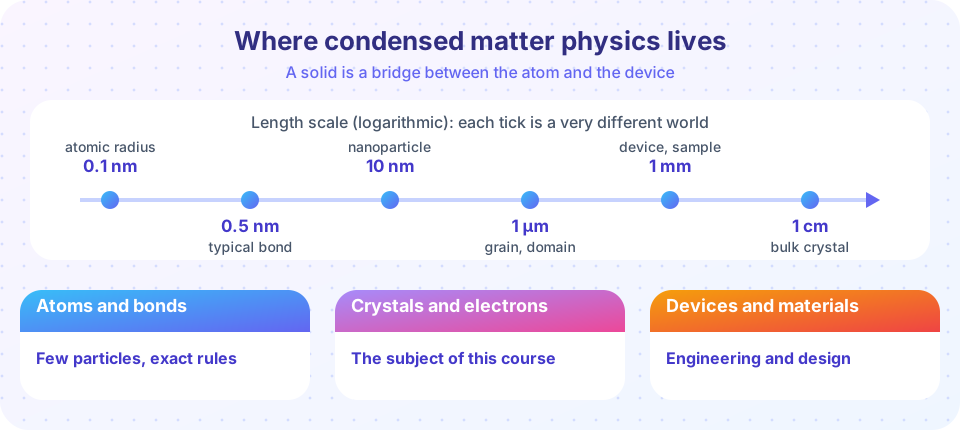
Take one hydrogen atom and physics gives you an exact answer. Take two and the problem is already hard. Take 10²³ and it should be hopeless, yet a block of iron is a magnet, a block of silicon is a computer chip, and a block of lead cooled to 7 K carries current forever. Condensed matter physics studies what happens when enormous numbers of particles interact, and its surprising lesson is that the many-particle problem often gets simpler in a new way, not harder.
This lesson maps the field: what it studies, why "more is different", the main phases of matter, and the milestones that shaped it.
What you will learn
- What "condensed" means and which systems the field covers.
- Why collective behavior (emergence) cannot be read off from the properties of one particle.
- How phases and phase transitions are described, using order and symmetry.
- A short timeline of the discoveries that built the field.
Key terms
Condensed phase: a phase in which particles are packed closely enough that their interactions dominate (solid, liquid, and related states).
Emergence: a property of a large system that is absent for its parts, such as temperature or superconductivity.
Order parameter: a quantity that is zero in a disordered phase and nonzero in an ordered one, for example the magnetization of a magnet.
Broken symmetry: a state with less symmetry than the laws that govern it.
What "condensed" means
In a gas at room temperature and atmospheric pressure, the particles are about 3 nm apart, ten times their own size, so they barely notice each other. The number density is around 2.5 × 10²⁵ m⁻³. In a solid or liquid the spacing falls to roughly 0.2 to 0.4 nm, and the density rises to around 10²⁸ to 10²⁹ m⁻³. Neighbors touch and constantly push and pull on each other. That is what "condensed" refers to, and it is why interactions can no longer be ignored.
The field's subjects include crystals, glasses, metals, semiconductors, insulators, magnets, superconductors, liquid crystals, polymers, superfluid helium and the ultracold atomic gases that physicists build in the lab to imitate solids. By most counts about a third of working physicists are in condensed matter, making it the largest division of physics.
More is different
In 1972 the physicist Philip W. Anderson wrote a famous essay titled "More Is Different". His point: knowing the laws for particles does not let you predict what a crowd of them does. A single water molecule is not wet and has no melting point. Wetness, freezing and the speed of sound in ice all belong to the crowd.
Three examples show the idea.
- Temperature and pressure. Neither exists for one particle. They describe the statistics of many.
- Phonons. A sound wave in a crystal can be treated as a particle (a phonon) with energy ħω. No such particle exists in empty space. It exists only because the atoms are coupled.
- Fractional charge. In some two-dimensional electron systems the excitations carry a fraction (such as 1/3) of the electron charge, even though every electron has the usual charge e.
The rules of the whole are not contradicted by the rules of the parts, but they are not obvious from them either. Condensed matter physicists therefore look for the right effective description: the few variables and equations that capture the behavior of the whole system without tracking every atom.
Phases, order and symmetry
A phase is a state of matter with uniform properties, and a phase transition is a change between phases. Ice melts at 273.15 K at atmospheric pressure. Iron stops being a magnet at 1043 K (its Curie temperature). Lead becomes superconducting below 7.2 K.
The most successful organizing idea comes from Lev Landau: phases are distinguished by symmetry. A liquid looks the same from every direction and at every point. A crystal does not; it is identical only when you shift by a lattice vector. The liquid-to-crystal transition therefore breaks continuous translation symmetry. A ferromagnet breaks rotation symmetry: above the Curie temperature the spins point every which way, and below it they pick one common direction. Each broken symmetry comes with an order parameter that switches on at the transition.
| Phase | What is ordered | Order parameter | Symmetry broken |
|---|---|---|---|
| Crystal | Atom positions | Density wave amplitude | Translation |
| Ferromagnet | Spin directions | Magnetization M | Spin rotation |
| Superconductor | Electron pairs | Pair amplitude Δ | Gauge (phase) |
| Liquid crystal | Molecule orientation | Director n | Rotation |
Not every phase fits this picture. In the 1980s von Klitzing discovered that the Hall conductance of a two-dimensional electron gas in a strong magnetic field is quantized in steps of e²/h. That ordering is topological, not symmetry-based. We meet such states in Chapter 8.
A short history
- 1900: Drude explains electrical conduction with a gas of classical electrons.
- 1911: Kamerlingh Onnes finds that mercury loses all resistance near 4 K.
- 1912: Laue, Friedrich and Knipping see X-rays diffract from a crystal, proving that crystals are periodic and X-rays are waves. Bragg father and son soon use this to solve crystal structures.
- 1928: Sommerfeld applies quantum statistics to the electron gas; Bloch derives the wave functions of electrons in a periodic potential.
- 1947: Bardeen, Brattain and Shockley build the first transistor at Bell Labs.
- 1957: Bardeen, Cooper and Schrieffer (BCS) explain superconductivity.
- 1980: von Klitzing observes the integer quantum Hall effect.
- 1986: Bednorz and Müller discover high-temperature superconductivity in a copper-oxide ceramic.
- 2004: Geim and Novoselov isolate graphene, a one-atom-thick carbon sheet.
Each step opened a technology: transistors, lasers, solid-state memory, magnetic hard drives, MRI magnets and LED lighting.
How theory and experiment work together
The usual loop is: measure a property (resistance, heat capacity, magnetic susceptibility, optical absorption), propose a simple model, solve it, compare, and refine. We will do this repeatedly. For example, the free electron model of Chapter 4 predicts that the electronic heat capacity is proportional to temperature, and experiments confirm it, with revealing quantitative differences that point to electron-electron and electron-lattice interactions.
Experimentally the field uses tools such as X-ray and neutron diffraction (structure), electrical transport (conduction), specific heat and thermal conductivity (energy), magnetometry, and angle-resolved photoemission spectroscopy (the electron bands directly). We describe what these measurements show; this course does not invent lab data.
Common misconceptions
"A solid is just a big molecule." The electrons in a metal are shared by the entire crystal, and the energy levels merge into continuous bands. There is no meaningful notion of a single molecule inside.
"Emergent means mysterious." Emergent properties are fully determined by the underlying physics. They are just not computable by brute force, so we use effective theories.
"Phase transitions need a latent heat." First-order transitions (melting) do, but continuous ones (the Curie point of a ferromagnet) have none.
Try it
Press Run (or Ctrl + Enter) to see the result here.
Program input · what you'd type while the program runs
Type the answers before you press Run, one per line. Each time the program reads a line (with input()), it gets the next line from this box.
Check your understanding
Quick check · 5 questions
of 5 answered You scored / 5 · perfect!
-
1. What does 'more is different' mean in condensed matter physics?
Collective properties such as temperature, superconductivity or magnetism belong to the crowd, not to individual particles, even though the underlying laws are unchanged. -
2. Which symmetry does a crystal break relative to a liquid?
A liquid looks the same everywhere. A crystal repeats only after specific shifts, so continuous translation symmetry is broken. -
3. An order parameter is
Magnetization is the standard example: zero above the Curie temperature, nonzero below. -
4. Who first showed that X-rays diffract from a crystal (1912)?
Their experiment proved that crystals are periodic and X-rays are waves, and it led straight to X-ray crystallography. -
5. In the toy magnet, what happens when the temperature is raised well above 2.27?
Thermal fluctuations beat the tendency of neighbors to align, so the order disappears.
Summary
- Condensed matter physics studies systems where closely packed particles interact strongly: solids, liquids and related states.
- Collective properties emerge from the crowd; effective theories capture them without tracking every particle.
- Phases are classified by order parameters and broken symmetries, with topological order as an important exception.
- The field grew from Drude, Laue, Bloch and Sommerfeld to transistors, BCS theory, quantum Hall physics and graphene.
Next: Bonding in solids
Track your progress
Create a free account to tick off lessons and pick up where you left off on any device.
of Condensed Matter Physics lessons completed