


















Lesson 35 of 46 · Magnetism and Superconductivity
BCS theory, flux quantization and Josephson junctions
Understand Cooper pairs and the BCS energy gap, why 2Delta = 3.53 k_B T_c, flux quantization h/2e, and the DC and AC Josephson effects behind SQUIDs and superconducting qubits.
For almost half a century after Onnes, superconductivity had no explanation. The first clue came in 1950 with the isotope effect: lead made of different isotopes has slightly different T_c, scaling as M^(−1/2) with the atomic mass. Lattice vibrations, which depend on the ion mass, must be involved. Seven years later John Bardeen, Leon Cooper and Robert Schrieffer published the theory that explains it. The surprising ingredient is an attraction between electrons, mediated by the lattice, and a ground state in which electrons form pairs that behave as one quantum object.
What you will learn
- How an electron-phonon attraction binds two electrons into a Cooper pair.
- What the BCS gap Δ means and why 2Δ(0) ≈ 3.53 k_B T_c.
- Why magnetic flux through a superconducting ring is quantized in units of h/2e.
- The DC and AC Josephson effects and how SQUIDs use them.
Key terms
Cooper pair: two electrons with opposite momenta (k, −k) and opposite spins bound by an effective attraction.
Energy gap Δ: the minimum energy to create one quasiparticle is Δ; breaking a pair costs 2Δ.
Flux quantum Φ₀: h/2e = 2.0678 × 10⁻¹⁵ Wb, the unit of flux through a superconducting loop.
Josephson junction: two superconductors separated by a thin insulating, normal or constricted link.
Cooper pairs
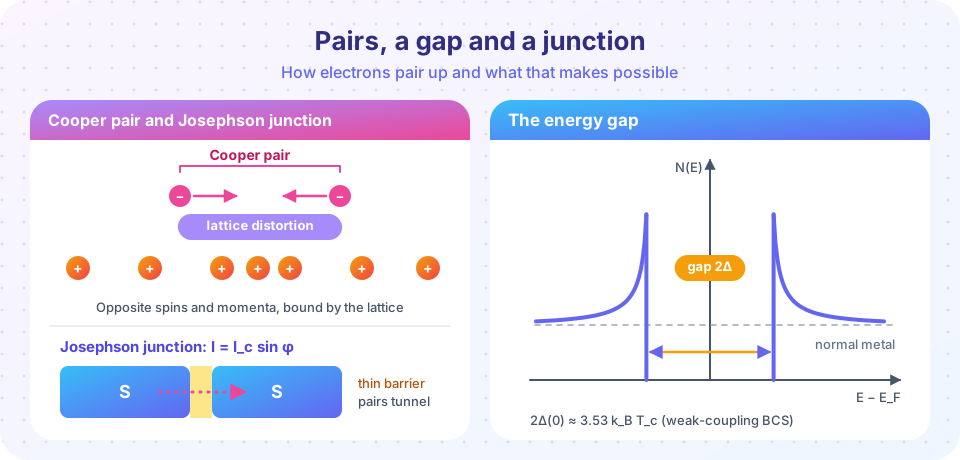
An electron moving through the lattice slightly pulls the positive ions towards it, leaving a region of excess positive charge behind. The ions are heavy and move slowly, so the distortion persists after the electron has gone; a second electron, at a different place and a time later, is attracted to it. The net effect is a weak attraction between electrons with energies within about ħω_D of the Fermi surface, where ω_D is the Debye frequency. Cooper showed in 1956 that any attraction, however weak, makes two electrons added on top of a filled Fermi sea form a bound state, because the sea restricts the available states to a region where the density of states is large. The most favorable pair has opposite momenta and spins, (k↑, −k↓), and zero total momentum.
The pair size is the coherence length ξ₀ ≈ ħ v_F/(π Δ), from tens of nanometers (niobium, about 40 nm) to over a micrometer (aluminum), much larger than the lattice spacing. Within one pair's volume there are millions of other pairs. BCS theory writes a ground state in which all electrons near the Fermi surface are paired coherently, with a common phase φ. This is a condensate, described by a macroscopic wave function Ψ = |Ψ| e^(iφ).
The gap and T_c
Pairing opens a gap Δ in the excitation spectrum around the Fermi level, shown in the right panel of the illustration. The density of states of quasiparticles is zero for |E − E_F| < Δ and diverges as |E|/sqrt(E² − Δ²) above it. At T = 0 the gap is Δ(0) = 1.764 k_B T_c, i.e.
2Δ(0) = 3.53 k_B T_c
for weak coupling. For niobium (T_c = 9.25 K), Δ(0) ≈ 1.41 meV from this relation; measured 1.5 meV. In lead the coupling is strong and 2Δ/k_B T_c ≈ 4.3. Near T_c the gap closes as Δ(T) ≈ 1.74 Δ(0) sqrt(1 − T/T_c). The BCS expression for T_c is k_B T_c ≈ 1.13 ħω_D exp(−1/(N(0)V)): exponentially small if the electron-phonon coupling N(0)V is small, which explains why good normal metals (copper, gold, silver), where the electron-phonon interaction is weak, are not superconducting at accessible temperatures. Zero resistance follows because scattering one electron out of the condensate requires breaking a pair, which costs 2Δ; at low T there is no energy available. In cuprates, heavy-fermion materials and some others the pairing is not conventional (the cuprates have d-wave pairs) and a complete theory is still debated.
Flux quantization
Since the condensate has a single-valued wave function, the phase φ must change by a multiple of 2π around a closed loop. Together with the gauge-invariant momentum of a pair (charge 2e), this forces the flux through a hole in a superconducting ring to be quantized:
Φ = n Φ₀, Φ₀ = h / 2e = 2.067833848 × 10⁻¹⁵ Wb
The experiments of Deaver and Fairbank and of Doll and Näbauer in 1961 measured the unit and found it equal to h/2e rather than h/e, directly confirming that the charge carriers are pairs. A loop of area 1 mm² contains one flux quantum when B is only 2 nT, which makes SQUID loops extremely sensitive magnetometers.
The Josephson effects
In 1962 the 22-year-old Brian Josephson predicted that two superconductors separated by a thin barrier would exchange pairs coherently, with a supercurrent
I = I_c sin φ, where φ is the phase difference across the junction,
even with zero voltage (DC effect). If a voltage V is applied, the phase advances at
dφ/dt = 2eV/ħ
so the supercurrent oscillates at frequency f = 2eV/h = 483.598 MHz per microvolt (AC effect). Irradiating a junction with microwaves of frequency f locks the oscillation and makes steps in the I-V curve at V_n = n h f/(2e): Shapiro steps, whose voltage depends only on fundamental constants and frequency, which is why the Josephson effect defines the standard of voltage.
A SQUID (Superconducting Quantum Interference Device) places two junctions in a superconducting loop. The critical current depends on the enclosed flux with period Φ₀: I_c(Φ) = 2 I₀ |cos(πΦ/Φ₀)| for identical junctions. Measuring I_c or the voltage thus counts flux in fractions of a flux quantum, giving field sensitivities of order femtotesla per square-root hertz. SQUIDs detect the tiny fields of the human brain (magnetoencephalography), and the Josephson junction is the nonlinear element at the heart of superconducting quantum computers.
Common misconceptions
"Cooper pairs are bosons that sit on top of each other, so electrons stop obeying the Pauli principle." The pairs overlap strongly and are not independent bosons; the pairing is a collective feature of all the electrons near the Fermi surface, and the Pauli principle is built into the BCS state.
"The gap means no electrons can move." The gap is for single-particle excitations. The condensate carries current as a whole, and a current of pairs needs no excitation.
"The Josephson current needs a voltage." The DC effect is a zero-voltage supercurrent up to I_c; voltage appears only above I_c or in the AC effect.
Try it
Press Run (or Ctrl + Enter) to see the result here.
Program input · what you'd type while the program runs
Type the answers before you press Run, one per line. Each time the program reads a line (with input()), it gets the next line from this box.
Press Run (or Ctrl + Enter) to see the result here.
Program input · what you'd type while the program runs
Type the answers before you press Run, one per line. Each time the program reads a line (with input()), it gets the next line from this box.
Check your understanding
Quick check · 6 questions
of 6 answered You scored / 6 · perfect!
-
1. The isotope effect (T_c ∝ M^(−1/2)) shows that conventional superconductivity involves
Phonon frequencies scale as M^(−1/2), so T_c depends on the isotope mass. -
2. In BCS theory the zero-temperature gap satisfies
Weak-coupling BCS gives Δ(0) = 1.764 k_B T_c. -
3. Flux through a superconducting ring is quantized in units of
The carriers are pairs of charge 2e. -
4. A Josephson junction biased at voltage V oscillates at frequency
dφ/dt = 2eV/ħ gives f = 2eV/h, about 484 MHz per µV. -
5. Why can a SQUID detect tiny magnetic fields?
Fractions of a flux quantum change the interference pattern of the two junctions. -
6. A weak attraction can bind a Cooper pair because
The Fermi sea blocks lower states and effectively makes the problem two-dimensional-like, so any attraction binds.
Summary
- Electron-phonon attraction binds electrons into Cooper pairs (k↑, −k↓); all pairs share one phase and form a condensate.
- The excitation spectrum has a gap Δ; weak-coupling BCS gives 2Δ(0) = 3.53 k_B T_c.
- Flux through a superconducting loop is quantized in Φ₀ = h/2e = 2.068 × 10⁻¹⁵ Wb.
- Josephson junctions give I = I_c sin φ and f = 2eV/h; SQUIDs and superconducting qubits build on them.
Next: Chapter review
Track your progress
Create a free account to tick off lessons and pick up where you left off on any device.
of Condensed Matter Physics lessons completed