


















Lesson 15 of 46 · Lattice Vibrations and Phonons
Chapter 3 review: Lattice vibrations and phonons
Review the monatomic and diatomic chains, acoustic and optical branches, phonons, Dulong-Petit, Einstein and Debye heat capacities, with a formula table and a ten-question quiz.
This chapter turned the frozen lattice of Chapter 2 into a living one. You solved a chain of masses and springs, saw that two atoms per cell create acoustic and optical branches with a gap, quantized the modes into phonons and explained why heat capacity changes with temperature. These ideas return in Chapter 7 (superconductivity relies on phonons) and in every discussion of thermal conductivity.
What you will learn
- A compact recap of Chapter 3 with all key formulas.
- A calculator that links Debye temperature to sound speed and atomic density.
- Which parts of the chapter to revisit based on the quiz.
The chapter in a table
| Concept | Result | Lesson |
|---|---|---|
| Monatomic chain | ω = 2√(K/m)|sin(ka/2)|; v = a√(K/m); N modes | Chain |
| Brillouin zone | −π/a < k ≤ π/a; ω(k+G) = ω(k) | Chain |
| Group velocity | v_g = dω/dk, zero at the zone edge | Chain |
| Diatomic chain | ω² = K(1/m+1/M) ± K√[…]; gap √(2K/M) to √(2K/m) | Branches |
| Branch count | 3 acoustic + 3(p−1) optical | Branches |
| Phonon occupation | ⟨n⟩ = 1/(e^{ħω/k_BT} − 1) | Phonons |
| Dulong-Petit | C_V = 3Nk_B = 24.9 J/(mol·K) | Phonons |
| Debye | θ_D = ħv(6π²N/V)^(1/3)/k_B; C ∝ T³ at low T | Phonons |
Key terms
Dispersion relation: ω as a function of k.
Acoustic and optical branches: in-phase and out-of-phase motions of the atoms in a cell.
Phonon: quantum of a lattice vibration.
Debye temperature: sets the scale where quantum freeze-out of phonons begins.
Common mistakes
Counting modes wrongly. N atoms in 3D have 3N modes, not N.
Using the Debye T³ law at room temperature. It holds only for T below roughly θ_D/50.
Confusing phase and group velocity. Sound is v = dω/dk at k → 0, but near the zone edge only the group velocity (not ω/k) describes energy flow.
Try it
Press Run (or Ctrl + Enter) to see the result here.
Program input · what you'd type while the program runs
Type the answers before you press Run, one per line. Each time the program reads a line (with input()), it gets the next line from this box.
Check your understanding
Quick check · 10 questions
of 10 answered You scored / 10 · perfect!
-
1. A chain of N atoms with periodic boundary conditions has how many allowed k values in the first Brillouin zone?
k = 2πj/(Na) with N distinct values inside the zone. -
2. The speed of sound in the monatomic chain is
From ω ≈ a√(K/m) k at small k. -
3. The maximum frequency of the monatomic chain is
sin(ka/2) = 1 at the zone edge, so ω_max = 2√(K/m). -
4. A 3D crystal has 5 atoms per primitive cell. How many acoustic branches does it have?
There are always three acoustic branches; the other 3p − 3 = 12 are optical. -
5. The Einstein model fails at low temperature because it predicts
A single frequency gives e^(−θ_E/T); Debye's continuum of low-frequency modes gives the observed T³. -
6. Dulong-Petit predicts the molar heat capacity of a solid to be about
3R = 24.94 J/(mol·K). -
7. At the zone edge of the monatomic chain the wave is
Group velocity vanishes; neighboring atoms move in opposition and the wave is Bragg reflected. -
8. What opens the gap between acoustic and optical branches?
When m = M the gap closes. -
9. The mean phonon number at ħω = 5 k_BT is approximately
1/(e⁵ − 1) = 1/147.4 = 0.0068, so the mode is nearly empty. -
10. Which is a property of Umklapp scattering?
Umklapp collisions make phonon momentum non-conserved and give finite lattice thermal resistance.
Summary
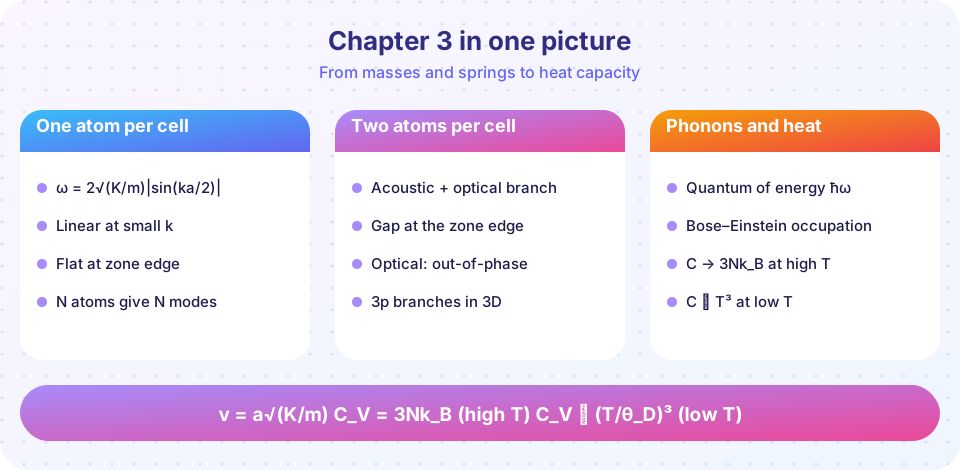
- The monatomic chain: ω = 2√(K/m)|sin(ka/2)|, N modes, sound speed a√(K/m), group velocity zero at the zone edge.
- Two atoms per cell: an acoustic and an optical branch separated by a gap; 3p branches in 3D.
- Phonons obey Bose-Einstein statistics; heat capacity goes from Dulong-Petit (3Nk_B) at high T to T³ at low T.
- Debye temperature measures lattice stiffness; Umklapp scattering sets thermal resistance.
Track your progress
Create a free account to tick off lessons and pick up where you left off on any device.
of Condensed Matter Physics lessons completed