


















Lesson 19 of 46 · Free Electron Model
Drude transport and the Hall effect
Derive Ohm's law from the Drude model, compute relaxation time and mean free path for copper, explain the Hall effect and the Wiedemann-Franz law with worked numbers.
Why does copper carry current so well and glass hardly at all? Why does a metal get a Hall voltage with a particular sign? Why are good electrical conductors also good heat conductors? The Drude model answers all three with one idea: electrons accelerate in a field and lose their momentum in occasional collisions. Its predictions are simple enough to compute with a pocket calculator, and the numbers they give are instructive, particularly where the model fails.
You will derive conductivity, learn what the relaxation time means for real metals, and use the Hall effect to count charge carriers.
What you will learn
- How Drude's equation of motion gives σ = ne²τ/m and the mobility.
- How to extract τ, the mean free path and the drift speed for copper.
- How the Hall effect measures carrier density and sign.
- Why thermal and electrical conductivity are linked (the Wiedemann-Franz law).
Key terms
Relaxation time τ: the average time between momentum-randomizing collisions.
Drift velocity v_d: the small average velocity of electrons superimposed on their random motion.
Mobility μ: drift velocity per unit electric field, μ = eτ/m.
Hall coefficient R_H: R_H = E_y/(j_x B); for a single carrier type R_H = 1/(qn).
Lorenz number L: κ/(σT) = π²k_B²/(3e²) = 2.44 × 10⁻⁸ W·Ω/K².
Ohm's law from collisions
Consider an electron (charge −e) in a field E. Between collisions it accelerates; each collision wipes out its momentum with probability dt/τ in a time dt. The average momentum p obeys
d**p**/dt = −e**E** − **p**/τ.
In steady state dp/dt = 0, so the mean velocity (drift velocity) is v_d = −eτE/m. The current density, with n electrons per unit volume, is
j = −n e v_d = (n e² τ / m) E.
Hence Ohm's law with
σ = n e² τ / m, resistivity ρ = 1/σ,
and the mobility μ = eτ/m (so σ = neμ), measured in m²/(V·s) or, commonly, cm²/(V·s).
What the numbers say for copper
Copper at 293 K has ρ = 1.68 × 10⁻⁸ Ω·m and n = 8.47 × 10²⁸ m⁻³. Rearranging σ = ne²τ/m:
τ = m/(ρ n e²) = 9.11 × 10⁻³¹ / (1.68 × 10⁻⁸ × 8.47 × 10²⁸ × (1.602 × 10⁻¹⁹)²) ≈ 2.5 × 10⁻¹⁴ s.
So an electron collides about 4 × 10¹³ times per second. The mobility is eτ/m = 4.4 × 10⁻³ m²/(V·s) = 44 cm²/(V·s).
The drift velocity at a current density of 1 A/mm² (10⁶ A/m²) is j/(ne) = 10⁶/(8.47 × 10²⁸ × 1.602 × 10⁻¹⁹) = 7.4 × 10⁻⁵ m/s, less than a tenth of a millimeter per second. A signal travels near light speed because the field, not the electrons, propagates.
Mean free path: Drude used the thermal velocity (about 10⁵ m/s) and found ℓ ≈ 0.3 nm, about one atomic spacing, which fit his picture of electrons bouncing off ions. But the true electron speed is the Fermi velocity: ℓ = v_Fτ = 1.57 × 10⁶ × 2.5 × 10⁻¹⁴ ≈ 39 nm, about a hundred lattice spacings. The electrons do not bounce off ions. Bloch showed in 1928 that waves move through a perfect lattice without scattering. Resistance comes from deviations: lattice vibrations (phonons), which grow with T, and impurities and defects, which do not. This is Matthiessen's rule: ρ(T) = ρ_impurity + ρ_phonon(T). At low T copper's resistivity falls by a factor of hundreds, limited only by defects.
The Hall effect
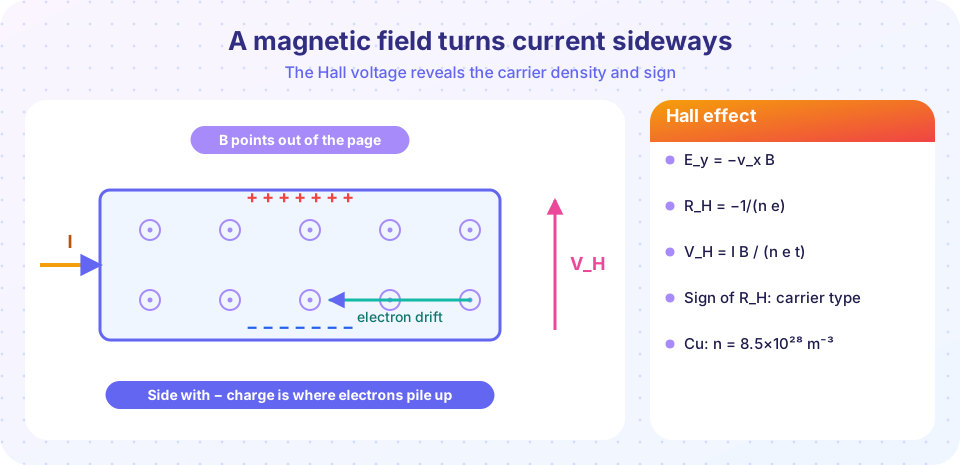
Apply a current along x through a strip with a magnetic field B along z (Edwin Hall, 1879). The magnetic force on the moving carriers deflects them toward one edge (the y direction). Charge piles up there, producing a transverse electric field E_y that grows until it cancels the magnetic force on the drifting carriers:
q E_y = q v_d B → E_y = v_d B.
Writing v_d in terms of the current density j_x = n q v_d gives the Hall coefficient
R_H = E_y / (j_x B) = 1/(n q).
For electrons q = −e, so R_H = −1/(ne): negative, with magnitude fixed by the density alone. The Hall voltage across a strip of thickness t carrying current I is
V_H = I B / (n q t) (magnitude I B/(n e t)).
For copper, R_H ≈ −7.4 × 10⁻¹¹ m³/C, and with I = 1 A, B = 1 T and t = 0.1 mm, V_H ≈ 0.74 µV, tiny, because the carrier density is huge. In a doped semiconductor with n = 10²² m⁻³, V_H is about ten million times larger, which is why semiconductors make the best Hall sensors (the ones in many smartphone compasses and car wheel-speed sensors).
The sign is as important as the size. Measured R_H is negative for most simple metals, as the free electron model predicts, but positive for some (beryllium, zinc, and others), which can only be explained if the carriers behave like positive charges, "holes" in a nearly filled band (Chapter 5). The Hall effect is also how semiconductor carriers are classified n-type or p-type.
The Wiedemann-Franz law
Electrons carry both charge and heat. Drude-Sommerfeld theory predicts that the ratio of thermal to electrical conductivity is proportional to temperature:
κ/σ = L T with L = π² k_B²/(3e²) = 2.44 × 10⁻⁸ W·Ω/K².
The universal constant L explains the 1853 empirical law of Wiedemann and Franz. For copper, κ = 401 W/(m·K) and σ = 5.96 × 10⁷ S/m at 300 K give L = 2.24 × 10⁻⁸: within 10% of the theory. Drude's classical gas gave almost the right answer by a lucky cancellation of two errors (it overestimated the heat capacity by a factor of 100 and underestimated the speed-squared by the same factor). Sommerfeld's quantum model gets both parts right.
AC response and the plasma frequency
For an oscillating field e^{−iωt}, Drude gives σ(ω) = σ₀/(1 − iωτ). Above the plasma frequency ω_p = √(ne²/(ε₀m)) the electron gas can no longer screen the field, and the metal becomes transparent. Free-electron ω_p corresponds to photon energies of about 5.9 eV for sodium (explaining why alkali metals become transparent in the ultraviolet) and 10.8 eV for copper (real copper's d electrons shift this). Below ω_p, metals reflect light, which is why they are shiny.
Common misconceptions
"Electrons move down the wire at the speed of the signal." Individual drift speeds are fractions of a millimeter per second; the signal is the electromagnetic field.
"Electrons bounce off ion cores." In a perfect crystal they do not. Resistance comes from deviations from perfect periodicity: phonons and defects.
"The Hall voltage depends on the material's resistivity." To lowest order it depends only on n, I, B and t, not on τ.
Try it
Press Run (or Ctrl + Enter) to see the result here.
Program input · what you'd type while the program runs
Type the answers before you press Run, one per line. Each time the program reads a line (with input()), it gets the next line from this box.
Check your understanding
Quick check · 5 questions
of 5 answered You scored / 5 · perfect!
-
1. In the Drude model, the conductivity is
From j = n e² τ E / m: carrier density times charge squared times relaxation time over mass. -
2. Copper's relaxation time is about
τ = m/(ρne²) ≈ 2.5 × 10⁻¹⁴ s. -
3. In the Hall effect with electron carriers, the Hall coefficient is
R_H = 1/(nq), and q = −e for electrons. -
4. A strip carries 10 mA in a 0.5 T field. Thickness 0.1 mm, n = 10²² m⁻³. V_H is about
V_H = IB/(net) = 0.01 × 0.5/(10²² × 1.6 × 10⁻¹⁹ × 10⁻⁴) = 0.005/0.16 ≈ 0.031 V = 31 mV, closest to 30 mV. -
5. What does the Wiedemann-Franz law state?
κ/(σT) = L = π²k_B²/(3e²) = 2.44 × 10⁻⁸ W·Ω/K², approximately the same for all simple metals.
Summary
- Drude: dp/dt = −eE − p/τ gives σ = ne²τ/m and mobility μ = eτ/m.
- Copper: τ ≈ 2.5 × 10⁻¹⁴ s, v_F-based mean free path ≈ 39 nm, drift speed ≈ 0.07 mm/s at 1 A/mm².
- Hall coefficient R_H = 1/(nq) and V_H = IB/(nqt) reveal carrier density and sign.
- Wiedemann-Franz: κ/(σT) = π²k_B²/(3e²) = 2.44 × 10⁻⁸ W·Ω/K².
- Resistance arises from phonons and defects, not from collisions with ion cores in a perfect crystal.
Next: Chapter 4 review
Track your progress
Create a free account to tick off lessons and pick up where you left off on any device.
of Condensed Matter Physics lessons completed