


















Lesson 3 of 46 · Getting Started
Bonding in solids
Learn the five kinds of bonding in solids, the Lennard-Jones and Madelung energy models, and why equilibrium spacing sits where attraction balances repulsion.
Why does a crystal of salt hold together, and why at a spacing of 0.28 nm and not 0.2 nm or 0.4 nm? Every solid answers the same question: atoms attract each other at long range, repel each other at short range, and settle where the total energy is lowest. The details of the attraction decide whether the solid is a hard insulator like diamond, a soft one like frozen argon, or a conducting metal like copper.
This lesson classifies the bond types, builds two simple energy models you can run, and connects the depth of the energy well to measurable quantities.
What you will learn
- The five bond types and which elements form them.
- Why every bond has a repulsive core as well as an attractive tail.
- How to use the Lennard-Jones potential for noble-gas solids.
- How the Madelung constant gives the energy of an ionic crystal.
Key terms
Cohesive energy: the energy needed to separate a solid into isolated neutral atoms, per atom.
Pauli repulsion: the short-range repulsion that arises because two electrons with the same spin cannot occupy the same state.
Madelung constant: a number that sums the Coulomb interactions of a point charge with all the ions of a crystal; α = 1.7476 for rock salt.
Equilibrium spacing r₀: the separation at which the energy is a minimum and the net force is zero.
The shape of every bond
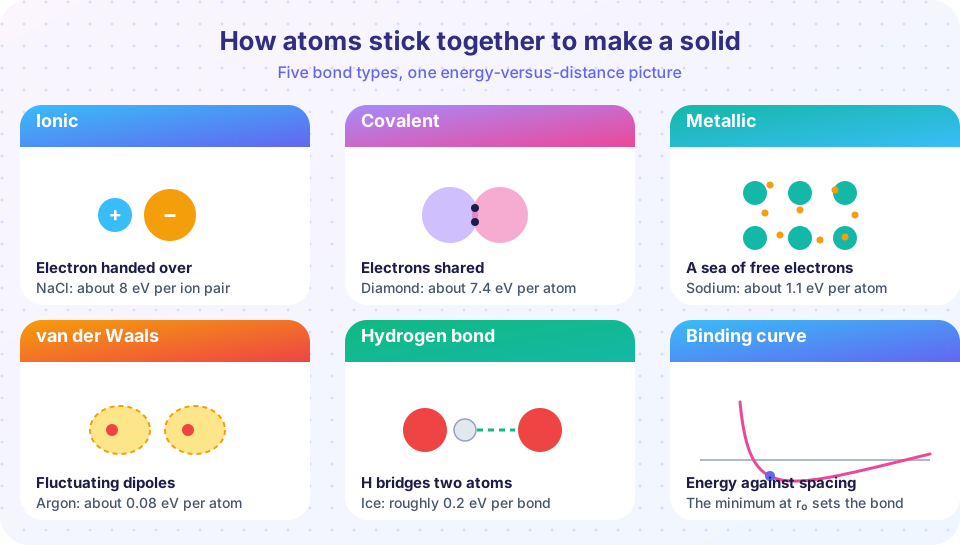
Plot the energy of two atoms against their separation r. At large r the energy slowly approaches zero from below (attraction). At small r it climbs steeply (repulsion). Between them lies a minimum at r₀ whose depth is the bond energy. Near the minimum the curve is approximately a parabola, which means a bond behaves like a spring. That fact powers the next chapters on vibrations.
The repulsion has two sources. When electron clouds overlap, the Pauli exclusion principle forces electrons into higher energy states. The nuclei also repel each other, partly shielded. Both rise very rapidly with decreasing r, much faster than any power of 1/r that describes the attraction.
The five bond types
Ionic bonding
An atom that loses an electron easily (sodium, ionization energy 5.14 eV) meets one that gains it readily (chlorine, electron affinity 3.61 eV). The resulting ions Na⁺ and Cl⁻ attract through the Coulomb force. In a crystal each ion is surrounded by six of opposite charge, and the attractions of all of them add up. The bond is strong (a few eV per ion pair), non-directional, and the crystals are hard, brittle, with high melting points and no free electrons, so they are insulators.
Covalent bonding
Atoms with half-filled shells share electron pairs. The shared electrons sit between the nuclei, so the bond has a direction. Carbon in diamond forms four bonds at the tetrahedral angle 109.5°, giving a rigid network. The cohesive energy of diamond is about 7.4 eV per atom, and silicon's about 4.6 eV per atom. Covalent solids are hard, have high melting points, and (if the gap is large) are insulators or semiconductors.
Metallic bonding
In sodium, copper or aluminum the outer electrons are not tied to any one atom. They form a sea shared across the crystal, and the positive ion cores sit in it. The bond is non-directional and moderately strong (sodium about 1.1 eV per atom, copper 3.5 eV). Because the electrons are free to move, metals conduct heat and electricity, and because the bond does not care about direction, planes of atoms slide past each other: metals are ductile.
van der Waals bonding
Neutral closed-shell atoms such as argon have no charge to share. Yet the electron cloud flickers, creating a momentary dipole that induces a dipole in the neighbor, and the two attract. The interaction energy falls as 1/r⁶. It is very weak (argon: about 0.08 eV per atom), so noble-gas solids melt at tens of kelvin (argon at 84 K). The same force holds the layers of graphite and many molecular crystals together.
Hydrogen bonding
A hydrogen atom attached to a very electronegative atom (O, N, F) carries a partial positive charge and attracts a lone pair on a neighboring molecule. It is stronger than van der Waals (about 0.1 to 0.3 eV) and directional. It makes ice open and hexagonal, which is why ice is less dense than liquid water, and it holds together the strands of DNA.
| Bond | Energy (eV per atom or pair) | Directional | Typical solid |
|---|---|---|---|
| Ionic | 5 to 9 (per ion pair) | No | NaCl, MgO |
| Covalent | 3 to 8 | Yes | Diamond, Si, Ge |
| Metallic | 1 to 4 | No | Na, Cu, Fe |
| Hydrogen | 0.1 to 0.3 | Yes | Ice |
| van der Waals | 0.01 to 0.1 | No | Solid Ar, graphite layers |
Real bonds are mixtures. Gallium arsenide is covalent with some ionic character; the amount of each shifts the properties.
The Lennard-Jones model
For noble-gas atoms the standard model, proposed by John Lennard-Jones in 1924, is
V(r) = 4ε [ (σ/r)¹² − (σ/r)⁶ ]
The −1/r⁶ term is the van der Waals attraction. The 1/r¹² term is a convenient, fast-rising repulsion (chosen because (σ/r)¹² is the square of (σ/r)⁶, which keeps the algebra simple). The parameter ε is the well depth and σ the distance at which V = 0. Setting dV/dr = 0 gives the minimum at
r₀ = 2^(1/6) σ ≈ 1.122 σ, where V(r₀) = −ε.
For argon the fitted values are ε ≈ 0.0103 eV (ε/k_B ≈ 120 K) and σ ≈ 0.3405 nm, so r₀ ≈ 0.382 nm. Argon crystallizes in the face-centered cubic structure with a measured nearest-neighbor distance of about 0.37 nm, close to the model value (zero-point motion expands the real lattice slightly). Summing over all neighbors in an fcc lattice gives a cohesive energy close to 8.6 ε per atom, since each atom has 12 neighbors but each bond is shared. The measured value of about 0.080 eV is a bit lower because of quantum zero-point motion.
The ionic crystal: Madelung energy
For rock salt, add up the Coulomb energy of one ion with all others. The nearest six neighbors have the opposite charge (attractive), the next twelve the same charge (repulsive, but farther away), then eight opposite, and so on. The sum converges slowly to a constant,
U_Coulomb = −α · e²/(4πε₀ r₀), with α = 1.7476 for the NaCl structure.
A repulsion of the form B/rⁿ, with n ≈ 8 from compressibility data, is added. Minimizing the total energy gives the energy per ion pair
U = −α · e²/(4πε₀ r₀) · (1 − 1/n).
The constant e²/(4πε₀) is 14.3996 eV·Å, which is a number worth remembering. For NaCl, r₀ = 2.82 Å gives about 7.8 eV per ion pair, close to the experimental lattice energy.
Common misconceptions
"Bonds are fixed sticks." Bonds are springs. Atoms vibrate about r₀ with energies of tens of meV even at low temperature.
"Metallic bonding is the weakest." It spans a huge range: mercury is weakly bound (0.67 eV per atom, liquid at room temperature), while tungsten is among the strongest bonded (8.9 eV per atom).
"Hydrogen bonds are real chemical bonds like covalent ones." They are mostly electrostatic and 10 to 50 times weaker than a typical covalent bond.
Try it
Press Run (or Ctrl + Enter) to see the result here.
Program input · what you'd type while the program runs
Type the answers before you press Run, one per line. Each time the program reads a line (with input()), it gets the next line from this box.
Press Run (or Ctrl + Enter) to see the result here.
Program input · what you'd type while the program runs
Type the answers before you press Run, one per line. Each time the program reads a line (with input()), it gets the next line from this box.
Check your understanding
Quick check · 5 questions
of 5 answered You scored / 5 · perfect!
-
1. Which bond type is directional and gives diamond its hardness?
Covalent bonds are shared electron pairs between specific atoms, giving fixed angles (109.5° in diamond). -
2. At the Lennard-Jones minimum r₀ = 2^(1/6) σ, what is V(r₀)?
Substituting r = 2^(1/6)σ gives (σ/r)⁶ = 1/2 and (σ/r)¹² = 1/4, so V = 4ε(1/4 − 1/2) = −ε. -
3. Why do noble-gas solids melt at very low temperatures?
Argon's cohesive energy is only about 0.08 eV per atom, so little thermal energy is needed to break the order (melting at 84 K). -
4. The Madelung constant of NaCl is 1.7476. What does it measure?
It is the sum of alternating ± 1/distance terms, giving a net attraction slightly bigger than that of the nearest six neighbors alone. -
5. Near r₀ a bond behaves like
The energy minimum is approximately parabolic, so small displacements feel a restoring force proportional to displacement.
Summary
- Every bond balances long-range attraction against short-range Pauli repulsion; the minimum at r₀ sets the spacing and the depth gives the bond energy.
- Ionic and covalent bonds are strong; metallic bonds span a wide range; hydrogen and van der Waals bonds are weak.
- Lennard-Jones, V = 4ε[(σ/r)¹² − (σ/r)⁶], describes noble gases with r₀ = 2^(1/6) σ.
- The Madelung sum with α = 1.7476 gives about 7.8 eV per ion pair for NaCl.
- A bond is a spring near r₀, which is why solids vibrate as we will see in Chapter 3.
Next: Chapter 1 review
Track your progress
Create a free account to tick off lessons and pick up where you left off on any device.
of Condensed Matter Physics lessons completed