


















Lesson 9 of 46 · Crystal Structure and Diffraction
Diffraction and the reciprocal lattice
Derive Bragg's law, build the reciprocal lattice, apply the Laue condition and structure-factor rules, and simulate the powder X-ray pattern of copper.
You cannot see atoms with a microscope that uses visible light: its wavelength (about 500 nm) is a thousand times the atomic spacing. But waves with wavelength near 0.1 nm will scatter from a crystal in a very particular way, producing sharp spots at certain angles. The pattern of spots is a magnified, inverted map of the crystal's periodicity, and reading it is how almost every known crystal structure was solved.
This lesson explains the pattern in two equivalent ways: Bragg's picture of reflecting planes, and the more powerful picture based on the reciprocal lattice.
What you will learn
- How Bragg's law, 2d sin θ = nλ, follows from path difference.
- How to build the reciprocal lattice and why the Laue condition k′ = k + G is equivalent.
- Why some Bragg peaks vanish (structure factor) and how fcc, bcc and diamond differ.
- How to predict the positions of peaks in a powder pattern.
Key terms
Bragg's law: constructive interference from parallel planes spaced d occurs when 2d sin θ = nλ.
Reciprocal lattice: the set of wave vectors G with G · R = 2π × integer for every lattice vector R.
Structure factor S_hkl: the sum over the basis atoms of their scattering amplitudes with phase factors; it can cancel a peak.
First Brillouin zone: the Wigner-Seitz cell of the reciprocal lattice.
Bragg's law
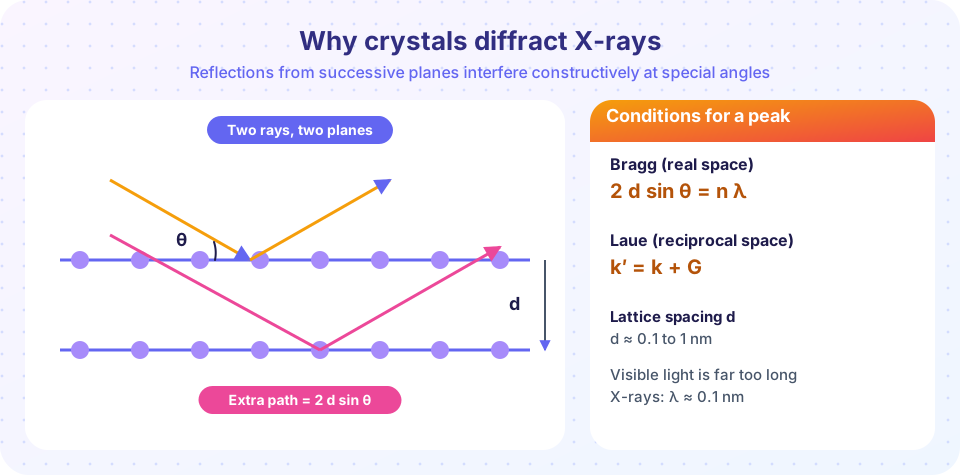
Imagine X-rays of wavelength λ striking a stack of parallel atomic planes spaced d apart, at a glancing angle θ measured from the planes (not from the normal). Each plane reflects a little. The ray that reflects from the second plane travels an extra distance of 2d sin θ compared with the ray from the first. The reflections reinforce each other only if that extra path is a whole number n of wavelengths:
2 d sin θ = n λ
Because sin θ ≤ 1 we need λ ≤ 2d, so visible light cannot do it. X-rays of energy E have wavelength λ (in ångströms) = 12.398 / E (in keV). The copper Kα line used in lab diffractometers has E ≈ 8.05 keV and λ = 1.5406 Å. Neutrons also work: a thermal neutron (25 meV) has λ = 0.286 / √E(eV) Å ≈ 1.8 Å, and electrons accelerated through a few tens of volts have the right wavelength too.
Bragg's law says where peaks appear for a given plane spacing, but not why some planes are silent. For that we need a better picture.
The reciprocal lattice
Given primitive vectors a₁, a₂, a₃ with cell volume V = a₁·(a₂×a₃), the reciprocal lattice vectors are
b₁ = 2π (a₂ × a₃)/V, b₂ = 2π (a₃ × a₁)/V, b₃ = 2π (a₁ × a₂)/V.
They satisfy aᵢ·bⱼ = 2π δᵢⱼ. Every reciprocal lattice vector has the form G = hb₁ + kb₂ + lb₃ with integer h, k, l, and then G·R is a multiple of 2π for every lattice vector R. Two key facts:
- G_hkl is perpendicular to the plane family (hkl) of the real lattice, and its length is
|G| = 2π / d_hkl. So the Miller indices are the coordinates of G. - For a simple cubic lattice of constant a, the reciprocal lattice is simple cubic with constant 2π/a. The fcc lattice has a bcc reciprocal lattice (constant 4π/a), and bcc has an fcc reciprocal lattice.
The reciprocal lattice has units of inverse length. A large real-space spacing gives a small reciprocal one: that is the "inversion" in the picture of the pattern.
The Laue condition
Treat the X-ray as a plane wave with wave vector k and scatter it elastically from every atom. Waves from atoms separated by a lattice vector R differ in phase by (k − k′)·R, and the sum over all atoms is large only if that phase is a multiple of 2π for every R. That means
k′ − k = G
for some reciprocal lattice vector G, with |k′| = |k| because the scattering is elastic. Squaring gives 2 k·G = G², and with |G| = 2πn/d and |k| = 2π/λ this reduces to Bragg's law. The two descriptions are exactly equivalent. The Laue form is far more useful: scattering from any periodic structure, whether electrons, neutrons, X-rays or phonons, is governed by momentum conservation up to a reciprocal lattice vector.
A neat geometric version is the Ewald sphere: draw the reciprocal lattice, put a sphere of radius |k| through the origin with its center at −k. Every reciprocal lattice point on the sphere gives a diffracted beam.
The structure factor
If the unit cell contains several atoms j at positions rⱼ, each with atomic scattering amplitude fⱼ, the amplitude of the (hkl) beam is
S_hkl = Σⱼ fⱼ exp(−i G·rⱼ)
and the intensity is proportional to |S|². Sometimes the sum is exactly zero. For the conventional cubic cell:
| Structure | Atoms at | Allowed (hkl) |
|---|---|---|
| sc | (0,0,0) | All |
| bcc | (0,0,0) and (½,½,½) | h + k + l even |
| fcc | corners and face centers | h, k, l all even or all odd |
| diamond | fcc plus a basis shifted by (¼,¼,¼) | fcc rule, and for all-even indices h + k + l must be a multiple of 4 |
So the first peaks of a bcc crystal are (110), (200), (211), (220); for fcc they are (111), (200), (220), (311), (222). Their ratios of sin²θ reveal the lattice type: for bcc, 2:4:6:8:10…; for fcc, 3:4:8:11:12… A crystallographer's first step was to compare these ratios.
Powder diffraction
In a powder, tiny crystals face every direction, so each (hkl) family gives a cone of scattered rays: a ring. A detector scanning the angle 2θ sees a set of peaks. For a cubic crystal each peak position follows from λ = 2 d sin θ with d = a/√(h²+k²+l²), so measuring the angles gives a. Peak widths tell crystallite size, and intensities tell the atoms' positions.
Common misconceptions
"θ is measured from the surface normal." In Bragg's law θ is the glancing angle between the beam and the planes. Detectors usually record 2θ, the angle between incoming and outgoing beams.
"Missing peaks mean missing planes." The planes exist; the waves from the basis atoms cancel. That is how we can tell bcc, fcc and diamond apart.
"X-rays diffract from atoms' nuclei." X-rays scatter from electrons; neutrons scatter from nuclei (and from magnetic moments), so the two are complementary.
Try it
Press Run (or Ctrl + Enter) to see the result here.
Program input · what you'd type while the program runs
Type the answers before you press Run, one per line. Each time the program reads a line (with input()), it gets the next line from this box.
Press Run (or Ctrl + Enter) to see the result here.
Program input · what you'd type while the program runs
Type the answers before you press Run, one per line. Each time the program reads a line (with input()), it gets the next line from this box.
Check your understanding
Quick check · 5 questions
of 5 answered You scored / 5 · perfect!
-
1. In Bragg's law, θ is the angle between the X-ray beam and
Bragg's θ is the glancing angle to the planes. The detector sits at 2θ from the incoming beam. -
2. What is the reciprocal lattice of an fcc lattice?
The fcc lattice with constant a has a bcc reciprocal lattice with cube side 4π/a. -
3. Which (hkl) peak is absent for a bcc crystal in the conventional cell?
For bcc, h + k + l must be even. (100) has sum 1, so waves from the corner and center atoms cancel. -
4. The Laue condition for elastic scattering is
Momentum is conserved up to a reciprocal lattice vector, because the crystal absorbs momentum in multiples of ħG. -
5. Cu Kα X-rays (1.5406 Å) hit a crystal with d = 2.087 Å. What is the first-order Bragg angle θ?
sin θ = λ/(2d) = 1.5406/4.174 = 0.369, so θ ≈ 21.7° and the detector 2θ ≈ 43.3°.
Summary
- Bragg's law 2d sin θ = nλ locates diffraction peaks; X-ray wavelengths are about 0.1 nm.
- The reciprocal lattice G = hb₁ + kb₂ + lb₃ has |G| = 2π/d_hkl; the Laue condition k′ = k + G is equivalent to Bragg's law.
- The structure factor cancels some peaks: bcc needs h+k+l even; fcc needs all-odd or all-even indices.
- Powder patterns plot peak angles that reveal the lattice type and the lattice constant.
Next: Chapter 2 review
Track your progress
Create a free account to tick off lessons and pick up where you left off on any device.
of Condensed Matter Physics lessons completed