


















Lesson 20 of 46 · Free Electron Model
Chapter 4 review: The free electron model
Review the Fermi gas, Fermi energy, density of states, electronic heat capacity, Drude conductivity and Hall effect, with a formula table, a calculator and a ten-question quiz.
The free electron model is one of the most successful oversimplifications in physics. It ignores the lattice and the electron-electron repulsion, yet it predicts Fermi energies of several eV, the correct order of magnitude for conductivity, the sign and size of the Hall coefficient and the linear heat capacity of metals. Its failures, such as positive Hall coefficients and effective masses different from 1, point directly to what Chapter 5 adds: the periodic potential of the crystal.
What you will learn
- A recap of the formulas and typical numbers of the free electron model.
- How to cross-check one metal's numbers against another's.
- Which results point toward band theory.
The chapter in a table
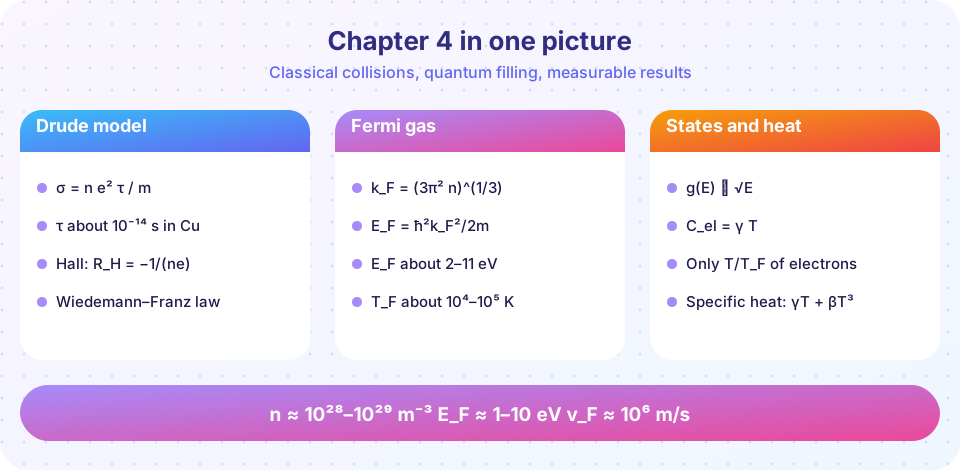
| Topic | Result | Lesson |
|---|---|---|
| Fermi wave vector | k_F = (3π²n)^(1/3) | Fermi gas |
| Fermi energy and velocity | E_F = ħ²k_F²/2m; v_F = ħk_F/m | Fermi gas |
| Typical values | E_F 2 to 12 eV; v_F ~ 10⁶ m/s; T_F ~ 10⁴ to 10⁵ K | Fermi gas |
| Density of states | g(E) = (V/2π²)(2m/ħ²)^(3/2)√E; g(E_F) = 3N/2E_F | DOS |
| Electronic heat | C_el = γT with γ = π²k_B²g(E_F)/3 | DOS |
| Conductivity | σ = ne²τ/m; μ = eτ/m | Drude |
| Hall effect | R_H = 1/(nq); V_H = IB/(nqt) | Drude |
| Wiedemann-Franz | κ/σT = π²k_B²/3e² = 2.44 × 10⁻⁸ W·Ω/K² | Drude |
Key terms
Fermi surface: the surface in k-space separating occupied from empty states at T = 0.
Degenerate: describes a gas with T ≪ T_F.
Thermal effective mass: m* = m γ_exp/γ_free.
Matthiessen's rule: resistivities from independent scattering mechanisms add.
Where the model struggles
- Positive Hall coefficients (Be, Zn) need carriers that act like positive charges.
- Insulators and semiconductors have no free electrons at all at T = 0; the model cannot say why.
- Effective masses differ from m by tens of percent, and by factors of 100 in heavy fermion compounds.
- Resistivity at low T depends on the quality of the crystal and on phonons, not on ion-core collisions.
Each of these is solved by treating electrons in the periodic potential (band theory), the subject of the next chapter.
Common mistakes
Using T instead of T_F. The ratio T/T_F (about 0.004 at room temperature) controls electronic heat and degeneracy.
Forgetting spin. The factor 2 in the state count appears in k_F and g(E).
Applying free-electron numbers to semiconductors. The model needs n large and the electron gas degenerate; neither holds in lightly doped semiconductors.
Try it
Press Run (or Ctrl + Enter) to see the result here.
Program input · what you'd type while the program runs
Type the answers before you press Run, one per line. Each time the program reads a line (with input()), it gets the next line from this box.
Check your understanding
Quick check · 10 questions
of 10 answered You scored / 10 · perfect!
-
1. A metal has n = 10²⁹ m⁻³. Compared with a metal with n = 10²⁸ m⁻³, its Fermi energy is larger by a factor of about
E_F ∝ n^(2/3); 10^(2/3) = 4.64. -
2. What is the Fermi velocity of a typical metal?
v_F = ħk_F/m ≈ 1 to 2 × 10⁶ m/s. -
3. The electronic heat capacity at low T is
C_el = γT: the number of thermally active electrons grows linearly with T. -
4. Which quantity determines the sign of the Hall voltage?
R_H = 1/(nq), so its sign is that of q. -
5. In a metal at 300 K the fraction of electrons that can be thermally excited is about
Only a shell of thickness k_BT around E_F is thermally active; the fraction is of order T/T_F. -
6. Drude conductivity is proportional to
σ = ne²τ/m: more carriers and longer relaxation times raise σ. -
7. Matthiessen's rule says that
ρ = ρ_impurity + ρ_phonon(T) for independent scattering. -
8. Why is the Fermi temperature (about 80,000 K for copper) not a real temperature of the metal?
T_F is a convenient way of writing E_F; the lattice and electrons are at room temperature. -
9. Wiedemann-Franz relates
κ = L σ T with L = 2.44 × 10⁻⁸ W·Ω/K². -
10. Which observation requires going beyond the free electron model?
A positive R_H needs hole-like carriers, explained by energy bands.
Summary
- Conduction electrons form a degenerate Fermi gas with E_F of several eV and T_F of order 10⁴ to 10⁵ K.
- k_F, E_F, v_F follow from the density alone; g(E) ∝ √E.
- C_el = γT, σ = ne²τ/m, R_H = 1/(nq) and κ/σT = 2.44 × 10⁻⁸ W·Ω/K² are the model's main predictions.
- Failures (positive Hall sign, insulators, effective masses) motivate band theory.
Track your progress
Create a free account to tick off lessons and pick up where you left off on any device.
of Condensed Matter Physics lessons completed