


















Lesson 5 of 46 · Crystal Structure and Diffraction
Chapter 2 overview: Crystal structure and diffraction
A guided tour of crystal structure: lattices, unit cells, cubic packing, Miller indices and X-ray diffraction, with a 2D lattice classifier you can run.
Look at a grain of table salt under a magnifying glass and you see tiny perfect cubes. That outer shape is a clue to an inner order: the atoms are arranged on a pattern that repeats in all three directions. This chapter gives you the vocabulary to describe such patterns exactly, and the experimental tool, diffraction, that lets us see them.
Everything that follows in the course depends on this chapter. Vibrations, electron states and optical properties all inherit the symmetry of the lattice.
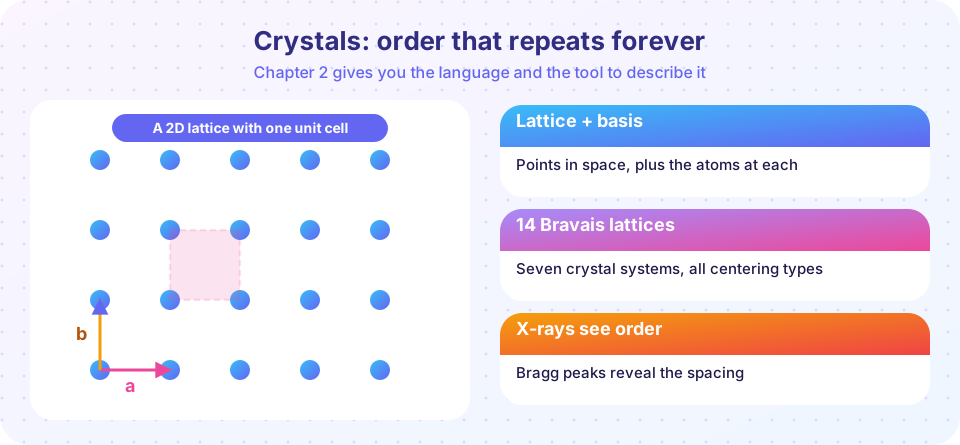
What you will learn
- What a lattice and a basis are, and how together they define a crystal.
- Why only 14 three-dimensional lattice types exist.
- How planes and directions in a crystal are labeled.
- How diffraction reveals the arrangement of atoms.
Key terms
Lattice: an infinite array of points generated by integer combinations of basis vectors a₁, a₂, a₃.
Basis: the group of atoms attached identically to every lattice point.
Unit cell: a region that fills space when repeated by lattice translations.
Bravais lattice: one of the 14 distinct three-dimensional lattice types.
The big picture
A crystal is defined by two things. The lattice says where the pattern repeats: positions R = n₁a₁ + n₂a₂ + n₃a₃ for integers n₁, n₂, n₃. The basis says what is placed at each lattice point. Sodium chloride is a face-centered cubic lattice with a basis of one Na⁺ and one Cl⁻. Diamond is a face-centered cubic lattice with a basis of two carbon atoms.
Symmetry restricts the possible lattices. In two dimensions, there are five. In three there are 14 Bravais lattices, grouped into seven crystal systems (cubic, tetragonal, orthorhombic, hexagonal, trigonal, monoclinic and triclinic) according to the shape of the cell. Adding the atoms of the basis, and their own point symmetry, gives 230 space groups.
Lattice and basis
Cubic family
Naming planes
Seeing atoms
What this chapter covers
- Lattices and unit cells: primitive and conventional cells, the Bravais lattices, and why graphene and hcp metals are not Bravais lattices.
- Cubic structures and packing: sc, bcc, fcc and diamond, counting atoms, packing fractions, and a density calculation.
- Miller indices: labeling planes and directions, spacing, and planar density.
- Diffraction and the reciprocal lattice: Bragg and Laue conditions, the reciprocal lattice, structure factors and a simulated powder pattern.
- Chapter 2 review: a summary picture and a ten-question quiz.
Common misconceptions
"A unit cell is unique." Many cells describe the same lattice. The primitive cell has the smallest volume (one lattice point), but a conventional cell is often larger because it shows the symmetry more clearly.
"All crystals have cubic symmetry." Most do not. Graphite is hexagonal, quartz is trigonal, and many organic crystals are monoclinic or triclinic.
Try it
Press Run (or Ctrl + Enter) to see the result here.
Program input · what you'd type while the program runs
Type the answers before you press Run, one per line. Each time the program reads a line (with input()), it gets the next line from this box.
Check your understanding
Quick check · 4 questions
of 4 answered You scored / 4 · perfect!
-
1. A crystal is defined by
The lattice gives the translational pattern and the basis the atoms at each lattice point. -
2. How many Bravais lattices exist in three dimensions?
There are 14 Bravais lattices in seven crystal systems. The number 230 counts space groups, and 5 is the 2D count. -
3. In the 2D classifier, a = b and the angle is 90 degrees. The lattice is
Equal lengths with a right angle define the square lattice. -
4. Which is true of the primitive cell?
The primitive cell is the smallest repeating cell and holds one lattice point (with its basis).
Summary
- A crystal is a lattice plus a basis; the lattice is generated by integer combinations of a₁, a₂, a₃.
- There are 5 two-dimensional and 14 three-dimensional Bravais lattices, in 7 crystal systems.
- Planes and directions get Miller labels, and diffraction connects the lattice to measurable X-ray peaks.
- The next four lessons cover cells, cubic packing, indices and diffraction.
Next: Lattices and unit cells
Track your progress
Create a free account to tick off lessons and pick up where you left off on any device.
of Condensed Matter Physics lessons completed