


















Lesson 8 of 46 · Crystal Structure and Diffraction
Miller indices: planes and directions
Learn to find Miller indices (hkl) from intercepts, label directions [uvw], compute cubic interplanar spacing d = a/√(h²+k²+l²) and compare planar densities in fcc.
A crystal is not the same in every direction. Silicon wafers are cut along a chosen plane because the surface properties depend on it; gold grows into triangular facets; a metal deforms by slip along particular planes. To discuss any of this we need a short, unambiguous label for a plane in a crystal. That label is the Miller index.
You will learn the four-step recipe, then use it to compute plane spacing, which is exactly what X-ray diffraction measures in the next lesson.
What you will learn
- How to turn the intercepts of a plane into Miller indices (hkl).
- How to write directions [uvw] and families {hkl} and ⟨uvw⟩.
- How to compute the interplanar spacing d_hkl in a cubic crystal.
- Why different planes have different atomic densities.
Key terms
Miller indices (hkl): the smallest integers proportional to the reciprocals of a plane's intercepts on the cell axes, in units of the lattice constants.
Direction [uvw]: the smallest integers proportional to the components of a vector along a₁, a₂, a₃.
Family {hkl}: all planes equivalent to (hkl) by the crystal's symmetry.
Interplanar spacing d_hkl: the perpendicular distance between adjacent parallel planes (hkl).
The four-step recipe
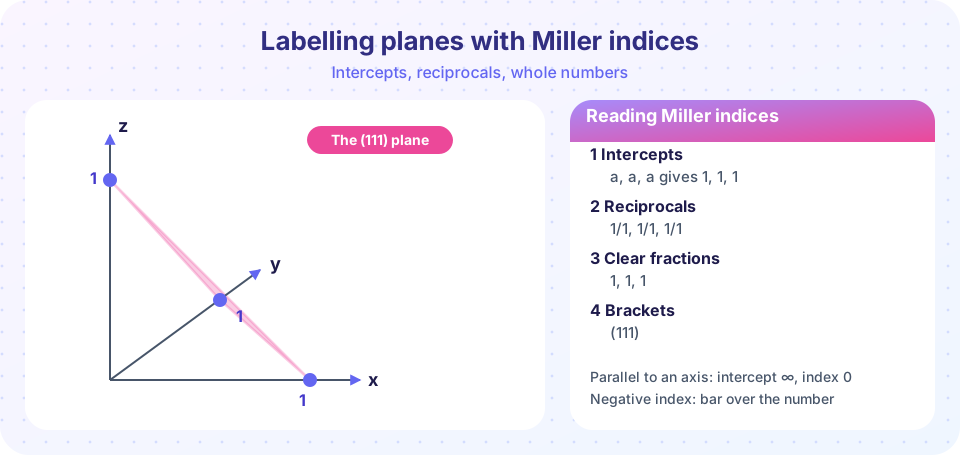
Suppose a plane meets the x, y and z axes at distances p a, q a, r a.
- Write the intercepts in units of the lattice constants: p, q, r. If the plane is parallel to an axis, the intercept is ∞.
- Take reciprocals: 1/p, 1/q, 1/r. A reciprocal of ∞ is 0.
- Multiply by the smallest factor that clears fractions, so the three numbers become the smallest integers h, k, l.
- Write (hkl) in round brackets. A minus sign is shown as a bar over the digit, for example (1 1̄ 0).
Worked example 1. A plane cuts the axes at 1, 1, 1. Reciprocals 1, 1, 1 give (111).
Worked example 2. A plane cuts at 1, 1/2, ∞. Reciprocals: 1, 2, 0. So (120).
Worked example 3. A plane cuts at 2, 3, 1. Reciprocals: 1/2, 1/3, 1. The smallest common multiple of the denominators is 6: 3, 2, 6, so (326).
Why reciprocals? Because the Miller indices are the components of the reciprocal lattice vector perpendicular to the plane, as the next lesson shows. Large indices mean closely spaced, densely stacked planes with few atoms on each; small indices mean widely spaced planes crowded with atoms. Those widely spaced planes are the ones that form crystal faces.
In a cubic crystal the vector [hkl] is perpendicular to the plane (hkl). That is special to cubic symmetry and fails in other systems.
Directions and families
A direction [uvw] is written in square brackets with no commas. [100] is along x, [110] is a face diagonal and [111] is the body diagonal. The angle φ between two directions in a cubic crystal follows from the dot product:
cos φ = (u₁u₂ + v₁v₂ + w₁w₂) / (√(u₁²+v₁²+w₁²) · √(u₂²+v₂²+w₂²)).
For [100] and [111], cos φ = 1/√3, so φ = 54.74°.
In a cubic crystal the planes (100), (010), (001) and their negatives are crystallographically identical. We call the whole set the family {100} and say it has 3 distinct planes (6 if we count the sign of the normal). Similarly {110} contains 6 distinct planes and {111} has 4. Curly brackets mean "any plane of the family"; angle brackets ⟨uvw⟩ do the same for directions.
Spacing between planes
For a cubic lattice with constant a, the spacing of (hkl) planes is
d_hkl = a / √(h² + k² + l²).
For copper (a = 0.3615 nm): d₁₀₀ = 0.3615 nm, d₁₁₀ = 0.2556 nm, d₁₁₁ = 0.2087 nm. In an fcc or bcc crystal described by the conventional cell, the diffraction rules (next lesson) remove some planes, so the true spacing of the physical planes is sometimes smaller: in fcc the planes (100) alone do not form a complete set of lattice planes, but (200) does, with d = a/2.
For orthorhombic cells the expression generalizes to 1/d² = h²/a² + k²/b² + l²/c².
Planar density
How many atoms sit on a plane per unit area? In fcc, with lattice constant a:
| Plane | Atoms in the area | Area | Planar density |
|---|---|---|---|
| (100) | 2 | a² | 2/a² |
| (110) | 2 | √2 a² | √2/a² = 1.414/a² |
| (111) | 2 | (√3/2) a² | 4/(√3 a²) = 2.309/a² |
The (111) plane is the densest, a close-packed hexagonal layer. That is why fcc metals slip on {111} planes and in ⟨110⟩ directions (the closest-packed directions), and why gold crystals grow as octahedra bounded by {111} faces.
Common misconceptions
"Intercepts, not reciprocals." The indices are reciprocals of the intercepts, so a plane that is close to the origin has large indices, and a plane parallel to an axis gets a zero.
"(hkl) and [hkl] mean the same thing." Round brackets are a plane, square brackets a direction. They only point the same way in cubic crystals.
"(200) is the same plane as (100)." They are parallel, but (200) has half the spacing. It is the plane you would see in diffraction when fcc planes at a/2 contribute.
Try it
Press Run (or Ctrl + Enter) to see the result here.
Program input · what you'd type while the program runs
Type the answers before you press Run, one per line. Each time the program reads a line (with input()), it gets the next line from this box.
Press Run (or Ctrl + Enter) to see the result here.
Program input · what you'd type while the program runs
Type the answers before you press Run, one per line. Each time the program reads a line (with input()), it gets the next line from this box.
Check your understanding
Quick check · 5 questions
of 5 answered You scored / 5 · perfect!
-
1. A plane cuts the axes at 1, 1/2 and infinity (parallel to z). Its Miller indices are
Reciprocals are 1, 2 and 0, giving (120). -
2. What is the spacing of the (110) planes in a cubic crystal with lattice constant a?
d = a/√(1² + 1² + 0²) = a/√2. -
3. Which fcc plane has the highest planar density?
(111) is the close-packed layer, with 4/(√3a²) ≈ 2.31/a² atoms per area. -
4. How many distinct planes belong to the family {111} in a cubic crystal?
There are 8 normals (±1, ±1, ±1) but each plane is paired with its negative, so 4 distinct planes. -
5. In a cubic crystal, the direction [hkl] is
In cubic crystals [hkl] is the normal to (hkl); this fails for lower-symmetry crystals.
Summary
- Miller indices (hkl) are the cleared reciprocals of the intercepts of a plane, in lattice-constant units.
- [uvw] is a direction, {hkl} a family of planes and ⟨uvw⟩ a family of directions.
- In a cubic crystal d_hkl = a/√(h²+k²+l²), and [hkl] is perpendicular to (hkl).
- Planes with small indices are widely spaced and densely populated; fcc's densest plane is (111).
Track your progress
Create a free account to tick off lessons and pick up where you left off on any device.
of Condensed Matter Physics lessons completed