


















Lesson 1 of 46 · Getting Started
Course map: Condensed Matter Physics
Who this condensed matter physics course is for, what you need first, how the nine chapters fit together, and how to study with the simulations and quizzes.
A teaspoon of copper holds about 10²³ atoms. Each atom has electrons that interact with every other atom's electrons, yet the whole lump conducts electricity, rings when struck and melts at a precise temperature. Condensed matter physics is the branch of physics that explains how such simple ingredients produce such rich behavior. It is the largest field of physics, and it is the science behind every chip, battery, LED, magnet and solar cell you use.
This course takes you from "what is a crystal?" to band theory, semiconductors, magnetism, superconductivity and topological materials. You will meet the main ideas, work with real numbers, and run small simulations of your own.
What you will learn
- Who this course is for and what background it assumes.
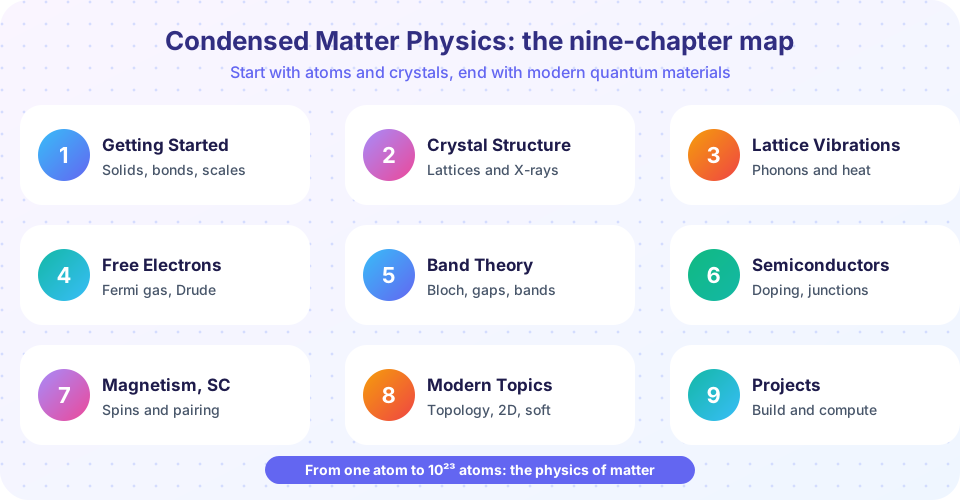
- How the nine chapters build on each other, from structure to electrons to collective phenomena.
- A study routine that makes the interactive examples and quizzes work for you.
- The key numbers and units you will use again and again.
Key terms
Condensed matter: matter in which atoms are close enough to interact strongly: solids and liquids, and also exotic states such as superfluids.
Crystal: a solid whose atoms sit on a repeating pattern in space.
Quasiparticle: a collective excitation that behaves like a particle, such as a phonon or a hole.
Emergence: a property of the whole system that no single particle has.
Who this course is for
It suits physics and engineering undergraduates, advanced school students preparing for olympiads, and adults who want to understand how modern devices work. You should be comfortable with:
- Algebra and basic calculus: derivatives, simple integrals, and the sine and exponential functions.
- Introductory physics: forces, energy, waves, and electric current. Quantum ideas such as the electron wave function and the Schrödinger equation help, but we recall each one when we use it.
- A little Python: the examples use numpy and matplotlib. You can run every one in your browser by pressing Run; you only need to read and tweak the code.
No Fourier analysis or solid state background is assumed. When a mathematical tool is needed we introduce it first and use it second.
How the nine chapters fit together
The course follows the story physicists themselves followed.
- Getting started sets the scene: what condensed matter is, how atoms bond into solids, and the sizes and energies involved.
- Crystal structure and diffraction gives the language of crystals: lattices, unit cells, Miller indices, and how X-rays reveal the arrangement of atoms.
- Lattice vibrations and phonons treats the atoms as masses on springs. The vibrations are quantized into phonons, which explain heat capacity and the speed of sound.
- The free electron model adds the electrons. A gas of non-interacting quantum electrons explains conduction and the Hall effect.
- Band theory puts the electrons in the periodic potential of the crystal, producing energy bands and gaps.
- Semiconductors and metals applies bands to doping, junctions and devices.
- Magnetism and superconductivity moves to collective states: ordering of spins and the pairing of electrons.
- Modern topics surveys topological insulators, two-dimensional materials and soft matter.
- Projects and practice puts the tools to work on complete problems.
Atoms form crystals
The lattice moves
Electrons roam
Bands rule devices
Collective states
The numbers to keep in your head
Condensed matter physics lives at a few characteristic scales. Learn them now and you will always know whether an answer is sensible.
| Quantity | Typical value |
|---|---|
| Atom spacing in a solid | 0.2 to 0.5 nm (2 to 5 Å) |
| Atoms per cm³ | about 10²² to 10²³ |
| Electron density in a metal | 10²⁸ to 10²⁹ m⁻³ |
| Fermi energy of a metal | 2 to 12 eV |
| Thermal energy at 300 K | k_B T ≈ 0.0259 eV |
| Phonon energy | 10 to 100 meV |
| Band gap of silicon | 1.12 eV |
One electronvolt is the energy an electron gains across 1 volt: 1 eV = 1.602 × 10⁻¹⁹ J. We use it constantly, because joules are absurdly large for atoms.
How to study
Read a lesson once for the idea, then go to the Try it blocks and change the numbers. Most lessons run a simulation or a calculator so you can see how a result depends on its inputs. After that, answer the quiz without looking back, and use the explanations to repair gaps. Each chapter ends with a review lesson that has a longer quiz and a one-page picture of the chapter.
Two habits pay off. First, always attach units to a number. Second, estimate before you compute: if the Fermi energy of a metal comes out as 10⁻³ eV, something is wrong.
The code blocks use real physical constants from the SI (CODATA 2018). When a value is a standard textbook figure rather than a precise measurement, the text says "about". Lab measurements in this course are described, never invented: we say what an experiment would show, not that we measured it.
Common misconceptions
"Solid state physics is just crystals." Glasses, polymers, liquid crystals, superconductors and magnets are all condensed matter. Crystals are the cleanest starting point because their repetition makes the mathematics tractable.
"You need to solve for every electron." No one does. The central skill of the field is knowing what to ignore and what to keep, and turning 10²³ coupled particles into a few collective modes.
Try it
Press Run (or Ctrl + Enter) to see the result here.
Program input · what you'd type while the program runs
Type the answers before you press Run, one per line. Each time the program reads a line (with input()), it gets the next line from this box.
Check your understanding
Quick check · 4 questions
of 4 answered You scored / 4 · perfect!
-
1. Roughly how many atoms are in one cubic centimeter of a typical solid?
Atoms are about 0.3 nm apart, so a centimeter cube holds around (3 × 10⁷)³ unit cells. That is of order 10²² to 10²³ atoms. -
2. Which chapter introduces phonons?
Chapter 3, Lattice Vibrations and Phonons, treats atoms as coupled oscillators and quantizes their motion. -
3. What is one electronvolt in joules?
It is the energy an electron gains crossing one volt: e × 1 V = 1.602 × 10⁻¹⁹ J. The other values are k_B, h and the electron mass. -
4. Why is thermal energy at 300 K (about 0.026 eV) important?
k_B T sets what thermal motion can do. Energies much larger than k_B T are frozen out, and energies much smaller are easily excited.
Summary
- Condensed matter physics explains how 10²³ interacting atoms produce the properties of solids and liquids.
- The course moves from structure, to vibrations, to electrons, to bands, to devices, to collective phenomena.
- Keep a few scales in mind: 0.3 nm spacing, 10²⁸ m⁻³ electron density, 1 eV energies, 0.026 eV at room temperature.
- Study by running the examples, changing numbers and attaching units to everything.
Track your progress
Create a free account to tick off lessons and pick up where you left off on any device.
of Condensed Matter Physics lessons completed