


















Lesson 22 of 46 · Band Theory
Bloch's theorem and Bloch waves
Learn Bloch's theorem: why electron states in a crystal are plane waves times a periodic function, what crystal momentum means and how the Brillouin zone works.
A crystal looks the same if you shift it by a lattice vector. This single fact, translation symmetry, forces a very specific form on every electron wave function. It was proved by Felix Bloch in 1929, in the early days of quantum mechanics, and everything in band theory follows from it. In this lesson you will state the theorem, understand what the quantum number k really is, and learn why you can always restrict k to a single cell of reciprocal space.
What you will learn
- The statement of Bloch's theorem and the two equivalent ways of writing it.
- What the crystal momentum ħk is, and how it differs from true momentum.
- How the first Brillouin zone follows from the periodicity of k.
- How periodic boundary conditions fix the number of allowed k values.
Key terms
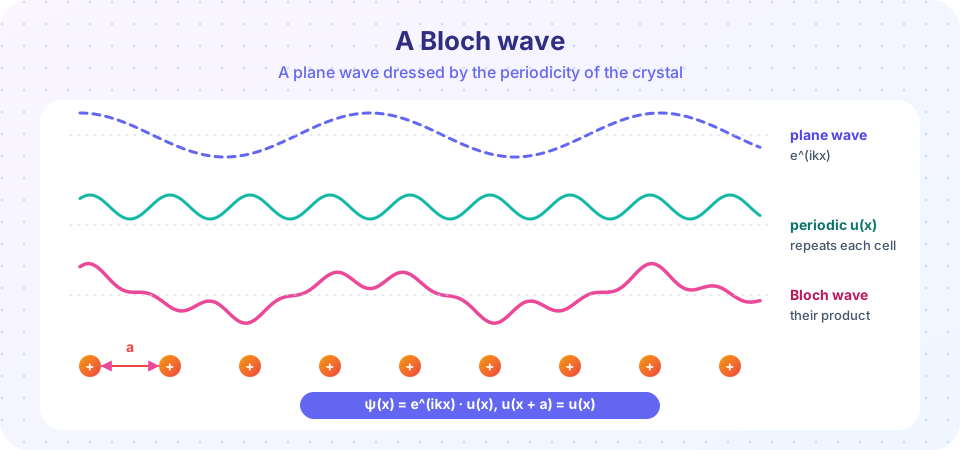
Bloch wave: an energy eigenstate of the form ψ_k(r) = e^(ik·r) u_k(r), where u_k has the lattice periodicity.
Crystal momentum: the quantity ħk labeling a Bloch state; it is conserved only up to a reciprocal lattice vector G.
Reciprocal lattice vector G: a vector with e^(iG·R) = 1 for every lattice vector R. In one dimension G = 2πn/a.
First Brillouin zone: the set of k closest to the origin; in one dimension −π/a < k ≤ π/a.
The theorem
Consider one electron in a potential with the lattice period: V(r + R) = V(r) for every lattice vector R. The Hamiltonian H = −ħ²∇²/2m + V(r) then commutes with every translation operator T_R that shifts a function by R. Commuting operators share eigenfunctions, so the energy eigenstates can be chosen to be eigenstates of all T_R at once. A translation by R does not change |ψ|² (the crystal looks identical), so its eigenvalue must be a pure phase. That gives Bloch's theorem:
ψ(r + R) = e^(ik·R) ψ(r)
Equivalently, ψ_k(r) = e^(ik·r) u_k(r) with u_k(r + R) = u_k(r). The wave function is not periodic, but its density |ψ|² is. A free electron is the special case u = constant.
In a real crystal the electron does not have a definite momentum: the periodic potential keeps scattering it by reciprocal lattice vectors, so ψ is a sum of plane waves e^(i(k+G)·r) for all G. The label ħk is called the crystal momentum. It behaves like a momentum in the equations of motion of wave packets (ħ dk/dt = force from external fields) but it is defined only modulo ħG.
Why k lives in a zone
Suppose you replace k by k' = k + G. Then e^(ik'·R) = e^(ik·R) e^(iG·R) = e^(ik·R): the same translation eigenvalue. So k and k + G label the same symmetry class. We can choose the representative of smallest magnitude, which defines the first Brillouin zone. In one dimension with lattice constant a it is the interval −π/a < k ≤ π/a. For each k in the zone there is a whole family of states with energies E_1(k) < E_2(k) < …, labeled by the band index n. This is why band structures are drawn as curves E_n(k) over the zone.
The free-electron parabola E = ħ²k²/2m, when folded back into the first zone (the reduced zone scheme), becomes a set of branches: each piece of the parabola beyond the zone edge is shifted by a reciprocal lattice vector. These are the bands of an "empty lattice", before any potential is switched on.
How many states in a band?
Impose periodic boundary conditions on a ring of N unit cells (length L = Na): ψ(x + L) = ψ(x). Bloch's theorem gives e^(ikL) = 1, so k = 2πm/(Na) with integer m. The zone has width 2π/a, so it contains exactly N allowed values of k. With spin, each band holds 2N electrons, a fact we used in the chapter overview. The spacing between neighboring k values is 2π/L, tiny for a macroscopic crystal, which is why we write sums over k as integrals.
Worked example: a chain of N = 10 cells with a = 0.40 nm. The allowed k are multiples of 2π/(4 nm) = 1.571 nm⁻¹. The zone edge is π/a = 7.854 nm⁻¹, so m runs from −4 to +5 (ten values, with m = 5 identified as the zone edge). Crystal momentum at the edge is ħπ/a, corresponding to a free-electron energy ħ²π²/(2ma²) = 3.81 eV·Å² × 9.87 / 16 Ų ≈ 2.35 eV.
Common misconceptions
"ħk is the momentum of the electron." The true momentum operator does not commute with H in a crystal, so Bloch states are not momentum eigenstates. Only ħk modulo ħG is conserved in collisions, which is why umklapp processes exist.
"Bloch's theorem needs weak potentials." It holds for any periodic potential, however strong. Weak potentials only make u_k nearly constant.
"A Bloch state is localized near one atom." It is spread uniformly over the whole crystal, with a density that repeats from cell to cell. Localized states are built by superposing many k, as in wave packets or Wannier functions.
Try it
The first example builds an explicit Bloch wave and verifies the theorem numerically.
Press Run (or Ctrl + Enter) to see the result here.
Program input · what you'd type while the program runs
Type the answers before you press Run, one per line. Each time the program reads a line (with input()), it gets the next line from this box.
The second example folds the free-electron parabola into the first Brillouin zone and counts allowed k values.
Press Run (or Ctrl + Enter) to see the result here.
Program input · what you'd type while the program runs
Type the answers before you press Run, one per line. Each time the program reads a line (with input()), it gets the next line from this box.
Check your understanding
Quick check · 5 questions
of 5 answered You scored / 5 · perfect!
-
1. Bloch's theorem states that in a periodic potential an eigenstate satisfies
A lattice translation multiplies the state by a phase factor, so |ψ|² is periodic but ψ itself is not. -
2. The crystal momentum ħk is defined only up to
Replacing k by k + G leaves e^(ik·R) unchanged because e^(iG·R) = 1. -
3. A ring of N primitive cells has how many distinct k values in the first Brillouin zone?
k = 2πm/(Na) and the zone has width 2π/a, which holds N values. -
4. Which of these is true for a free electron seen as a Bloch state?
A plane wave is the special case of a Bloch wave with u_k constant. -
5. In one dimension with lattice constant a, the first Brillouin zone is
The zone has width equal to the reciprocal lattice spacing 2π/a, centered on zero.
Summary
- Translation symmetry forces eigenstates into the form ψ_k = e^(ik·r) u_k(r) with u_k periodic.
- The crystal momentum ħk is conserved only modulo ħG; the first Brillouin zone contains every distinct k.
- For each k there is a family of bands E_n(k), n = 1, 2, 3, ...
- A crystal of N cells has N k-values per band and holds 2N electrons per band.
Track your progress
Create a free account to tick off lessons and pick up where you left off on any device.
of Condensed Matter Physics lessons completed