


















Lesson 25 of 46 · Band Theory
Chapter 5 review: band theory
Review the key results of band theory: Bloch waves, crystal momentum, gaps from Bragg reflection, tight-binding bands and effective mass, with a ten-question quiz.
You have now seen the three pillars of band theory: the symmetry argument (Bloch), the weak-potential argument (nearly free electrons) and the strong-binding argument (tight binding). This review puts the formulas side by side and then tests you with questions that mix all three lessons.
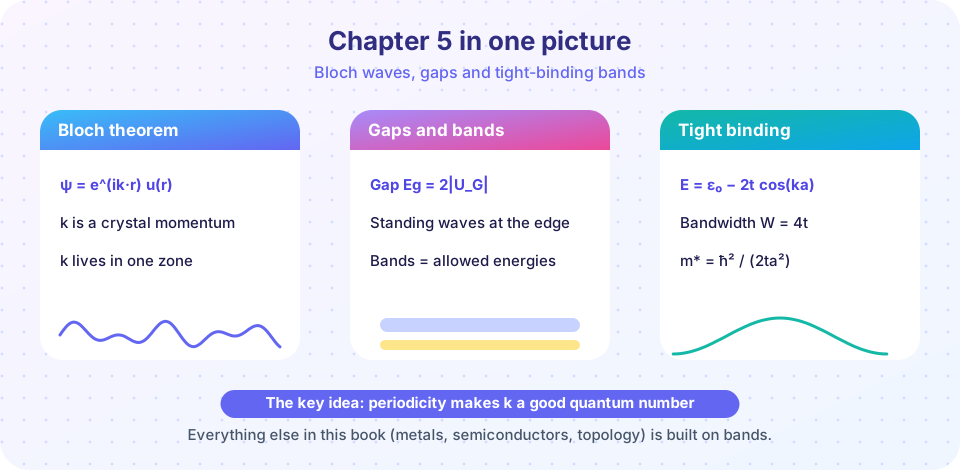
What you should be able to do
- State Bloch's theorem and explain crystal momentum and the Brillouin zone.
- Derive the gap Eg = 2|U_G| from degenerate perturbation theory.
- Derive E(k) = ε₀ − 2t cos(ka) and the effective mass m* = ħ²/(2ta²).
- Count the states in a band and decide whether a solid can be a metal.
Recap table
| Idea | Result | Where it applies |
|---|---|---|
| Bloch's theorem | ψ_k = e^(ik·r) u_k(r), u_k periodic | any periodic potential |
| Crystal momentum | ħk, defined modulo ħG | scattering, transport |
| First zone (1D) | −π/a < k ≤ π/a, N values for N cells | counting states |
| Nearly free electrons | Eg = 2|U_G| at k = nπ/a | sp metals, weak potentials |
| Kronig-Penney | cos(ka) = cos(qa) + (P/qa) sin(qa) | exact toy model of gaps |
| Tight binding (chain) | E = ε₀ − 2t cos(ka), W = 4t | narrow d bands, molecules, graphene |
| Effective mass | m* = ħ²/(d²E/dk²) = ħ²/(2ta²) at the bottom | response to forces |
| Dimerized chain | Eg = 2|t₁ − t₂| | Peierls, SSH model |
| Filling | band holds 2N electrons | metal vs insulator |
Where students go wrong
Mixing up k and momentum. If a problem asks about conservation in a collision, remember that only k mod G is conserved.
Forgetting spin. Each k-state holds two electrons. An even number of electrons per primitive cell is necessary (not sufficient) for an insulator.
Using the wrong sign for the effective mass. Near the top of a band the curvature is negative, so m* < 0 and the carrier acts like a positive charge.
Try it
Press Run (or Ctrl + Enter) to see the result here.
Program input · what you'd type while the program runs
Type the answers before you press Run, one per line. Each time the program reads a line (with input()), it gets the next line from this box.
Check your understanding
Quick check · 10 questions
of 10 answered You scored / 10 · perfect!
-
1. Which statement is a direct consequence of translation symmetry?
Commuting translation operators and the Hamiltonian share eigenstates of Bloch form. -
2. k and k + G describe
e^(iG·R) = 1 for lattice vectors R. -
3. For a 1D crystal of 100 cells, how many electrons fit in one band?
100 k values times two spin states. -
4. In the nearly free electron model the gap at the first zone boundary is 1.6 eV. What is |U_G|?
Eg = 2|U_G|, so |U_G| = 0.8 eV. -
5. A tight-binding chain has t = 0.75 eV. What is its bandwidth?
W = 4t = 3.0 eV. -
6. The effective mass at the top of a cosine band is
The curvature of −2t cos(ka) at ka = π is negative. -
7. Doubling the hopping t (same a) changes m* by a factor of
m* = ħ²/(2ta²) is inversely proportional to t. -
8. The dimerized chain has t₁ = 1.0 eV and t₂ = 0.6 eV. The gap is
2|t₁ − t₂| = 2 × 0.4 = 0.8 eV. -
9. A crystal has two valence electrons per primitive cell. It
An even count allows a filled band, but overlapping bands (as in magnesium) can still give a metal. -
10. Which effect does the Kronig-Penney model demonstrate?
Larger P widens the forbidden intervals; for P → 0 the free-electron parabola returns.
Summary
- Bloch's theorem: ψ_k = e^(ik·r) u_k(r), with k defined in the first Brillouin zone.
- Weak potential: gaps 2|U_G| at k = nπ/a. Strong binding: bandwidth 4t for a chain.
- Effective mass is the curvature of the band; it is positive at minima and negative at maxima.
- Counting 2N states per band and checking for partly filled bands tells you whether a solid can conduct.
Track your progress
Create a free account to tick off lessons and pick up where you left off on any device.
of Condensed Matter Physics lessons completed