


















Lesson 17 of 46 · Free Electron Model
The Fermi gas and the Fermi energy
Fill k-space with electrons to derive k_F = (3π²n)^(1/3), E_F, v_F and T_F, compute them for copper, sodium and aluminum, and meet degeneracy pressure.
If you could cool a metal to absolute zero, its electrons would not stop. Because of the Pauli exclusion principle, no two electrons can share a state, so as electrons are added they must occupy higher and higher energy states. In a typical metal the last electron has an energy of several electronvolts and a speed of about 10⁶ m/s, even at T = 0. That energy, the Fermi energy, is the single most important number for a metal.
In this lesson we count states in k-space, derive the Fermi wave vector, energy and velocity from the electron density alone, and compute them for real metals.
What you will learn
- How to count the electron states in k-space for a box of volume V.
- How to derive k_F, E_F, v_F and T_F from the density n.
- Typical values for real metals and why they are so large.
- Why a degenerate electron gas exerts a large pressure.
Key terms
Fermi wave vector k_F: the radius of the filled sphere in k-space at T = 0.
Fermi energy E_F: the energy of the highest occupied state at T = 0, E_F = ħ²k_F²/2m.
Fermi temperature T_F: E_F/k_B, the temperature at which thermal energy would equal E_F; typically 10⁴ to 10⁵ K.
Degenerate gas: a fermion gas at T ≪ T_F, where the exclusion principle dominates.
Counting the states
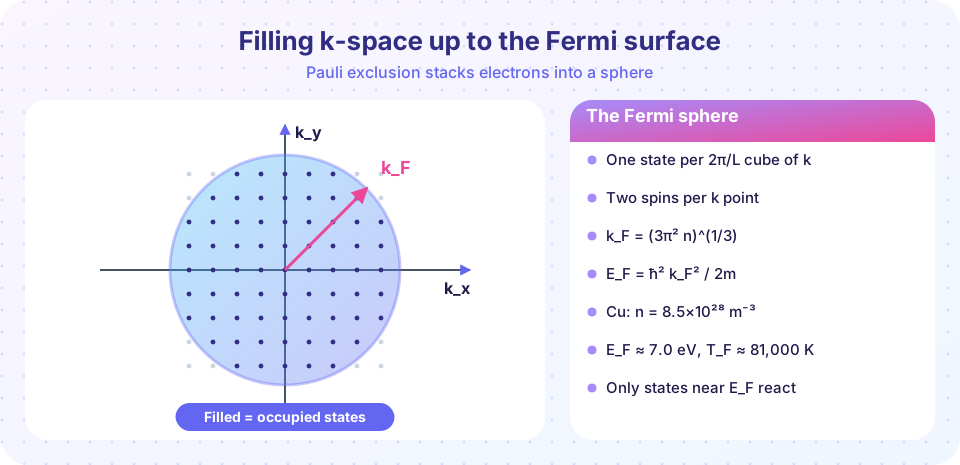
Put N electrons in a cubic box of side L with periodic boundary conditions. The one-electron wave functions are plane waves e^{ik·r}, and periodicity restricts the wave vector to
k_x, k_y, k_z = 0, ±2π/L, ±4π/L, …
so the allowed k points form a cubic grid with spacing 2π/L. The volume of k-space per allowed point is (2π/L)³ = 8π³/V. The energy of a plane wave is E = ħ²k²/2m, which depends only on |k|, so states of equal energy lie on a sphere.
At T = 0 the electrons fill the lowest-energy states, which means a sphere of radius k_F centered at the origin. Each k point holds two electrons (spin up and down):
N = 2 × (4π k_F³/3) / (8π³/V) = V k_F³ / (3π²).
Solving for k_F gives the central result:
k_F = (3π² n)^(1/3), where n = N/V.
Notice that k_F depends only on the density.
The Fermi quantities
From k_F everything else follows:
| Quantity | Formula | Copper (n = 8.47 × 10²⁸ m⁻³) |
|---|---|---|
| Fermi wave vector | k_F = (3π²n)^(1/3) | 1.36 × 10¹⁰ m⁻¹ |
| Fermi energy | E_F = ħ²k_F²/2m | 7.0 eV |
| Fermi velocity | v_F = ħk_F/m | 1.57 × 10⁶ m/s |
| Fermi temperature | T_F = E_F/k_B | 8.1 × 10⁴ K |
A useful constant: ħ²/(2m) = 3.81 eV·Å², so E_F (eV) = 3.81 × (k_F in Å⁻¹)². The Fermi velocity of copper is half a percent of the speed of light, hardly "slow", and quantum mechanics, not heat, is the reason: at 300 K the thermal energy k_BT = 0.026 eV is a tiny fraction of E_F.
Values for several metals, from the density and valence:
| Metal | Valence | n (10²⁸ m⁻³) | E_F (eV) | v_F (10⁶ m/s) |
|---|---|---|---|---|
| Na | 1 | 2.65 | 3.24 | 1.07 |
| Cu | 1 | 8.47 | 7.00 | 1.57 |
| Al | 3 | 18.1 | 11.7 | 2.03 |
| Au | 1 | 5.90 | 5.53 | 1.40 |
The energies span 3 to 12 eV, which is why metals respond to fields at the Fermi level in a similar way despite the variety of atoms.
Degeneracy pressure
The mean kinetic energy per electron is (3/5) E_F, so even at T = 0 the gas has energy and pressure. The pressure is P = (2/5) n E_F, and the corresponding bulk modulus is B = (2/3) n E_F. For copper that gives about 63 GPa, within a factor of about two of the measured 140 GPa. The electron gas alone accounts for a big part of why a solid resists compression; it is the same degeneracy pressure that supports white dwarf stars against gravity.
What the Fermi sea means
At T = 0 the occupation f(E) is 1 for E < E_F and 0 above it. At a finite temperature the edge is smeared over a width of about k_BT. Because T ≪ T_F, only the electrons near the surface of the Fermi sphere can change state: they have empty states nearby to move into. The other 99% are locked in place by their neighbors. That is the qualitative reason the electronic heat capacity is small, and it is also why only electrons at the Fermi surface carry current and heat. We quantify it in the next lesson.
Common misconceptions
"The Fermi temperature is the actual temperature of the electrons." It is just E_F/k_B, a convenient scale. The electrons are at room temperature, which is very cold compared with T_F.
"A fast electron is a hot electron." The electrons move at v_F because of the exclusion principle, not because of heat.
"E_F is the same in all metals." It depends on density as n^(2/3). Aluminum, with three valence electrons per atom, has the highest value in the table.
Try it
Press Run (or Ctrl + Enter) to see the result here.
Program input · what you'd type while the program runs
Type the answers before you press Run, one per line. Each time the program reads a line (with input()), it gets the next line from this box.
Check your understanding
Quick check · 5 questions
of 5 answered You scored / 5 · perfect!
-
1. How does k_F depend on the electron density n?
k_F = (3π²n)^(1/3), because the filled sphere must hold N electrons. -
2. Why does each k point hold two electrons?
Spin up and spin down electrons may share the same spatial wave function. -
3. Copper has E_F = 7.0 eV. What is k_BT at 300 K compared with it?
k_BT = 0.0259 eV, so k_BT/E_F ≈ 0.0037, i.e. about 0.4%. The electron gas is very degenerate. -
4. E_F as a function of n scales as
E_F ∝ k_F² ∝ n^(2/3). -
5. The mean kinetic energy per electron at T = 0 is
Averaging E over the filled sphere gives 3E_F/5.
Summary
- Allowed k points are spaced 2π/L apart, so a spin-degenerate Fermi sphere holds N = Vk_F³/(3π²) electrons.
- k_F = (3π²n)^(1/3), E_F = ħ²k_F²/2m, v_F = ħk_F/m, T_F = E_F/k_B.
- For metals E_F is 2 to 12 eV, v_F about 10⁶ m/s and T_F of order 10⁴ to 10⁵ K.
- The mean energy is (3/5)E_F, producing a degeneracy pressure P = (2/5)nE_F.
- Only electrons near the Fermi surface take part in thermal and transport processes.
Track your progress
Create a free account to tick off lessons and pick up where you left off on any device.
of Condensed Matter Physics lessons completed