


















Lesson 38 of 46 · Modern Topics
The quantum Hall effect and topological phases
Learn Landau levels, the quantum Hall plateaus rho_xy = h/(nu e^2), edge states, Chern numbers and topological insulators, with a runnable edge-state model.
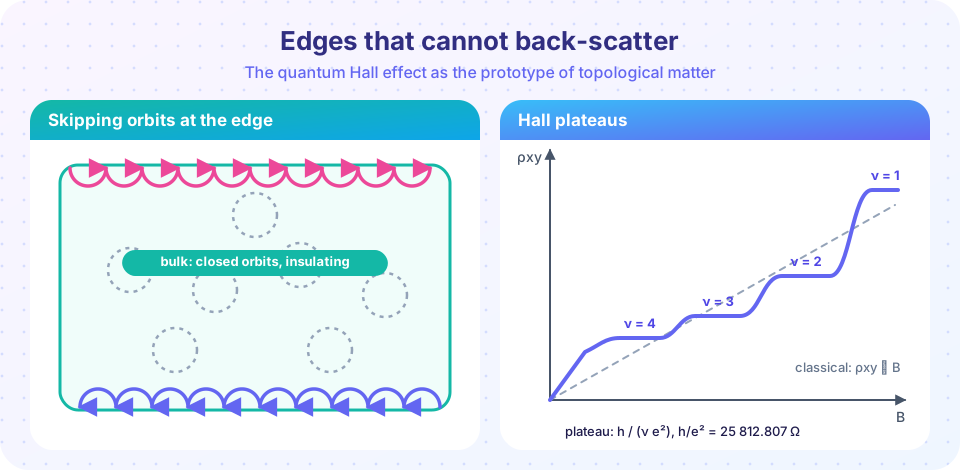
In 1980 Klaus von Klitzing measured the Hall resistance of a silicon transistor at 1.5 K in a 18 T field and found something that should have been impossible: instead of rising smoothly with the field as the classical formula R_H = B/(ne) predicts, it climbed in flat steps. The height of each step was h/(ν e²) with ν an integer, to an accuracy of a few parts per million, independent of the sample's size, shape, material or the amount of disorder. A resistance determined by two constants of nature and an integer was found in a dirty, imperfect semiconductor device. It led to a Nobel Prize in 1985 and to the modern idea that topology can protect physical properties.
What you will learn
- Landau levels, their degeneracy eB/h and the filling factor ν = nh/(eB).
- Why the Hall resistance is quantized and the longitudinal resistance vanishes.
- Edge states, Chern numbers and the Thouless-Kohmoto-Nightingale-den Nijs idea.
- What topological insulators are and how they differ from the quantum Hall state.
Key terms
Landau level: energy E_n = ħω_c(n + 1/2), with ω_c = eB/m*, each with a degeneracy eB/h per unit area (per spin).
Filling factor ν: the number of filled Landau levels, ν = n h/(eB).
von Klitzing constant: R_K = h/e² = 25 812.807 Ω.
Berry curvature: a field in k-space whose integral over the Brillouin zone gives 2π times the Chern number.
Landau levels and the filling factor
Put a two-dimensional electron gas (2DEG), for example the interface of a GaAs/AlGaAs heterostructure, in a perpendicular magnetic field B. Classically electrons move in circles at the cyclotron frequency ω_c = eB/m*. Quantum mechanically the continuous spectrum of kinetic energy collapses into discrete Landau levels E_n = ħω_c(n + 1/2) with n = 0, 1, 2, …. Each level can hold eB/h electrons per unit area (the number of flux quanta h/e threading the sample, per spin state). If the electron density is n, the filling factor is
ν = n h / (e B)
For GaAs with m* = 0.067 m₀ and B = 10 T the cyclotron energy is ħω_c ≈ 17 meV, far above the thermal energy at 1 K (0.086 meV): at low temperature the levels are well resolved. With n = 3 × 10¹⁵ m⁻², ν = 1 occurs at B = n h/e = 3 × 10¹⁵ × 4.136 × 10⁻¹⁵ ≈ 12.4 T, ν = 2 at 6.2 T and so on.
Why the resistance is quantized
When the Fermi level lies in the gap between two Landau levels, there are no states available to scatter into, so the longitudinal resistance ρ_xx drops to zero. The Hall resistance then takes the value
ρ_xy = h / (ν e²) = R_K / ν
where ν is the integer number of filled levels. Disorder localizes states between the levels, so the Fermi level can move through many magnetic field values while staying in localized states that do not conduct: this explains why the plateaus are wide and why imperfections do not matter. Since 1990 R_K has been used as a resistance standard; since the 2019 redefinition of the SI, h and e are fixed constants and h/e² = 25 812.80745… Ω exactly.
The picture in real space is simple. In the bulk the classical orbits close on themselves: no current. At the sample edge the confining potential bends the levels up; orbits there cannot close and electrons skip along the boundary in one direction on one edge and the opposite direction on the other edge. These chiral edge channels carry the current. Because a backscattering electron would have to cross the whole bulk to the other edge, it cannot be scattered by impurities: each channel is perfectly conducting with conductance e²/h.
Topology: the Chern number
In 1982 Thouless, Kohmoto, Nightingale and den Nijs showed that the Hall conductance of a filled band in a periodic potential is σ_xy = (e²/h) C where the Chern number C is an integer given by the integral of the Berry curvature over the Brillouin zone. An integer cannot change under small changes of the Hamiltonian, so the quantization is exact. C can only jump when the gap closes, at a topological phase transition. In 1988 Haldane showed that even with zero net magnetic field a lattice model with complex hopping can have C ≠ 0: a Chern insulator. This was realized experimentally as the quantum anomalous Hall effect in magnetic topological insulator films (2013).
The fractional quantum Hall effect, discovered by Tsui, Störmer and Gossard in 1982 at ν = 1/3 in cleaner samples, is a different story: it is caused by electron-electron interactions, not independent particles. Laughlin's wave function describes an incompressible liquid whose quasiparticles carry a fraction of the electron charge (e/3, measured in 1997 through shot noise).
Topological insulators
Strong spin-orbit coupling can do the work of the magnetic field. In a topological insulator (TI) the bulk has a gap but the boundary hosts gapless states protected by time-reversal symmetry. In 2D (the quantum spin Hall state, predicted for HgTe/CdTe quantum wells in 2006 by Bernevig, Hughes and Zhang and observed by König and colleagues in 2007) the edge carries two counter-propagating channels with opposite spin: the spin direction is locked to the direction of motion ("helical" edge). In 3D (Bi₂Se₃ and Bi₂Te₃, 2009) the surface hosts a single Dirac cone with spin locked perpendicular to momentum; Bi₂Se₃ has a bulk gap of about 0.3 eV. Topological insulators are classified by a Z₂ invariant (0 or 1) rather than an integer.
The Su-Schrieffer-Heeger chain: a one-dimensional example
You can see bulk-boundary correspondence in the simplest model, the dimerized chain from the tight-binding lesson. If the intra-cell hopping t₁ is weaker than the inter-cell hopping t₂, a finite chain ends on a weakly bonded site and has two zero-energy states localized at its ends, protected by the chiral symmetry of the model. If t₁ > t₂ there are none. The two phases have the same bulk gap formula 2|t₁ − t₂| but different winding numbers (0 and 1).
Common misconceptions
"The quantization is exact because the samples are perfect." The opposite: it needs disorder to localize states and create plateaus; and the accuracy (about 10⁻⁹) is a consequence of topology, not of sample quality.
"Edge states are one-way paths for individual electrons." In the quantum Hall effect the chiral edge channels are one-way for a given edge; the counter-propagating channel lives on the opposite edge, which is why backscattering is suppressed. In a quantum spin Hall edge, opposite spins move in opposite directions and backscattering needs a spin flip, which is forbidden by time reversal.
"Topological insulators conduct in the bulk." The bulk is insulating; only the edge or surface conducts.
Try it
Press Run (or Ctrl + Enter) to see the result here.
Program input · what you'd type while the program runs
Type the answers before you press Run, one per line. Each time the program reads a line (with input()), it gets the next line from this box.
Press Run (or Ctrl + Enter) to see the result here.
Program input · what you'd type while the program runs
Type the answers before you press Run, one per line. Each time the program reads a line (with input()), it gets the next line from this box.
Check your understanding
Quick check · 6 questions
of 6 answered You scored / 6 · perfect!
-
1. The Hall resistance on the ν = 2 plateau is
ρ_xy = h/(νe²) = 25 812.8 Ω / 2. -
2. The filling factor ν = nh/(eB) counts
n is the electron density and eB/h the density of flux quanta. -
3. Why is the longitudinal resistance zero on a plateau?
With no available states, dissipation vanishes. -
4. In a quantum spin Hall edge, backscattering is forbidden because
Helical edge states with opposite spins and momenta are protected by time-reversal symmetry. -
5. The SSH chain has end states when
The end site is weakly coupled when the intra-cell hopping is the smaller one, leaving a zero mode. -
6. A Chern number is
Topological invariants are integers and change only at transitions where the gap closes.
Summary
- A 2D electron gas in a strong field forms Landau levels E_n = ħω_c(n + 1/2); the filling factor is ν = nh/(eB).
- The Hall resistance on a plateau is h/(νe²) and ρ_xx = 0; edge channels carry the current.
- The Hall conductance is e²/h times a Chern number, an integer that is robust to disorder.
- Topological insulators have an insulating bulk and protected, spin-locked edge or surface states; the SSH chain is their simplest model.
Track your progress
Create a free account to tick off lessons and pick up where you left off on any device.
of Condensed Matter Physics lessons completed