


















Lesson 23 of 46 · Band Theory
The nearly free electron model and band gaps
See how a weak periodic potential opens an energy gap of 2|U| at the Brillouin zone boundary, and solve the Kronig-Penney model numerically.
Bloch's theorem tells you what the wave functions look like but not what the energies are. To get energies you need to solve the Schrödinger equation. The simplest nontrivial approach starts from the free electron and treats the lattice potential as a weak perturbation. It is surprisingly successful for simple metals such as sodium, magnesium and aluminum, and it gives the most important qualitative result of the chapter: gaps open exactly where Bragg reflection happens.
What you will learn
- Why a weak potential changes the free electron spectrum only near the zone boundary.
- How to derive the two-band result E± and the gap Eg = 2|U_G|.
- Why the two standing waves at the boundary have different energies.
- How the Kronig-Penney model confirms and extends the picture.
Key terms
Fourier component U_G: the coefficient of e^(iGx) in the expansion of the periodic potential, V(x) = Σ_G U_G e^(iGx).
Bragg condition (1D): k = ±nπ/a, the wave numbers where a wave is reflected by the lattice planes.
Energy gap: a range of energies in which no Bloch state exists.
Standing wave: an equal mixture of e^(ikx) and e^(−ikx), with no net propagation.
The two-band calculation
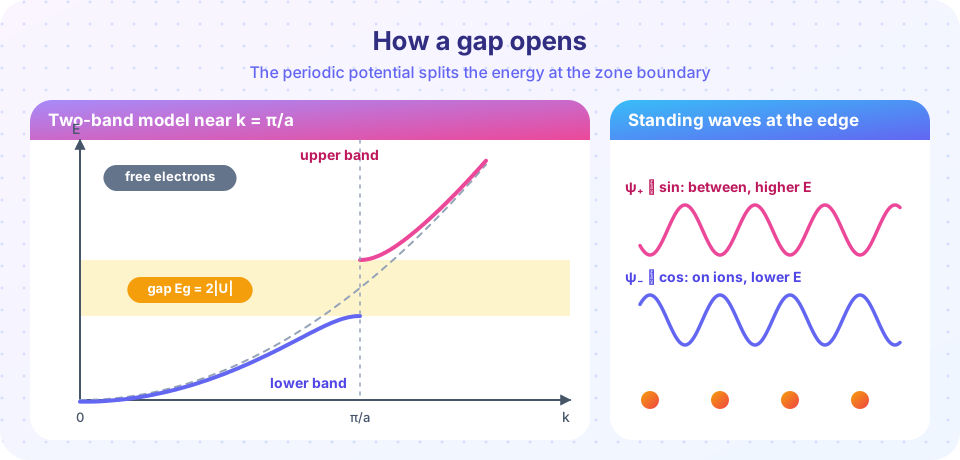
Take free electrons with E⁰(k) = ħ²k²/2m in a weak potential V(x) = Σ U_G e^(iGx). To first order the potential changes the energy of a plane wave |k⟩ by U₀, which is just a constant shift. Far from the zone boundary nothing else happens at first order. The trouble starts when two plane waves are degenerate: |k⟩ and |k − G⟩ have the same free energy when k = G/2, that is, at k = π/a for G = 2π/a. The potential couples them with matrix element U_G, so we must use degenerate perturbation theory. For k near π/a, only these two waves matter, and the secular equation is
(E⁰(k) − E)(E⁰(k − G) − E) = |U_G|²
with solutions
E± = (E⁰(k) + E⁰(k − G))/2 ± sqrt( ((E⁰(k) − E⁰(k − G))/2)² + |U_G|² )
At the zone boundary the two free energies are equal, so E± = E⁰(π/a) ± |U_G| and the gap is
Eg = 2|U_G|
The wave function at the boundary shows why. The two degenerate waves combine into the standing waves ψ₊ ∝ cos(πx/a) and ψ₋ ∝ sin(πx/a) (up to which is called which). Their probability densities are ∝ cos² and ∝ sin²: one piles the electron on the positive ions, where the potential energy is low, the other puts it between the ions. The first has lower energy, the second higher, and the difference is the gap.
Numbers: in sodium the lowest Fourier component of the pseudopotential is of order 0.2 eV, which is small compared with the free-electron Fermi energy of 3.2 eV, so the nearly free approximation is good. In silicon the first gap is about 1.1 eV, because the pseudopotential components are larger and because of the diamond structure.
Effective mass near the gap
Expand the two-band result near the zone edge, with q = k − π/a and E_b = ħ²π²/(2ma²) the free-electron energy there. For |U_G| much smaller than E_b the bands become parabolas with effective mass m* ≈ ± m|U_G|/(2E_b): positive for the upper band and negative for the top of the lower band (where the electron behaves like a positive hole). The magnitude is proportional to the gap. Narrow gaps mean light carriers, which is why InSb, with a gap of about 0.17 eV, has electrons with m* ≈ 0.014 m₀.
The Kronig-Penney model
To go beyond perturbation theory, solve an exactly solvable potential: a row of delta-function barriers of strength V₀b spaced by a. The result (derived by matching Bloch-form solutions across each barrier) is a single equation for allowed energies:
cos(ka) = cos(qa) + (P / qa) sin(qa), with E = ħ²q²/2m and P = m V₀ b a / ħ²
An energy E is allowed if the right side lies between −1 and 1, because only then does a real k exist. Outside that range k is complex and the wave grows exponentially: a gap. As P → 0 the gaps close and you recover free electrons; as P → ∞ the bands shrink to the levels of an isolated square well, qa = nπ. This model shows in one equation how a free-electron parabola turns into bands separated by gaps, how the gaps widen as the potential grows, and how the band edges come at ka = 0 and ka = π.
Common misconceptions
"Gaps open at every k." At first order only at the Bragg points k = nπ/a, where states are degenerate. Elsewhere the energy changes only at second order.
"The gap size is the potential strength." It is the Fourier component U_G of the potential at the specific reciprocal vector G. A potential with a vanishing U_G has no gap there, even if the potential is large.
"Nearly free electron theory works for any solid." It works for sp-bonded metals. For transition metals and ionic crystals, tightly bound d or f electrons need a different starting point, such as tight binding.
Try it
Press Run (or Ctrl + Enter) to see the result here.
Program input · what you'd type while the program runs
Type the answers before you press Run, one per line. Each time the program reads a line (with input()), it gets the next line from this box.
The second example solves the Kronig-Penney equation and lists the allowed bands.
Press Run (or Ctrl + Enter) to see the result here.
Program input · what you'd type while the program runs
Type the answers before you press Run, one per line. Each time the program reads a line (with input()), it gets the next line from this box.
Check your understanding
Quick check · 5 questions
of 5 answered You scored / 5 · perfect!
-
1. In the nearly free electron model the energy gap at k = π/a equals
The two standing waves have energies E⁰ ± |U_G|, so they differ by 2|U_G|. -
2. Why do gaps open at the Brillouin zone boundary?
Degenerate states k and k − G are strongly mixed by the potential at first order, lifting the degeneracy. -
3. Which standing wave has the lower energy at the boundary in a lattice of positive ions?
Electron density on the positive ions lowers the Coulomb energy. -
4. As the Kronig-Penney strength P goes to zero, the allowed bands
Without barriers there is no potential to open a gap. -
5. A narrow gap in the nearly free electron picture implies
Effective mass scales with the gap, so small gaps give small masses.
Summary
- A weak periodic potential leaves free-electron energies nearly unchanged except near k = nπ/a.
- At the boundary, degenerate perturbation theory gives E = E⁰ ± |U_G| and a gap Eg = 2|U_G|.
- The lower standing wave sits on the ions, the upper one between them.
- The Kronig-Penney model gives the allowed bands exactly: cos(ka) = cos(qa) + (P/qa) sin(qa).
Next: The tight-binding model
Track your progress
Create a free account to tick off lessons and pick up where you left off on any device.
of Condensed Matter Physics lessons completed