


















Lesson 10 of 46 · Crystal Structure and Diffraction
Chapter 2 review: Crystal structure and diffraction
Review lattices, unit cells, cubic packing, Miller indices, Bragg's law and the reciprocal lattice, with a formula table, a Bragg calculator and a ten-question quiz.
Chapter 2 gave you the language of crystals and the main tool for examining them. If you can take a crystal structure, say how many atoms it has per cell, how its planes are labeled and where its diffraction peaks fall, you are ready for the dynamics of Chapter 3 and the electrons of Chapter 4.
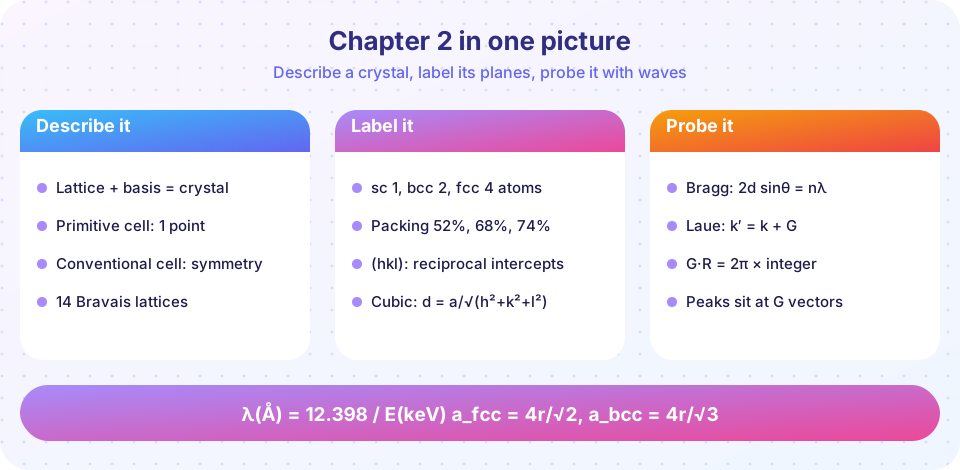
What you will learn
- A one-page recap of Chapter 2 with every key formula.
- How to use Bragg's law as a calculator for angles and spacings.
- Which topics to revisit if the quiz shows a gap.
The chapter in a table
| Topic | Formula or rule | Lesson |
|---|---|---|
| Lattice | R = n₁a₁ + n₂a₂ + n₃a₃; V = | a₁·(a₂×a₃) |
| Atoms per cubic cell | sc 1, bcc 2, fcc 4, diamond 8 | Cubic |
| Packing fraction | 0.524, 0.680, 0.740, 0.340 | Cubic |
| Density | ρ = Z M/(N_A a³) | Cubic |
| Miller indices | Reciprocal intercepts, cleared to integers | Miller |
| Cubic plane spacing | d = a/√(h²+k²+l²) | Miller |
| Bragg's law | 2d sin θ = nλ | Diffraction |
| Reciprocal lattice | aᵢ·bⱼ = 2πδᵢⱼ; | G |
| Structure factor | bcc: h+k+l even; fcc: all odd or all even | Diffraction |
Key terms
Primitive cell: smallest cell with one lattice point.
Coordination number: number of nearest neighbors.
Miller indices: integers (hkl) labeling a plane family.
Reciprocal lattice: the set of wave vectors G that satisfy the Laue condition.
Common mistakes
Mixing up θ and 2θ. Bragg's equation uses θ; instruments report 2θ.
Forgetting the basis. NaCl and diamond are both fcc lattices; they differ in their bases and thus in their structure factors.
Using intercepts instead of reciprocals. A plane parallel to an axis has an intercept of infinity and an index of zero.
Try it
Press Run (or Ctrl + Enter) to see the result here.
Program input · what you'd type while the program runs
Type the answers before you press Run, one per line. Each time the program reads a line (with input()), it gets the next line from this box.
Check your understanding
Quick check · 10 questions
of 10 answered You scored / 10 · perfect!
-
1. The primitive cell of bcc (cubic side a) has volume
The conventional bcc cube holds 2 lattice points, so each point owns a³/2. -
2. Which structure has the highest packing fraction of the four listed?
fcc fills 74.0% of space, bcc 68.0%, sc 52.4% and diamond 34.0%. -
3. A plane cuts the axes at 2, 2 and 2 lattice constants. Its Miller indices are
Reciprocals are 1/2, 1/2, 1/2. Multiplying by 2 gives (111). Miller indices are always the smallest integers. -
4. d for (200) planes in a cubic crystal with a = 0.4 nm is
d = a/√(4+0+0) = 0.4/2 = 0.2 nm. -
5. Why does Bragg's law require λ ≤ 2d?
nλ = 2d sin θ ≤ 2d, so even first-order diffraction needs λ ≤ 2d. -
6. Which pair of (hkl) is both allowed for fcc?
fcc allows all-odd (111) or all-even (200), not mixed parity such as (100) or (110). -
7. The reciprocal lattice of simple cubic (constant a) is
For sc, b = 2π/a along each axis. -
8. Diffraction measures the length of G as
|G_hkl| = 2π/d_hkl: large spacing in real space means a short reciprocal vector. -
9. Why is graphene not a Bravais lattice?
The honeycomb is a triangular lattice with a two-atom basis. -
10. Cu Kα X-rays have energy about
λ = 12.398/E(keV) = 1.54 Å gives E = 8.05 keV.
Summary
- A crystal = lattice + basis; the 14 Bravais lattices cover all possible lattices.
- sc, bcc, fcc and diamond have 1, 2, 4 and 8 atoms per cell and packing fractions 52.4%, 68.0%, 74.0% and 34.0%.
- Miller indices label planes; cubic d = a/√(h²+k²+l²).
- Bragg's law and the Laue condition locate diffraction peaks; the structure factor decides which peaks survive.
Track your progress
Create a free account to tick off lessons and pick up where you left off on any device.
of Condensed Matter Physics lessons completed