


















Lesson 24 of 46 · Band Theory
The tight-binding model
Build energy bands from atomic orbitals with the tight-binding model: derive E(k) = e0 - 2t cos(ka), find effective mass and see a gap in a dimerized chain.
The nearly free electron model starts from a gas of electrons and adds a lattice. Tight binding starts from the opposite end: electrons that belong to atoms, with a small chance to hop to a neighbor. It is the natural language for d-electron metals, for semiconductors described by sp³ orbitals, for graphene, and for most modern theory of topological materials. It is also very easy to put on a computer: a band structure is nothing but the eigenvalues of a small matrix.
What you will learn
- How to write the tight-binding Hamiltonian of a chain and solve it with a Bloch ansatz.
- How the hopping t sets the bandwidth, the velocity and the effective mass.
- How the same idea extends to square and cubic lattices.
- How two atoms per cell, with alternating hopping, open a gap.
Key terms
On-site energy ε₀: the energy of an electron sitting on one atom's orbital, before hopping.
Hopping amplitude t: the matrix element −t that moves an electron between neighboring orbitals; larger overlap means larger t.
Bandwidth W: the difference between the top and bottom of a band; W = 4t for a chain, 2zt for coordination number z.
Effective mass m*: ħ²/(d²E/dk²), the curvature of the band; it sets how the electron responds to forces.
The chain
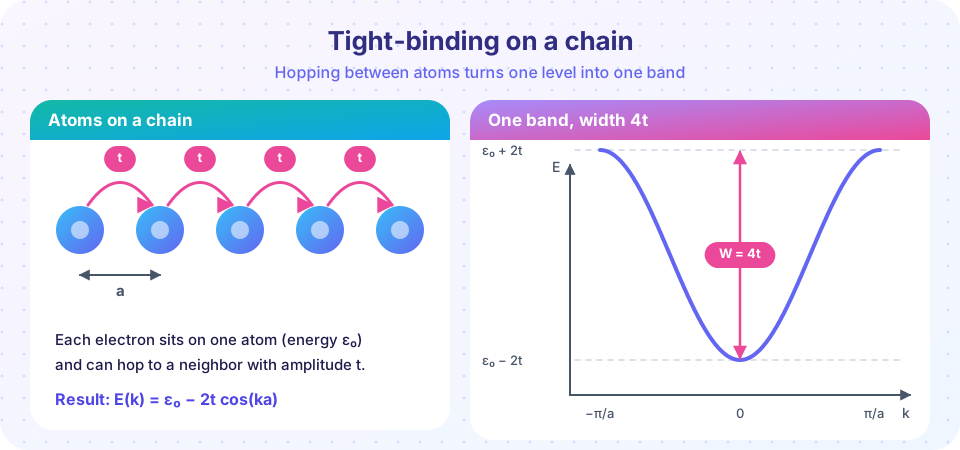
Put one orbital φ(x − na) on each atom n of a chain with spacing a. Write a state as ψ = Σ c_n |n⟩. If an electron on atom n has energy ε₀ and can hop to its two neighbors with amplitude −t, then the Schrödinger equation becomes
E c_n = ε₀ c_n − t (c_(n+1) + c_(n−1))
Bloch's theorem says c_n = e^(ikna). Substituting, e^(ik a) + e^(−ik a) = 2 cos(ka), so
E(k) = ε₀ − 2t cos(ka)
This is one band, with bottom ε₀ − 2t at k = 0, top ε₀ + 2t at k = ±π/a and total width W = 4t. With N atoms there are N values of k, one per orbital, in agreement with the counting rule from the chapter overview. The sign convention: for s orbitals t is positive and the band bottom sits at the zone center. For p orbitals pointing along the chain it flips.
Effective mass. Near the bottom, cos(ka) ≈ 1 − (ka)²/2, so E ≈ ε₀ − 2t + t a² k², and
m* = ħ² / (2 t a²)
Narrow bands (small t) are heavy; wide bands are light. With a = 0.30 nm and t = 1.5 eV, using ħ²/2m₀ = 3.81 eV·Å², m*/m₀ = 3.81 / (1.5 × 9) ≈ 0.28. Velocity: v = (1/ħ) dE/dk = (2ta/ħ) sin(ka), largest in the middle of the band, v_max = 2ta/ħ ≈ 1.4 × 10⁶ m/s for the same numbers. Electrons at the very top or bottom of the band have zero velocity, even though they carry crystal momentum.
Higher dimensions
On a square lattice with hopping t between nearest neighbors, E(k) = ε₀ − 2t(cos kxa + cos kya). The bandwidth is 8t; the band bottom is at k = 0, the top at (π/a, π/a), and at the energy ε₀ the constant-energy contour is a square in the zone, which has a van Hove singularity in the density of states. In three dimensions a simple cubic lattice has W = 12t. In general W = 2zt where z is the number of nearest neighbors.
Two atoms per cell
Now alternate the hopping along the chain: t₁ inside a cell and t₂ between cells. The unit cell has two sites, so there are two bands. The Bloch Hamiltonian is a 2 × 2 matrix with off-diagonal element −(t₁ + t₂ e^(−ika)), and the energies are
E±(k) = ε₀ ± |t₁ + t₂ e^(−ika)| = ε₀ ± sqrt(t₁² + t₂² + 2 t₁ t₂ cos ka)
At the edge of the (now smaller) zone, k = π/a, the square root equals |t₁ − t₂|. So the bands are separated by a gap Eg = 2|t₁ − t₂| and the gap closes when the hoppings are equal (the uniform chain, whose two bands fold into one cosine band). This is the simplest model of a Peierls distortion: a half-filled chain lowers its energy by dimerizing, which opens a gap at the Fermi level. It is also the Su-Schrieffer-Heeger model, which you will meet again in the chapter on topological matter.
Tight binding is a model, not a first-principles calculation. In practice t and ε₀ are fitted to experiment or to density functional theory. The qualitative lessons (bandwidth set by overlap, gaps from unequal hopping, effective mass from curvature) are robust.
Common misconceptions
"Tight binding means electrons stay on their atoms." Each Bloch state is spread over the whole crystal. Tight binding only says that the basis orbitals are atomic.
"The band shape depends on the number of atoms." The shape E(k) is set by t and ε₀ and the lattice. The number of atoms only sets how many k points fill the curve.
"Narrow bands are bad conductors because the velocity is small." Band narrowness (large m*) lowers the velocity, but conductivity also depends on the scattering time and on how many carriers there are. Very narrow bands are where interactions dominate.
Try it
Press Run (or Ctrl + Enter) to see the result here.
Program input · what you'd type while the program runs
Type the answers before you press Run, one per line. Each time the program reads a line (with input()), it gets the next line from this box.
Press Run (or Ctrl + Enter) to see the result here.
Program input · what you'd type while the program runs
Type the answers before you press Run, one per line. Each time the program reads a line (with input()), it gets the next line from this box.
Check your understanding
Quick check · 5 questions
of 5 answered You scored / 5 · perfect!
-
1. The tight-binding band of a chain with nearest-neighbor hopping t has total width
E = ε₀ − 2t cos(ka) runs from ε₀ − 2t to ε₀ + 2t. -
2. The effective mass at the bottom of the chain band is
Expanding the cosine gives E ≈ ε₀ − 2t + t a² k², so ħ²/2m* = t a². -
3. Why does a larger orbital overlap produce a wider band?
Bandwidth is proportional to t, which grows with orbital overlap. -
4. A chain with two sites per cell and hoppings t₁ and t₂ has a gap of
The two bands approach within |t₁ − t₂| of the center at the zone edge, so the gap is 2|t₁ − t₂|. -
5. For a square lattice with nearest-neighbor hopping t the bandwidth is
W = 2zt with z = 4 neighbors.
Summary
- Tight binding builds bands from atomic orbitals with on-site energy ε₀ and hopping −t.
- A chain gives E(k) = ε₀ − 2t cos(ka), bandwidth 4t and m* = ħ²/(2ta²) at the bottom.
- Bandwidth is 2zt for z nearest neighbors; overlap controls t.
- Two sites per cell with unequal hopping give two bands and a gap 2|t₁ − t₂|.
Next: Chapter review
Track your progress
Create a free account to tick off lessons and pick up where you left off on any device.
of Condensed Matter Physics lessons completed