


















Lesson 39 of 46 · Modern Topics
Graphene, Dirac electrons and twisted layers
Derive the graphene band structure from tight binding, find the Dirac cone and Fermi velocity of about 10^6 m/s, see relativistic Landau levels and meet the magic-angle twisted bilayer.
Graphite is a stack of carbon sheets held together by weak forces. For decades a single sheet, one atom thick, was assumed to be thermodynamically unstable and a mere theoretical device: Philip Wallace used it in 1947 as a first step to understand graphite's bands. In 2004 Andre Geim and Konstantin Novoselov peeled a flake off graphite with adhesive tape, put it on a silicon wafer and measured its electrical properties. The electrons turned out to behave in a way no ordinary metal or semiconductor does: they move as if they had no mass, at a speed about 300 times smaller than light, and obey a Dirac-like equation. The work won the 2010 Nobel Prize in Physics.
What you will learn
- How the honeycomb lattice leads, by tight binding, to E(k) = ±t|f(k)|.
- Why the bands touch linearly at the K points, and how to compute v_F.
- How Landau levels in graphene differ from those of ordinary electrons.
- What a magic-angle twisted bilayer is and why it is interesting.
Key terms
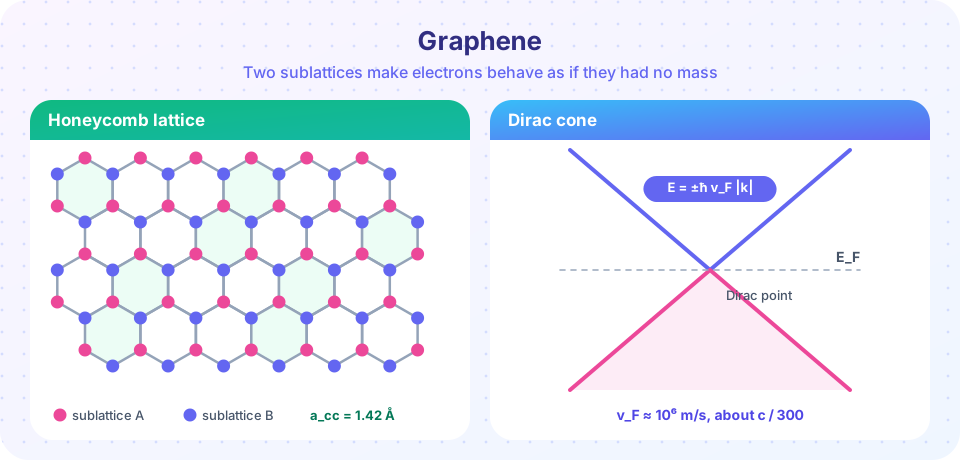
Honeycomb lattice: a triangular Bravais lattice with a two-atom basis (sublattices A and B), bond length a_cc = 1.42 Å, lattice constant a = √3 a_cc = 2.46 Å.
Dirac point: a k-point (K or K′) where the conduction and valence bands touch.
Fermi velocity v_F: the slope of the linear dispersion, E = ħ v_F |k − K|.
Moiré pattern: the long-period interference pattern of two slightly rotated or mismatched lattices.
Tight binding on the honeycomb lattice
Each carbon atom has one electron in a p_z orbital perpendicular to the sheet (the other three form the σ bonds). With one orbital per atom and hopping t ≈ 2.7 eV between nearest neighbors, there are two atoms per unit cell, so the Bloch Hamiltonian is a 2 × 2 matrix with off-diagonal element −t f(k), where f(k) = 1 + e^(−ik·a₁) + e^(−ik·a₂) and the lattice vectors are a₁ = a(1, 0), a₂ = a(1/2, √3/2). The two bands are
E±(k) = ± t |f(k)|
At the zone center Γ, f = 3 and E = ±3t. At the corners of the hexagonal Brillouin zone, K = (4π/3a, 0) and K′, f = 0: the bands touch. At the M point E = ±t. The Fermi level in neutral graphene is exactly at E = 0 because each carbon contributes one electron to the π bands, filling the lower band entirely, so the Fermi surface shrinks to the six corner points. Near K, expand f(K + q) ≈ −(√3/2) a (q_x − i q_y) up to a phase, so
E = ± ħ v_F |q|, with v_F = √3 t a / (2ħ) = 3 t a_cc / (2ħ)
With t = 2.7 eV and a = 2.46 Å this gives v_F ≈ 8.7 × 10⁵ m/s; experiments give about 10⁶ m/s, roughly c/300. The relation E = ħ v_F |q| is the energy of a massless relativistic particle with the speed of light replaced by v_F: electrons in graphene obey the 2D massless Dirac equation, where the two-component wave function lives on the A and B sublattices (a "pseudospin"). The two inequivalent corners K and K′ give a valley degeneracy of 2, and spin gives another 2, so the degeneracy is 4.
Consequences
- Berry phase π. Moving once around a Dirac point rotates the pseudospin by 2π and gives the electron wave function a phase π. This suppresses backscattering by smooth potentials and produces a half-integer quantum Hall sequence σ_xy = ±4(n + 1/2) e²/h, the hallmark of graphene (observed in 2005).
- Linear density of states. g(E) ∝ |E| vanishes at the Dirac point; carrier density n ∝ E_F², so v_F-based quantities scale with sqrt(n).
- Minimum conductivity. Even at charge neutrality, a clean sheet conducts, with σ of order e²/h per channel.
- Universal optical absorption. A single sheet absorbs a fraction πα ≈ 2.3 percent of incident light across the visible spectrum, set by the fine-structure constant α alone.
- Klein tunneling. Electrons at normal incidence pass through potential barriers with unit transmission, because the barrier turns electrons into holes that continue to propagate.
Landau levels of Dirac electrons
In a magnetic field the Landau levels of ordinary electrons are equally spaced, E_n = ħω_c(n + 1/2). For massless Dirac electrons they are not:
E_n = sgn(n) v_F sqrt(2 e ħ B |n|), n = 0, ±1, ±2, …
There is a level at exactly E = 0 shared by electrons and holes, and spacings that shrink as 1/sqrt(n) at high n. For v_F = 10⁶ m/s and B = 10 T, E₁ ≈ 115 meV, large enough that the quantum Hall effect in graphene survives to room temperature in strong fields.
A gap and a twist
A gap can be opened by breaking the equivalence of sublattices (graphene on hexagonal boron nitride), by confining electrons in narrow nanoribbons, or by applying a perpendicular electric field to bilayer graphene. A different idea appeared in 2011 when Bistritzer and MacDonald predicted that two graphene sheets rotated by a small magic angle, about 1.1°, would form a long-period moiré pattern in which the Dirac cones flatten into narrow bands. In 2018 Cao, Jarillo-Herrero and colleagues at MIT found that such samples show correlated insulating states and superconductivity at about 1.7 K. Because the band is flat, the kinetic energy is small and interactions dominate: the system is a tunable playground for strongly correlated physics that is still being explored.
Common misconceptions
"The electrons in graphene travel at the speed of light." They behave like massless particles, but with a velocity v_F ≈ c/300; the relation E = ħ v_F |q| is an effective description valid at low energy.
"Graphene is a metal." It has no Fermi surface at neutrality, only points; it is a semimetal whose carrier density can be varied continuously, from electrons to holes, with a gate.
"Magic-angle graphene is superconducting because of phonons, like BCS." The pairing mechanism is still debated.
Try it
Press Run (or Ctrl + Enter) to see the result here.
Program input · what you'd type while the program runs
Type the answers before you press Run, one per line. Each time the program reads a line (with input()), it gets the next line from this box.
Press Run (or Ctrl + Enter) to see the result here.
Program input · what you'd type while the program runs
Type the answers before you press Run, one per line. Each time the program reads a line (with input()), it gets the next line from this box.
Check your understanding
Quick check · 6 questions
of 6 answered You scored / 6 · perfect!
-
1. Graphene has two carbon atoms per unit cell. The resulting number of π bands is
One p_z orbital per atom gives a 2 × 2 Hamiltonian and two bands. -
2. At the K point of graphene's Brillouin zone
f(K) = 0, so E± = 0 and the bands touch in a Dirac cone. -
3. The Fermi velocity of graphene is about
v_F ≈ 3ta_cc/(2ħ) ≈ 10⁶ m/s, about c/300. -
4. Landau levels of graphene scale with level index n as
E_n = v_F sqrt(2eħB n) for massless Dirac electrons. -
5. The magic angle of twisted bilayer graphene is about
At this angle the moiré bands become nearly flat. -
6. Neutral graphene has its Fermi level
One electron per atom fills the lower π band exactly, leaving the Fermi level at the touching point.
Summary
- Tight binding on the honeycomb lattice gives E = ±t|f(k)| with Dirac cones at the K points.
- Near K the dispersion is linear, E = ħ v_F |q|, with v_F = √3 t a/(2ħ) ≈ 10⁶ m/s.
- Dirac electrons have Berry phase π, half-integer quantum Hall plateaus and Landau levels ∝ sqrt(nB).
- Twisting two layers by about 1.1° flattens the bands and produces correlated phases and superconductivity.
Next: Chapter review
Track your progress
Create a free account to tick off lessons and pick up where you left off on any device.
of Condensed Matter Physics lessons completed