


















Lesson 46 of 46 · Projects and Practice
Where to go next: further study in condensed matter
A roadmap for continuing after this course: statistical mechanics, advanced quantum mechanics, semiconductor devices, materials science and how to read research papers.
You now have a working picture of how electrons behave in solids: bands and gaps, carriers and doping, magnetism and superconductivity, and the geometric ideas that protect quantized responses. Condensed matter physics is the largest branch of physics by number of researchers, and every topic in this course opens onto a bigger field. This page suggests where to go, in an order that follows what the physics demands.
What you will learn
- Which prerequisites unlock the next level of the subject.
- Which tracks on this site cover them.
- How to start reading research papers without drowning.
Key terms
Many-body physics: the study of systems of many interacting particles, where emergent behavior (superconductivity, magnetism) appears.
Second quantization: a formalism that describes many-particle states by creation and annihilation operators.
Density functional theory (DFT): a computational method that finds electronic structure from the electron density.
Review article: a survey of a field written by experts; the best entry point to the literature.
The roadmap
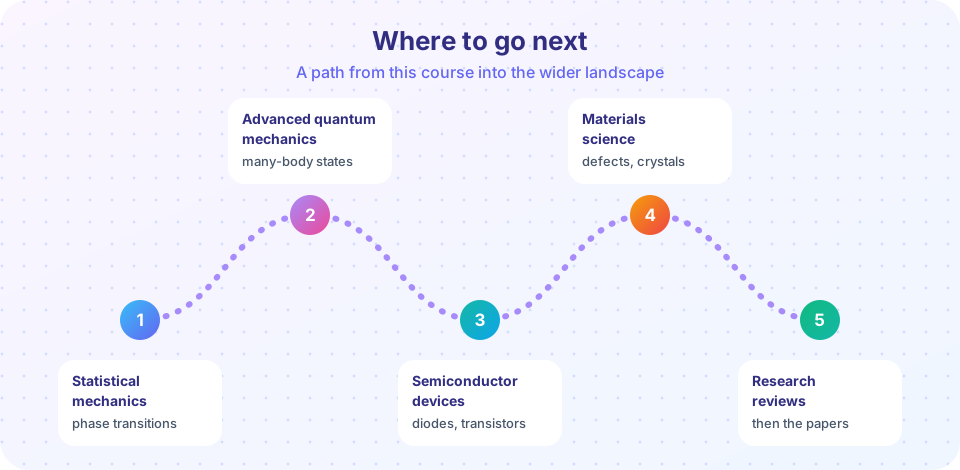
- Statistical mechanics gives the language of phase transitions, order parameters, critical exponents and fluctuations, which this course used informally (Curie temperature, mean field, Fermi-Dirac distribution). See the statistical mechanics track.
- Advanced quantum mechanics supplies second quantization, perturbation theory, Green's functions and the many-body methods behind BCS theory and the Fermi liquid. See the advanced quantum mechanics track, and if the basics of wave mechanics feel rusty, the quantum mechanics track.
- Semiconductor devices applies chapter 6 to diodes, transistors, solar cells and LEDs, adding junction capacitance, MOS structures and device scaling. See the semiconductor devices track.
- Materials science connects the electronic picture to real crystals: defects, alloys, phase diagrams, mechanical and thermal behavior. See the materials science track. For the electromagnetic side of magnetism and superconductors, see the electrodynamics track.
- Research reviews are the last step: choose one topic from this course and read a recent review on it.
Topics worth exploring from here
- Many-body and strongly correlated systems: Mott insulators, heavy fermions, high-T_c cuprates, the Hubbard model, quantum spin liquids.
- Topological matter beyond what you saw: Weyl and Dirac semimetals, higher-order topological insulators, topological superconductors and Majorana modes.
- Low-dimensional and 2D materials: transition-metal dichalcogenides, van der Waals heterostructures, moiré physics.
- Quantum devices: superconducting qubits, spin qubits, quantum dots and single-electron transistors.
- Computational methods: density functional theory, Wannier functions, exact diagonalization and quantum Monte Carlo.
How to read a research paper
- Read the title, abstract and last paragraph of the introduction first: what is the question and what is claimed?
- Look at every figure and its caption before reading the text.
- Identify the experiment or model: what is measured or calculated, and what is the control parameter?
- Read the discussion and ask which claims are supported by the data and which are interpretation.
- Look up each unfamiliar term in a review article, not in a chain of other papers.
- Write a one-paragraph summary in your own words and check whether it makes a testable prediction.
Good starting points are free review articles in journals such as Reviews of Modern Physics and Annual Review of Condensed Matter Physics, and lecture notes from university courses posted by the authors.
Common misconceptions
"I have to master all of quantum field theory first." You can do a great deal of condensed matter physics with the tools of this course plus second quantization. Field theory methods become useful for critical phenomena and strongly correlated systems.
"Computation replaces theory." Numerical methods such as DFT are powerful, but they need physical understanding to choose the right model and to interpret the output.
Try it
Press Run (or Ctrl + Enter) to see the result here.
Program input · what you'd type while the program runs
Type the answers before you press Run, one per line. Each time the program reads a line (with input()), it gets the next line from this box.
Check your understanding
Quick check · 4 questions
of 4 answered You scored / 4 · perfect!
-
1. Which prerequisite gives the language of phase transitions and order parameters?
Phase transitions, mean-field theory and fluctuations are central topics of statistical mechanics. -
2. Second quantization is mainly used to
It is the standard formalism for many-body physics. -
3. When approaching a new research paper, you should first
The abstract and figures tell you the question and the central claim. -
4. Which method is used to compute electronic structure from the electron density?
DFT is the workhorse of computational materials science.
Summary
- Statistical mechanics, advanced quantum mechanics, devices and materials science are the natural next tracks.
- Strongly correlated electrons, topological matter, 2D materials and quantum devices are active frontiers.
- Read research by starting from reviews, abstracts and figures.
- Keep checking numbers against typical values, as in this course.
You have reached the end of the course. Return to the Condensed Matter Physics course page any time to revisit a chapter.
Track your progress
Create a free account to tick off lessons and pick up where you left off on any device.
of Condensed Matter Physics lessons completed