


















Lesson 37 of 46 · Modern Topics
Chapter 8 overview: topology, Dirac materials and twisted layers
A guided preview of modern condensed matter physics: quantum Hall plateaus, topological insulators, graphene's Dirac electrons and twisted bilayers, and how they extend band theory.
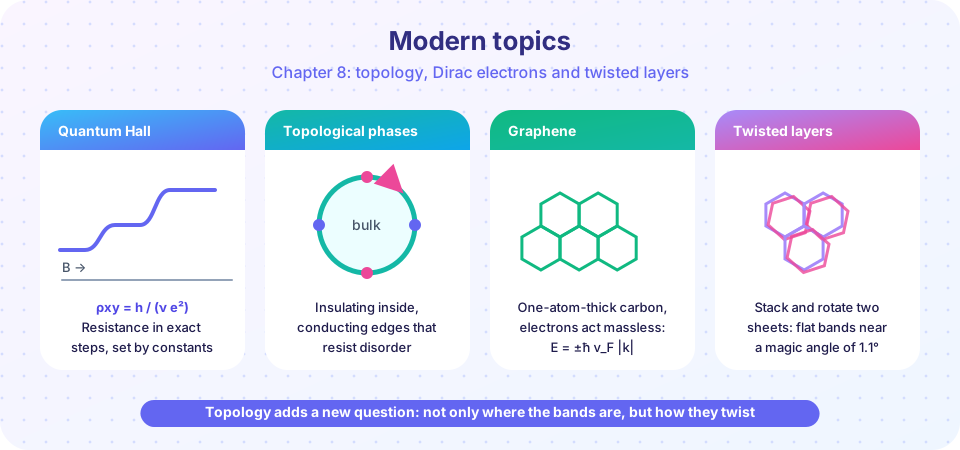
Band theory classifies crystals by where the bands are and how they are filled. Since the 1980s physicists realized that bands also have a hidden geometry: the way the Bloch wave functions twist as k moves around the Brillouin zone. Two insulators with identical gaps can differ in a global, integer-valued property that cannot change unless the gap closes. This is topology, and it has produced new states of matter whose properties (exact quantized resistance, edge currents that ignore impurities) are protected by mathematics rather than by fine-tuning. In the same period a single sheet of carbon turned out to host electrons that mimic massless particles. This chapter introduces both ideas.
What you will learn
- What the quantum Hall effect is and why its resistance is quantized.
- What a topological insulator is and why its edge conducts.
- Why graphene's electrons obey a linear, Dirac-like dispersion.
- Why twisting two layers by a magic angle creates flat bands.
Key terms
Landau level: a quantized energy level of an electron in a magnetic field, E_n = ħω_c(n + 1/2).
Chern number: an integer built from the Berry curvature of a band; it equals the quantized Hall conductance in units of e²/h.
Edge state: a conducting state localized at the boundary of a topological insulator.
Dirac point: the point in k-space where conduction and valence bands touch linearly.
Four ideas
Quantum Hall effect
von Klitzing, 1980.
Topological insulators
Graphene
Geim and Novoselov, 2004.
Twisted layers
What each lesson covers
- The quantum Hall effect and topological phases: Landau levels, the Hall plateaus, edge channels, Chern numbers and an edge-state model you can run.
- Graphene and Dirac electrons: the honeycomb tight-binding band, the Dirac cone, the Fermi velocity and Landau levels of massless electrons.
- Chapter review: formulas and ten questions.
The unifying idea
In all four stories a physical observable is protected by a global property. A quantized Hall conductance cannot change by a small perturbation because an integer cannot change by a small amount. An edge state in a topological insulator cannot be gapped out by disorder because that would require changing the bulk invariant. The linear touching of two bands at a Dirac point in graphene is protected by a combination of symmetries and carries a Berry phase of π, which shows up in an anomalous sequence of quantum Hall plateaus. The study of such properties led to the Nobel Prizes in 1985 (von Klitzing), 1998 (Tsui, Störmer, Laughlin), 2010 (Geim, Novoselov) and 2016 (Thouless, Haldane, Kosterlitz).
Common misconceptions
"Topological means the sample has a nontrivial shape." Here it refers to the wave functions in momentum space, not to the geometry of the sample.
"Edge states are the same as surface states from dangling bonds." Ordinary surface states can be removed by modifying the surface; a topological edge state is guaranteed to exist as long as the bulk gap remains open and the protecting symmetry holds.
"Graphene is a semiconductor." It has no gap at the Dirac point, so it is a semimetal (zero-gap semiconductor).
Try it
Press Run (or Ctrl + Enter) to see the result here.
Program input · what you'd type while the program runs
Type the answers before you press Run, one per line. Each time the program reads a line (with input()), it gets the next line from this box.
Press Run (or Ctrl + Enter) to see the result here.
Program input · what you'd type while the program runs
Type the answers before you press Run, one per line. Each time the program reads a line (with input()), it gets the next line from this box.
Check your understanding
Quick check · 4 questions
of 4 answered You scored / 4 · perfect!
-
1. What kind of quantity is a Chern number?
It is the integral of the Berry curvature over the Brillouin zone divided by 2π. -
2. Graphene is best described as
The valence and conduction bands touch at the Dirac points. -
3. Why does the edge of a topological insulator conduct?
The interface between a topological and a trivial region must close the gap. -
4. The Nobel Prize in Physics 2016 recognized work on
Thouless, Haldane and Kosterlitz were honored for topological phases and phase transitions.
Summary
- Band geometry (Berry phase, Chern number) gives properties protected by topology.
- The quantum Hall effect, topological insulators, graphene and twisted layers are the main examples of this chapter.
- Protected properties include quantized resistance and conducting edges that ignore disorder.
- The next lessons work the quantum Hall effect and graphene in detail.
Track your progress
Create a free account to tick off lessons and pick up where you left off on any device.
of Condensed Matter Physics lessons completed