


















Lesson 16 of 46 · Free Electron Model
Chapter 4 overview: The free electron model
Why a gas of non-interacting quantum electrons explains metals: Drude, Sommerfeld, Fermi energy, density of states and the Hall effect, with a Pauli-filling demo.
Metals conduct electricity and heat extraordinarily well. Copper wire carries a current density of 10⁶ A/m² without complaint, and a copper spoon in hot tea burns your fingers within seconds. Something in the metal is free to move, and in 1900 Paul Drude suggested what: the outer electrons of each atom detach and wander through the crystal as a gas.
The idea is crude, since it ignores both the ion lattice and the repulsion between the electrons. Yet it works astonishingly well, once the electrons obey the right statistics. This chapter builds the model in two stages (Drude's classical gas, then Sommerfeld's quantum gas) and tests it against measurements.
What you will learn
- The assumptions of the free electron model and why they are plausible.
- How Pauli exclusion changes the classical picture.
- What the model explains (conductivity, Hall effect, heat capacity) and where it fails.
- The roadmap of the four lessons in this chapter.
Key terms
Conduction electrons: the outer (valence) electrons that are free to move through the metal.
Fermi energy E_F: the highest occupied one-electron energy at T = 0.
Fermi-Dirac distribution: the occupation probability of a state of energy E for fermions.
Relaxation time τ: the average time between collisions of an electron, about 10⁻¹⁴ s in a good metal.
The model
The free electron model makes four assumptions:
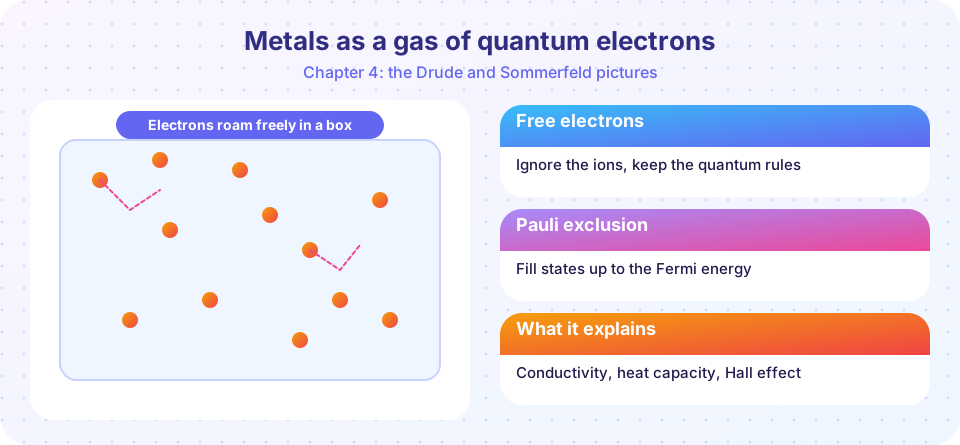
- Each atom gives up its valence electrons (one for Na, Cu and Au; two for Mg; three for Al) to a common gas of density n.
- The electrons ignore the periodic potential of the ions, treating them as a uniform background that keeps the metal neutral.
- The electrons do not interact with one another (the independent electron approximation).
- Electrons scatter occasionally, characterized by τ.
Typical densities are n = 10²⁸ to 10²⁹ m⁻³, hundreds of times the density of molecules in a gas and comparable to the density of atoms in a solid. This is a dense gas. Classically such a gas at 300 K would have electrons moving at around 10⁵ m/s. The quantum treatment will show that the electrons' typical speed is actually about 10⁶ m/s even at absolute zero.
Two stages
Drude (1900) treated electrons as classical particles of a gas, colliding at random. It gave Ohm's law, σ = ne²τ/m, a correct Hall coefficient and the Wiedemann-Franz law relating thermal and electrical conductivity. But it predicted a heat capacity from electrons about 60 times larger than observed at room temperature, an embarrassing failure.
Sommerfeld (1927) applied Fermi-Dirac statistics. Because of the exclusion principle, electrons occupy states from the bottom upward, filling a Fermi sea of k-space up to the Fermi energy, typically several eV. Only electrons within about k_BT of the Fermi energy can be thermally excited, a fraction of order T/T_F ~ 1%. That gives the right, small electronic heat capacity, and lets the model's successes from Drude survive.
A gas of electrons
Drude: classical
Sommerfeld: quantum
What it explains
What this chapter covers
- The Fermi gas and the Fermi energy: k-space filling, k_F, E_F, T_F and the Fermi velocity for real metals.
- Density of states and electronic heat: g(E) ∝ √E, the Fermi-Dirac distribution and the linear heat capacity.
- Drude transport and the Hall effect: conductivity, mobility, the Hall coefficient and the Wiedemann-Franz law.
- Chapter 4 review: summary and quiz.
Common misconceptions
"Electrons in a metal move slowly because the drift speed is mm/s." The drift speed (response to a field) is tiny, but each electron moves at the Fermi velocity, about 10⁶ m/s, in random directions.
"The free electron model ignores the lattice entirely." The lattice enters through the relaxation time τ and later through energy bands (Chapter 5), but the electrons are treated as if the periodic potential were absent.
Try it
Press Run (or Ctrl + Enter) to see the result here.
Program input · what you'd type while the program runs
Type the answers before you press Run, one per line. Each time the program reads a line (with input()), it gets the next line from this box.
Check your understanding
Quick check · 4 questions
of 4 answered You scored / 4 · perfect!
-
1. The Drude model treats conduction electrons as
Drude (1900) used kinetic theory: free classical particles scattering with relaxation time τ. -
2. Which concept fixes the heat-capacity problem of the Drude model?
Only electrons within about k_BT of the Fermi energy can be excited, so the electron heat capacity is small. -
3. A typical conduction-electron density in a metal is
About one free electron per atom, with 10²⁸ to 10²⁹ atoms per m³. -
4. How many electrons can share one spatial energy level in the box demo?
Two, with opposite spins, according to the Pauli exclusion principle.
Summary
- The free electron model treats valence electrons as a gas moving in a uniform background of ions.
- Drude's classical version explains Ohm's law and Hall coefficients but fails for heat capacity.
- Sommerfeld's quantum version fills states up to E_F (a few eV), leaving only a fraction T/T_F excitable.
- The chapter develops k_F, E_F, the density of states, electronic heat and transport.
Track your progress
Create a free account to tick off lessons and pick up where you left off on any device.
of Condensed Matter Physics lessons completed