


















Lesson 43 of 46 · Projects and Practice
Practice problem set: bands, semiconductors, magnetism, superconductors
Thirteen worked problems on tight binding, band gaps, doping, p-n junctions, the Hall effect, Curie law, London depth, BCS gap, Josephson frequency and the quantum Hall effect.
Reading about physics and solving problems are different skills. Below are thirteen problems that cover chapters 5 to 8, each with a short worked answer. Try each one on paper first, then check your result against the answer, and finally run the script in the first TryIt to verify the numbers with code.
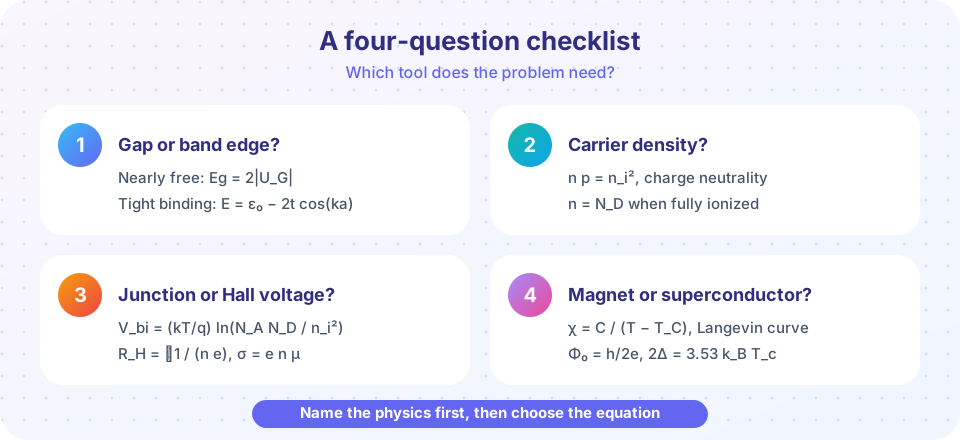
What you will learn
- How to choose the right model for a problem and carry units through a calculation.
- How to sanity-check numbers against typical values.
- How to verify hand calculations with a short script.
How to attack a problem
- Write down the physical quantity asked for and its units.
- Name the physics: gap or band (chapter 5), carriers (chapter 6), magnet or superconductor (chapter 7), topology or graphene (chapter 8).
- Write the formula before you put numbers in.
- Convert units once (cm⁻³ to m⁻³, eV to J) and keep track of powers of ten.
- Check the order of magnitude against something you know: kT = 25.85 meV at 300 K, n_i(Si) about 10¹⁰ cm⁻³.
The problems
1. Tight-binding chain. A chain with spacing a = 0.30 nm has hopping t = 1.5 eV. Find (a) the bandwidth and (b) the effective mass at the band bottom in units of m₀. Use ħ²/2m₀ = 3.81 eV·Å².
2. Nearly free electrons. The Fourier component of a crystal potential at the first reciprocal lattice vector is U_G = 0.8 eV. What is the gap at the zone boundary?
3. Doped silicon. N_D = 5 × 10¹⁵ cm⁻³ in silicon at 300 K (n_i = 10¹⁰ cm⁻³, kT = 25.85 meV). Find p and E_F − E_i.
4. Junction. A silicon p-n junction has N_A = 10¹⁸ cm⁻³ and N_D = 10¹⁶ cm⁻³. Find the built-in voltage.
5. Hall bar. A bar of thickness 0.20 mm carries I = 2.00 mA in B = 0.400 T. The Hall voltage is 1.25 mV. Find the carrier density.
6. Paramagnet. Moments of one Bohr magneton in B = 2 T at T = 4 K: find x = μ_B B/kT and the Langevin value L(x).
7. Curie-Weiss. A ferromagnet has T_C = 300 K. By what factor does χ change between 450 K and 350 K?
8. London depth. The superconducting electron density is 4 × 10²⁸ m⁻³. Find λ_L.
9. BCS gap. Niobium has T_c = 9.2 K. Estimate 2Δ(0) in meV.
10. Josephson. A junction is biased at 10 µV. Find the oscillation frequency.
11. SQUID. A loop of area 1 mm² encloses one flux quantum. What field is that?
12. Quantum Hall. A 2DEG has n = 4 × 10¹⁵ m⁻². Find the field for ν = 2 and the Hall resistance there.
13. Graphene. At k = 2 × 10⁸ m⁻¹ from the Dirac point (v_F = 10⁶ m/s), what is the electron energy?
Worked answers
- (a) W = 4t = 6.0 eV. (b) m*/m₀ = (ħ²/2m₀)/(t a²) = 3.81 / (1.5 × 9) = 0.28.
- Eg = 2|U_G| = 1.6 eV.
- n = N_D = 5 × 10¹⁵, p = n_i²/n = 10²⁰/(5 × 10¹⁵) = 2 × 10⁴ cm⁻³. E_F − E_i = kT ln(n/n_i) = 0.02585 × ln(5 × 10⁵) = 0.02585 × 13.12 = 0.339 eV.
- V_bi = kT ln(N_A N_D/n_i²) = 0.02585 × ln(10³⁴/10²⁰) = 0.02585 × ln(10¹⁴) = 0.02585 × 32.24 = 0.833 V.
- n = I B/(e t V_H) = (2 × 10⁻³ × 0.4)/(1.602 × 10⁻¹⁹ × 2 × 10⁻⁴ × 1.25 × 10⁻³) = 2.0 × 10²² m⁻³ (2 × 10¹⁶ cm⁻³).
- x = (9.274 × 10⁻²⁴ × 2)/(1.381 × 10⁻²³ × 4) = 0.336. L(x) = coth x − 1/x = 0.111 (compare x/3 = 0.112).
- χ ∝ 1/(T − T_C): χ(450)/χ(350) = (350 − 300)/(450 − 300) = 1/3.
- λ_L = sqrt(m/(μ₀ n_s e²)) = sqrt(9.109 × 10⁻³¹ / (1.2566 × 10⁻⁶ × 4 × 10²⁸ × 2.566 × 10⁻³⁸)) = 2.66 × 10⁻⁸ m = 26.6 nm.
- 2Δ = 3.53 k_B T_c = 3.53 × 0.08617 meV/K × 9.2 K = 2.80 meV.
- f = 2eV/h = 483.6 MHz/µV × 10 µV = 4.84 GHz.
- B = Φ₀/A = 2.068 × 10⁻¹⁵ / 10⁻⁶ = 2.07 × 10⁻⁹ T = 2.07 nT.
- B = nh/(νe) = 4 × 10¹⁵ × 4.1357 × 10⁻¹⁵ / 2 = 8.27 T; ρ_xy = h/(2e²) = 12 906 Ω.
- E = ħ v_F k = 6.582 × 10⁻¹⁶ eV·s × 10⁶ m/s × 2 × 10⁸ m⁻¹ = 0.132 eV.
Try it
Press Run (or Ctrl + Enter) to see the result here.
Program input · what you'd type while the program runs
Type the answers before you press Run, one per line. Each time the program reads a line (with input()), it gets the next line from this box.
Press Run (or Ctrl + Enter) to see the result here.
Program input · what you'd type while the program runs
Type the answers before you press Run, one per line. Each time the program reads a line (with input()), it gets the next line from this box.
Check your understanding
Quick check · 4 questions
of 4 answered You scored / 4 · perfect!
-
1. What should you do first when you meet an unfamiliar problem?
Naming the physics tells you which model and which units to use. -
2. If you compute n_i for silicon at 300 K and get 10¹⁶ cm⁻³, you should
Known values (about 10¹⁰ cm⁻³) give a quick sanity check. -
3. For problem 7, why is the ratio 1/3?
χ(450)/χ(350) = (350 − 300)/(450 − 300). -
4. Why use a script to check a hand calculation?
A script verifies the arithmetic but not the choice of model.
Summary
- Name the physics, write the formula, convert units once, then compute.
- Compare answers with typical values (kT = 25.85 meV, n_i of silicon, flux quantum, R_K) to catch errors.
- A script is a good checker for arithmetic but cannot choose the model for you.
Next: Glossary
Track your progress
Create a free account to tick off lessons and pick up where you left off on any device.
of Condensed Matter Physics lessons completed