


















Lesson 7 of 46 · Crystal Structure and Diffraction
Cubic structures and packing
Count atoms per cell, coordination number and packing fraction for sc, bcc, fcc, hcp and diamond, and compute the density of copper, iron, aluminum and silicon.
Nature has a surprisingly short list of favorite crystal structures. Most elemental metals are fcc, bcc or hcp, and most of the semiconductors you use crystallize in the diamond or zinc blende form. Why these? Largely because they pack atoms efficiently, balancing the bond energy against the space each atom needs.
In this lesson you will count atoms in a cubic cell, compute how much of the volume is filled, and turn lattice constants into densities you can compare with a handbook.
What you will learn
- How to count atoms in a cubic conventional cell.
- How to find the nearest-neighbor distance and the packing fraction.
- Why fcc and hcp are the densest possible packing of equal spheres.
- How to compute density from lattice constant, atomic mass and structure.
Key terms
Lattice constant (a): the edge length of the conventional cubic cell.
Coordination number: the number of nearest neighbors of an atom.
Packing fraction: the fraction of space filled by hard spheres touching their nearest neighbors.
Close-packed: arrangement of equal spheres with the maximum packing fraction, π/(3√2) = 0.7405.
Counting atoms in a cell
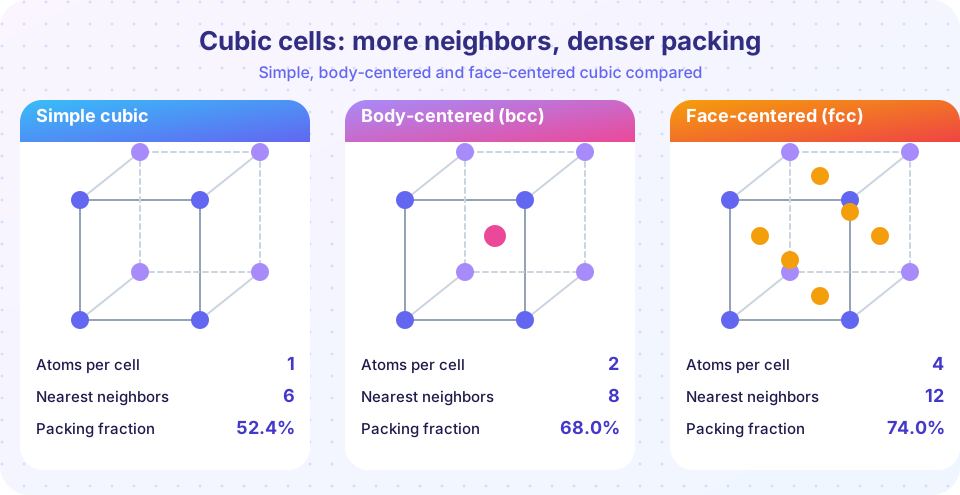
An atom at a corner of the cubic cell is shared by 8 cells, at a face center by 2, and fully inside by 1. So:
- Simple cubic (sc): 8 corners × 1/8 = 1 atom.
- Body-centered cubic (bcc): 8 × 1/8 + 1 = 2 atoms.
- Face-centered cubic (fcc): 8 × 1/8 + 6 × 1/2 = 4 atoms.
Simple cubic is rare because it packs poorly; polonium (α-Po) is the only element that adopts it at ambient conditions. Iron (below 912 °C), chromium, tungsten and the alkali metals are bcc. Copper, aluminum, gold, silver and nickel are fcc.
Nearest neighbors and packing fraction
Model atoms as hard spheres of radius r that touch their nearest neighbors. The touching condition fixes r in terms of the lattice constant a.
| Structure | Touching direction | r in terms of a | Neighbors | Atoms per cell | Packing fraction |
|---|---|---|---|---|---|
| sc | Along an edge | a/2 | 6 | 1 | π/6 = 0.5236 |
| bcc | Along the body diagonal | √3 a/4 | 8 | 2 | π√3/8 = 0.6802 |
| fcc | Along a face diagonal | √2 a/4 | 12 | 4 | π/(3√2) = 0.7405 |
| diamond | Along a quarter body diagonal | √3 a/8 | 4 | 8 | π√3/16 = 0.3401 |
The packing fraction is (atoms per cell) × (4/3 π r³) / a³. For fcc: 4 × (4/3)π (√2 a/4)³ / a³ = π√2/6 = 0.7405. The Kepler conjecture, stated in 1611 and proved by Thomas Hales (announced 1998, formally verified in 2014), says no arrangement of equal spheres can beat this value. hcp, with the stacking sequence ABAB, achieves the same density as fcc, whose stacking is ABCABC. The ideal hcp axial ratio is c/a = √(8/3) ≈ 1.633.
Notice what diamond tells us. Its packing fraction is only 34%, half that of sc. The structure is open because covalent bonds are directional: each carbon atom has just four neighbors at the tetrahedral angle, and the tetrahedral arrangement leaves much empty space. Here the bond type, not space-filling, picks the structure.
From lattice constant to density
Once you know the structure you can predict the mass density:
ρ = Z M / (N_A a³)
with Z atoms per conventional cell, M the molar mass and N_A = 6.022 × 10²³ mol⁻¹. For copper with a = 0.3615 nm and Z = 4: ρ = 4 × 63.546 g/mol / (6.022 × 10²³ × (3.615 × 10⁻⁸ cm)³) ≈ 8.93 g/cm³, matching the handbook value (8.96). Such a check was an early proof that the structure had been assigned correctly, long before atoms could be imaged.
Typical room-temperature lattice constants:
| Material | Structure | a (nm) |
|---|---|---|
| Al | fcc | 0.4050 |
| Cu | fcc | 0.3615 |
| Au | fcc | 0.4078 |
| α-Fe | bcc | 0.2866 |
| Si | diamond | 0.5431 |
| Ge | diamond | 0.5658 |
| NaCl | rock salt (fcc + basis) | 0.5640 |
Common misconceptions
"The densest structure is always the one nature picks." Diamond-structure silicon and germanium are far from dense, because bond directionality matters more than packing.
"bcc has 9 atoms per cell." The center atom is fully inside; the 8 corners contribute 1 atom in total, for 2 atoms per cell.
"The lattice constant is the nearest-neighbor distance." Only for sc. In bcc the nearest distance is √3a/2, and in fcc it is a/√2.
Try it
Press Run (or Ctrl + Enter) to see the result here.
Program input · what you'd type while the program runs
Type the answers before you press Run, one per line. Each time the program reads a line (with input()), it gets the next line from this box.
Check your understanding
Quick check · 5 questions
of 5 answered You scored / 5 · perfect!
-
1. How many atoms does the conventional fcc cell contain?
Eight corners contribute 8 × 1/8 = 1, and six face centers contribute 6 × 1/2 = 3. The total is 4. -
2. What is the packing fraction of the bcc structure?
π√3/8 = 0.680. -
3. Why is the packing fraction of diamond so low?
Tetrahedral bonding with four neighbors leaves lots of empty space. The structure is set by bonding, not packing. -
4. The nearest-neighbor distance in an fcc crystal with lattice constant a is
Nearest neighbors touch along a face diagonal of length √2 a, which holds two atom diameters, so the distance is a/√2. -
5. A cubic crystal has Z = 2, M = 55.845 g/mol and a = 0.2866 nm. What is its approximate density?
ρ = ZM/(N_A a³) = 2 × 55.845 / (6.022 × 10²³ × 2.354 × 10⁻²³) ≈ 7.88 g/cm³, which is iron.
Summary
- Atoms per conventional cell: sc 1, bcc 2, fcc 4, diamond 8.
- Coordination numbers 6, 8, 12 and 4; packing fractions 52.4%, 68.0%, 74.0% and 34.0%.
- fcc and hcp are the densest possible packings of equal spheres (Kepler conjecture, Hales, 1998 and 2014).
- Density = Z M / (N_A a³) links a diffraction measurement to a handbook number.
Next: Miller indices
Track your progress
Create a free account to tick off lessons and pick up where you left off on any device.
of Condensed Matter Physics lessons completed