


















Lesson 32 of 46 · Magnetism and Superconductivity
Diamagnetism and paramagnetism
Derive the Langevin function and the Curie law for paramagnets, estimate diamagnetic susceptibility, and see how the Brillouin function and Pauli paramagnetism refine the picture.
When there is no interaction between atomic moments, the physics of magnetism is the physics of a two-level or many-level system in a field at temperature T. The result is the Curie law, discovered experimentally by Pierre Curie in 1895 and derived by Paul Langevin in 1905. It is a clean example of how statistical mechanics turns a microscopic moment into a macroscopic susceptibility, and it provides the baseline from which ferromagnetism is a departure.
What you will learn
- How to compute the average moment of a classical dipole in a field (the Langevin function).
- How the Curie law χ = C/T and the Curie constant follow.
- The quantum version: the Brillouin function and the effective moment.
- The origin and size of diamagnetism, and the Pauli paramagnetism of metals.
Key terms
Langevin function: L(x) = coth x − 1/x, the average alignment of classical moments, with x = μB/kT.
Curie law: χ = C/T with C = μ₀ N μ²/(3k).
Larmor diamagnetism: the induced moment of orbiting electrons, opposite to the field, χ = −μ₀ N Z e² ⟨r²⟩/(6m).
Pauli paramagnetism: the weak temperature-independent paramagnetism of conduction electrons.
Langevin theory
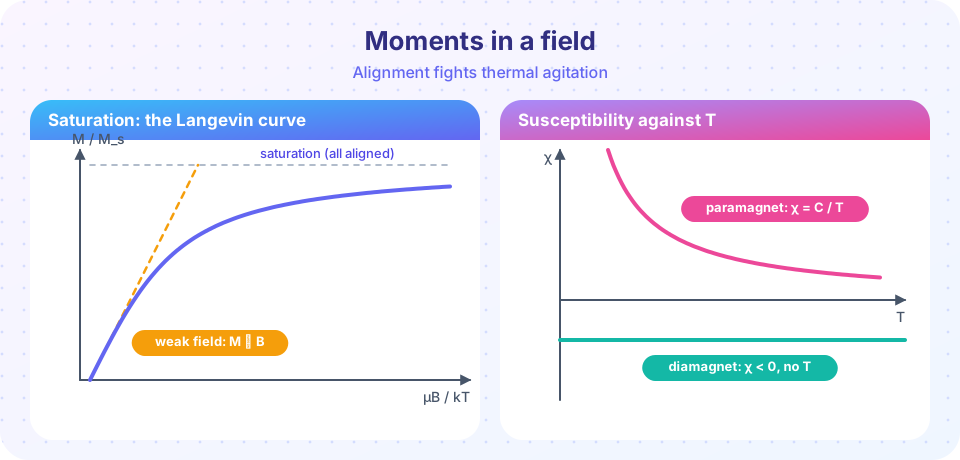
A magnetic moment μ at angle θ to a field B has energy −μB cos θ. At temperature T the Boltzmann weight is exp(μB cos θ/kT). Averaging cos θ over the sphere gives
⟨cos θ⟩ = coth x − 1/x = L(x), with x = μB/kT
so the magnetization of N moments per volume is M = N μ L(x). Two limits:
- Weak field or high T (x ≪ 1): L(x) ≈ x/3, so M = N μ² B/(3kT). With B = μ₀H, χ = M/H = μ₀ N μ²/(3kT) = C/T. The susceptibility is inversely proportional to temperature (Curie law).
- Strong field or low T (x ≫ 1): L(x) → 1, so M → N μ, saturation: all moments aligned.
Numbers. Take N = 10²⁸ m⁻³ and μ = μ_B = 9.274 × 10⁻²⁴ J/T. At 300 K: χ = 4π × 10⁻⁷ × 10²⁸ × (9.274 × 10⁻²⁴)² / (3 × 1.381 × 10⁻²³ × 300) ≈ 8.7 × 10⁻⁵, a typical paramagnetic magnitude. At B = 1 T and 300 K, x = μ_B B/kT = 2.2 × 10⁻³: deep in the linear regime, magnetization is far from saturation. At B = 2 T and T = 4 K, x = 0.336 and L = 0.111, so the sample reaches 11 percent of saturation. To approach saturation you need x of order 5, such as 10 T at 1 K.
The quantum version
Real atoms have quantized moments μ = g_J μ_B J_z with J_z = −J, ..., J. The thermal average over these 2J + 1 levels gives the Brillouin function B_J(x), where x = g_J J μ_B B/kT. For J = 1/2 (g = 2), B_{1/2}(x) = tanh(x): the familiar two-level result. For large J it approaches the Langevin function. The weak-field limit has the same form as Curie's law, with an effective moment μ_eff = g_J μ_B sqrt(J(J + 1)). For example, Mn²⁺ and Fe³⁺ (high-spin d⁵, S = 5/2, g = 2) have μ_eff = 2 sqrt(35/4) μ_B = 5.92 μ_B. Measuring the Curie constant tells you the number of unpaired electrons.
Diamagnetism
Every atom has some diamagnetism. In a field B, the electron orbit precesses at the Larmor frequency ω_L = eB/2m, which gives an induced moment opposing B. For an atom with Z electrons and mean-square radius ⟨r²⟩ (perpendicular to the field), the susceptibility per volume is χ = −μ₀ N Z e² ⟨r²⟩ /(6m). With N = 5 × 10²⁸ m⁻³, Z = 10 and ⟨r²⟩ ≈ (0.5 Å)² this gives χ ~ −10⁻⁵, in line with experiment. It is temperature independent, because the induced moment does not depend on thermal motion. Strongly diamagnetic materials include bismuth (about −1.7 × 10⁻⁴) and pyrolytic graphite (−4.5 × 10⁻⁴ perpendicular to its layers), which can be levitated stably over a lattice of permanent magnets.
Paramagnetism of metals
In a metal, the conduction electrons form a Fermi gas. A field splits the spin-up and spin-down populations by μ_B B each, but only electrons within about μ_B B of the Fermi level can flip. The resulting Pauli paramagnetism is χ_P = μ₀ μ_B² g(E_F), independent of temperature and about 100 times smaller than the Curie value for free moments. The orbital response of the free electron gas, Landau diamagnetism, subtracts one third of it. This is why alkali metals are weakly paramagnetic with nearly temperature-independent susceptibility.
Common misconceptions
"A paramagnet becomes magnetized forever in a field." Without interaction, the magnetization vanishes the moment the field is removed, because thermal motion randomizes the moments again.
"Diamagnetism only appears in atoms without moments." It exists in every atom, but paramagnetism usually wins when permanent moments exist.
"Curie's law holds down to zero temperature." It requires x ≪ 1. At low T the magnetization saturates and interactions between moments take over, which is what leads to ordering.
Try it
Press Run (or Ctrl + Enter) to see the result here.
Program input · what you'd type while the program runs
Type the answers before you press Run, one per line. Each time the program reads a line (with input()), it gets the next line from this box.
Press Run (or Ctrl + Enter) to see the result here.
Program input · what you'd type while the program runs
Type the answers before you press Run, one per line. Each time the program reads a line (with input()), it gets the next line from this box.
Check your understanding
Quick check · 5 questions
of 5 answered You scored / 5 · perfect!
-
1. In the weak-field, high-temperature limit the magnetization of a Langevin paramagnet is
L(x) ≈ x/3 with x = μB/kT, so M ∝ B/T. -
2. The Curie constant C = μ₀ N μ²/(3k) increases when
C depends on N and μ², not on T or B. -
3. For J = 1/2 and g = 2 the Brillouin function reduces to
A two-level system gives M = Nμ tanh(μB/kT). -
4. Diamagnetic susceptibility is typically
Larmor precession of the orbits is not affected by thermal motion. -
5. Pauli paramagnetism of metals is much smaller than Curie paramagnetism because
The Pauli principle blocks deeper electrons from flipping, so the response is reduced by about kT/E_F.
Summary
- A classical moment in a field gives M = Nμ L(μB/kT); at small x this is the Curie law χ = C/T.
- Quantum moments give the Brillouin function and an effective moment g_J μ_B sqrt(J(J + 1)).
- Diamagnetism is a weak, universal, temperature-independent effect from induced orbital currents.
- Conduction electrons contribute a small temperature-independent Pauli paramagnetism.
Next: Ferromagnetism
Track your progress
Create a free account to tick off lessons and pick up where you left off on any device.
of Condensed Matter Physics lessons completed