


















Lesson 36 of 46 · Magnetism and Superconductivity
Chapter 7 review: magnetism and superconductivity
Review chapter 7: Curie and Curie-Weiss laws, Weiss theory, hysteresis, the Meissner effect, London depth, BCS gap, flux quantization and Josephson relations, with ten questions.
This chapter walked from independent moments (paramagnets) through interacting ones (ferromagnets) to the condensation of electron pairs. The formulas share a theme: temperature competes with an energy scale, and order appears when the energy wins. Use this review to consolidate the results and then try the mixed quiz.
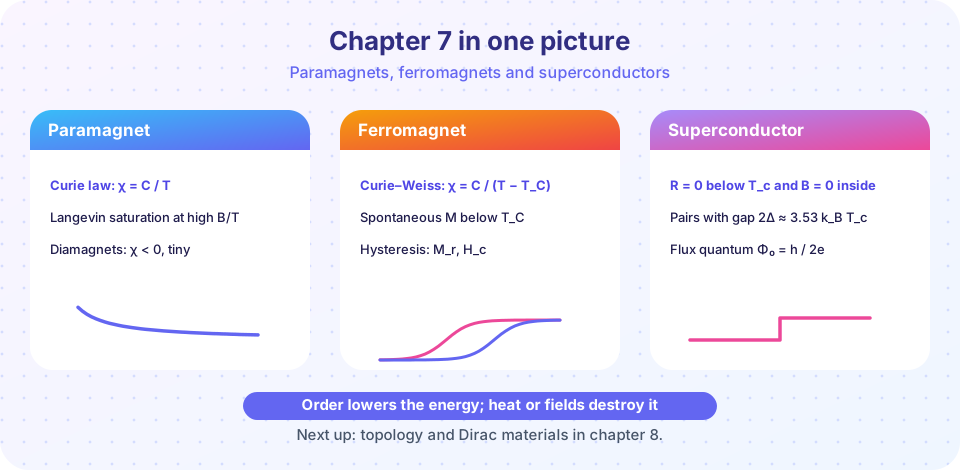
What you should be able to do
- Use the Langevin function and the Curie law to estimate susceptibilities.
- Explain the Weiss molecular field, T_C and the Curie-Weiss law, and read a hysteresis loop.
- Describe the Meissner effect and compute a London penetration depth.
- State the BCS gap relation, the flux quantum and the Josephson relations and apply them numerically.
Recap table
| Topic | Key result | Number to remember |
|---|---|---|
| Bohr magneton | μ_B = eħ/2m | 9.274 × 10⁻²⁴ J/T |
| Curie law | χ = μ₀ N μ² / (3kT) = C/T | χ ≈ 9 × 10⁻⁵ for N = 10²⁸ m⁻³, μ = μ_B, 300 K |
| Langevin function | L(x) = coth x − 1/x, x = μB/kT | L ≈ x/3 for small x |
| Curie-Weiss | χ = C / (T − T_C) | Fe 1043 K, Ni 627 K |
| Mean-field m | m = tanh(m T_C/T) | m ≈ sqrt(3(1 − T/T_C)) near T_C |
| Hysteresis | M_s, M_r, H_c | soft vs hard magnets |
| London depth | λ_L = sqrt(m/(μ₀ n_s e²)) | 53 nm for n_s = 10²⁸ m⁻³ |
| Critical field | H_c(T) = H_c(0)[1 − (T/T_c)²] | Pb: 80 mT at 0 K |
| BCS gap | 2Δ(0) = 3.53 k_B T_c | Nb: ≈ 2.8 meV |
| Flux quantum | Φ₀ = h/2e | 2.068 × 10⁻¹⁵ Wb |
| Josephson | I = I_c sin φ, f = 2eV/h | 483.6 MHz per µV |
Where students go wrong
Confusing T_C and T_c. The Curie temperature of a ferromagnet and the critical temperature of a superconductor are different quantities with similar symbols. Always check which one a problem means.
Applying Curie's law below T_C. Curie-Weiss holds only for T > T_C, and Curie's law only for noninteracting moments with μB ≪ kT.
Forgetting that superconductors are not just conductors. The Meissner effect is what distinguishes a superconductor from a hypothetical perfect conductor.
Try it
Press Run (or Ctrl + Enter) to see the result here.
Program input · what you'd type while the program runs
Type the answers before you press Run, one per line. Each time the program reads a line (with input()), it gets the next line from this box.
Check your understanding
Quick check · 10 questions
of 10 answered You scored / 10 · perfect!
-
1. A Curie paramagnet has χ = 1.2 × 10⁻⁴ at 300 K. At 150 K its susceptibility is about
χ ∝ 1/T, so halving T doubles χ. -
2. A ferromagnet has T_C = 300 K. The ratio χ(450 K)/χ(350 K) from the Curie-Weiss law is
χ ∝ 1/(T − T_C): (350 − 300)/(450 − 300) = 1/3. -
3. Exchange rather than dipole interaction explains ferromagnetism because exchange energies are about
Exchange arises from the Pauli principle and the Coulomb energy, about 1000 times larger. -
4. Which loop has the largest energy loss per cycle?
The enclosed area is the energy dissipated per cycle per unit volume. -
5. A superconducting sphere in a weak field has inside the bulk
The Meissner effect expels the field except for a thin surface layer. -
6. λ_L for n_s = 4 × 10²⁸ m⁻³ is about
λ_L ∝ n_s^(−1/2); 53 nm × (1/2) = 26.6 nm. -
7. For Nb with T_c = 9.2 K, the weak-coupling gap 2Δ is about
3.53 × 0.0862 meV/K × 9.2 K ≈ 2.8 meV. -
8. A Josephson junction at 10 µV oscillates at about
f = 483.6 MHz/µV × 10 µV = 4.84 GHz. -
9. The isotope effect points to which pairing glue?
T_c ∝ M^(−1/2) matches the dependence of lattice vibration frequencies. -
10. In a type II superconductor between H_c1 and H_c2 the field enters as
Each vortex carries one flux quantum Φ₀.
Summary
- Paramagnets obey the Curie law; ferromagnets obey Curie-Weiss above T_C and order below it.
- Superconductors have zero resistance and expel flux; London theory gives the penetration depth.
- BCS pairing gives a gap 2Δ = 3.53 k_B T_c and quantized flux h/2e; Josephson junctions give I = I_c sin φ.
- The final content chapter turns to topology and Dirac materials.
Track your progress
Create a free account to tick off lessons and pick up where you left off on any device.
of Condensed Matter Physics lessons completed