


















Lesson 42 of 46 · Projects and Practice
Project: carrier density against temperature
Solve charge neutrality for doped silicon from 20 K to 900 K with Python and find the freeze-out, extrinsic and intrinsic regimes, the Fermi level and the Hall coefficient.
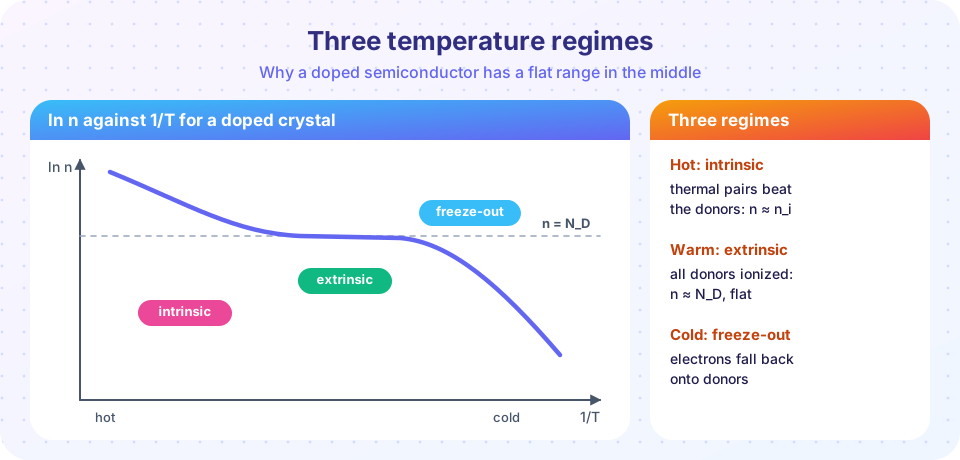
The most famous plot in semiconductor physics shows the carrier density of a doped crystal against inverse temperature. It has three regimes: freeze-out at low temperature, a flat extrinsic plateau, and an exponential intrinsic rise at high temperature. In this project you will compute that curve yourself by solving a single equation, charge neutrality, at each temperature. You will use the effective densities of states from chapter 6, the donor level of phosphorus and the temperature-dependent gap of silicon.
What you will learn
- How to set up the charge-neutrality equation with partial donor ionization.
- How to solve it numerically with a root finder at each temperature.
- How to identify the three regimes and the temperature where each ends.
- How to compute the Fermi level and the Hall coefficient from the result.
Key terms
Charge neutrality: p + N_D⁺ = n (for donors only): total positive charge equals total negative charge.
Ionized donor density: N_D⁺ = N_D / (1 + 2 exp((E_F − E_d)/kT)), where the factor 2 comes from spin degeneracy of the donor level.
Freeze-out: the regime where thermal energy is too low to ionize donors, so n is much less than N_D.
Varshni formula: E_g(T) = E_g(0) − αT²/(T + β), an empirical fit to the temperature dependence of the gap.
The model
Measure energies from the top of the valence band, E_v = 0, so E_c = E_g(T). For silicon use E_g(T) = 1.17 − 4.73 × 10⁻⁴ T²/(T + 636) eV, which gives 1.12 eV near 300 K. The effective densities of states scale as T^(3/2): N_c = 2.8 × 10¹⁹ (T/300)^(3/2) cm⁻³ and N_v = 1.04 × 10¹⁹ (T/300)^(3/2) cm⁻³. A phosphorus donor sits E_d = 0.045 eV below the conduction band. In the Boltzmann approximation
n = N_c exp((E_F − E_c)/kT), p = N_v exp(−E_F/kT), N_D⁺ = N_D / (1 + 2 exp((E_F − E_c + E_d)/kT))
and the Fermi level E_F is whatever makes p + N_D⁺ − n = 0. The function of E_F is monotonic (positive far below the gap, negative far above), so a bracketing root finder always succeeds.
Press Run (or Ctrl + Enter) to see the result here.
Program input · what you'd type while the program runs
Type the answers before you press Run, one per line. Each time the program reads a line (with input()), it gets the next line from this box.
Reading the result
The curve for N_D = 10¹⁶ cm⁻³ shows what theory predicts. At room temperature n ≈ N_D, a flat plateau. Below roughly 100 K the donors begin to freeze out: with E_d = 45 meV and kT falling to a few meV, electrons fall back onto the donors and n drops exponentially with an activation energy of about E_d/2 (when there are no compensating acceptors). At high temperature n_i exceeds N_D: the curve merges with the intrinsic line, with slope −E_g/2k. The Fermi level starts near the donors at low T, approaches the middle of the gap as the sample becomes intrinsic. A lightly doped sample (N_D = 10¹⁴) becomes intrinsic at a much lower temperature, because n_i reaches 10¹⁴ cm⁻³ earlier.
The Hall coefficient is then R_H = −1/(n e) in the n-type regimes. Plotting it against T on a log scale is a standard characterization measurement: the slope in the freeze-out range gives E_d, and the slope in the intrinsic range gives E_g.
Extensions
- Add acceptors N_A and compensate: the charge equation becomes p + N_D⁺ = n + N_A⁻ with N_A⁻ = N_A/(1 + 4 exp((E_a − E_F)/kT)).
- Replace the Boltzmann approximation by the Fermi-Dirac integral (needed when N_D approaches N_c ≈ 10¹⁹ cm⁻³; the model above fails for degenerate doping and also ignores band-gap narrowing).
- Compute the conductivity by multiplying n by a temperature-dependent mobility μ(T) ∝ T^(−3/2) at high T, and plot σ(T).
Common misconceptions
"Heating a doped semiconductor always raises its conductivity." The carrier density is flat in the extrinsic range, while the mobility falls with T, so the conductivity actually decreases there before intrinsic carriers take over.
"The Fermi level of an n-type semiconductor stays at a fixed distance below E_c." It moves with temperature: closer to E_c at low T (near the donor level), and toward midgap as T rises.
Check your understanding
Quick check · 4 questions
of 4 answered You scored / 4 · perfect!
-
1. In the extrinsic plateau of n-type silicon the electron density is approximately
All donors are ionized and each contributes one electron. -
2. The slope of ln n against 1/T in the intrinsic regime is
n_i ∝ exp(−E_g/2kT). -
3. At low temperature (freeze-out) the electron density falls because
With kT much below E_d, electrons stay on donors. -
4. Why does a lightly doped sample become intrinsic at lower temperature?
The crossover occurs where n_i(T) = N_D.
Summary
- Charge neutrality with partial donor ionization gives n(T) in all regimes from a single root-finding step.
- The curve has freeze-out (slope ≈ −E_d/2k), a plateau n = N_D and an intrinsic rise (slope −E_g/2k).
- The crossover to intrinsic behavior moves to lower T for lighter doping.
- Hall measurements versus temperature give E_d and E_g.
Next: Practice problem set
Track your progress
Create a free account to tick off lessons and pick up where you left off on any device.
of Condensed Matter Physics lessons completed