


















Lesson 44 of 46 · Projects and Practice
Glossary of condensed matter terms (chapters 5 to 8)
A glossary of more than 40 key terms from band theory, semiconductors, magnetism, superconductivity and topological matter, with one-line definitions and a flashcard drill.
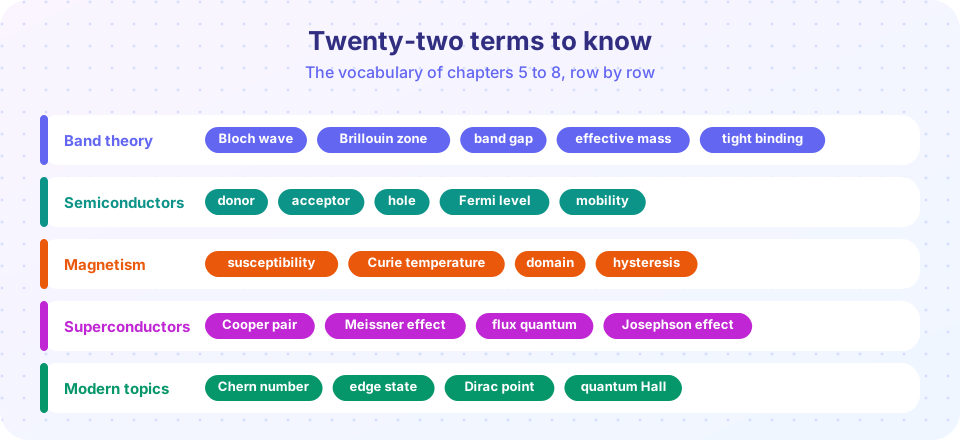
A good vocabulary makes the physics easier to read. This glossary collects the terms used in chapters 5 to 8, grouped by chapter, with short definitions. Use the flashcards to drill yourself, then browse the term map to see how the words connect.
What you will learn
- The precise meaning of the key terms of each chapter.
- How terms from different chapters relate (for example effective mass, Fermi level, gap).
- A quick drill method for remembering them.
Band theory
- Bloch wave: an electron state ψ_k = e^(ik·r) u_k(r) in a periodic potential.
- Crystal momentum: ħk, conserved modulo a reciprocal lattice vector.
- Brillouin zone: the primitive cell of reciprocal space; the first zone contains each distinct k once.
- Band gap: a range of energies with no electron states.
- Effective mass: m* = ħ²/(d²E/dk²), the curvature of a band.
- Tight binding: a model in which electrons hop between atomic orbitals with amplitude −t.
- Kronig-Penney model: an exactly solvable periodic delta-barrier potential.
- Van Hove singularity: a peak in the density of states where the band velocity vanishes.
Semiconductors and metals
- Intrinsic semiconductor: a pure crystal with n = p = n_i.
- Donor / acceptor: an impurity that supplies an electron / a hole.
- Hole: the absence of an electron in a nearly filled band, acting as a positive carrier.
- Fermi level: the chemical potential of the electrons.
- Mass-action law: n p = n_i² in equilibrium.
- Depletion region: the layer at a p-n junction emptied of mobile carriers.
- Built-in voltage: the equilibrium potential step V_bi across a junction.
- Mobility: drift velocity per unit electric field.
- Hall coefficient: R_H = 1/(nq), the transverse response in a magnetic field.
- Freeze-out: loss of donor ionization at low temperature.
Magnetism
- Susceptibility: χ = M/H.
- Diamagnetism: a weak response opposing the field (χ < 0).
- Paramagnetism: alignment of permanent moments with the field (χ > 0).
- Langevin function: L(x) = coth x − 1/x, the classical alignment curve.
- Bohr magneton: μ_B = eħ/2m = 9.274 × 10⁻²⁴ J/T.
- Exchange interaction: a spin coupling from the Pauli principle and Coulomb repulsion.
- Curie temperature: the temperature above which a ferromagnet is disordered.
- Curie-Weiss law: χ = C/(T − T_C).
- Domain: a region of uniform magnetization separated from others by Bloch walls.
- Hysteresis: dependence of M on the history of H; characterized by M_r and H_c.
Superconductors
- Critical temperature T_c: the onset of superconductivity.
- Meissner effect: expulsion of magnetic field from the bulk.
- London penetration depth: the length λ_L over which a field decays inside.
- Type I / type II: without / with a mixed state of vortices between H_c1 and H_c2.
- Cooper pair: two electrons (k↑, −k↓) bound by lattice-mediated attraction.
- Energy gap Δ: half the energy needed to break a Cooper pair; 2Δ ≈ 3.53 k_B T_c.
- Flux quantum: Φ₀ = h/2e = 2.068 × 10⁻¹⁵ Wb.
- Josephson effect: pair tunneling with I = I_c sin φ and f = 2eV/h.
- SQUID: a superconducting loop with Josephson junctions; a sensitive magnetometer.
Modern topics
- Landau level: a quantized cyclotron orbit energy E_n = ħω_c(n + 1/2).
- Filling factor: ν = nh/(eB).
- Chern number: an integer topological invariant of a filled band.
- Edge state: a conducting state at the boundary of a topological phase.
- Dirac point: a point of linear band touching, as in graphene.
- Berry phase: a geometric phase acquired by a state moved around a loop in parameter space.
- Moiré pattern: a long-period pattern from two slightly mismatched lattices.
Try it
Press Run (or Ctrl + Enter) to see the result here.
Program input · what you'd type while the program runs
Type the answers before you press Run, one per line. Each time the program reads a line (with input()), it gets the next line from this box.
Check your understanding
Quick check · 4 questions
of 4 answered You scored / 4 · perfect!
-
1. Which pair of terms belongs to superconductivity?
Both describe the superconducting state. -
2. The term 'effective mass' describes
m* = ħ²/(d²E/dk²). -
3. A Chern number is
It quantizes the Hall conductance in units of e²/h. -
4. Which term refers to the magnetic order temperature of an iron bar?
T_C separates the ordered and disordered states.
Summary
- Terms cluster by chapter: bands, carriers, moments, pairs and topology.
- Several terms bridge chapters: effective mass, Fermi level, gap and flux quantum.
- Drill the definitions with cards, then use them in sentences.
Next: Cheat sheet
Track your progress
Create a free account to tick off lessons and pick up where you left off on any device.
of Condensed Matter Physics lessons completed