


















Lesson 11 of 46 · Lattice Vibrations and Phonons
Chapter 3 overview: Lattice vibrations and phonons
See why atoms in a crystal vibrate as normal modes, what a phonon is, and how vibrations explain sound and heat, with a normal-mode eigenvalue demo you can run.
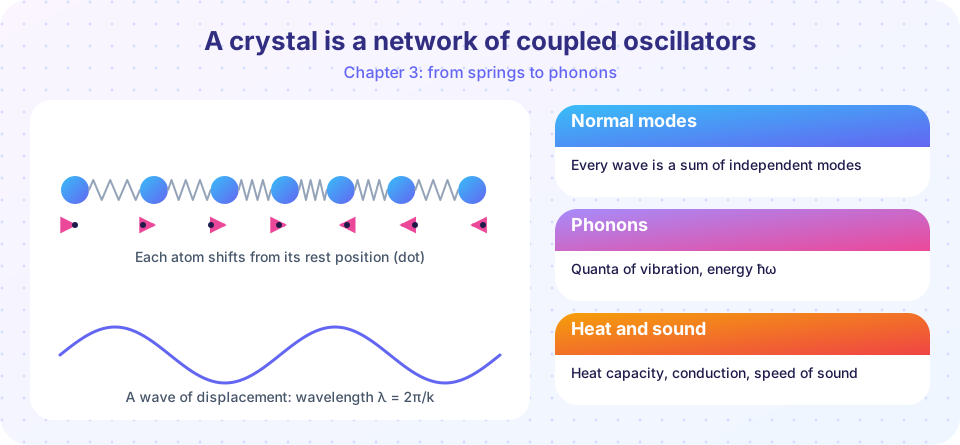
In Chapter 2 the atoms sat perfectly still on lattice points. Real atoms never do. At room temperature each atom jiggles by about a tenth of the bond length, and the jiggling of neighbors is coupled: pull one atom and the springs tug on the next. The crystal is a gigantic network of coupled oscillators.
That sounds like an impossible problem, but it has an elegant solution. The motion decomposes into independent normal modes, each a traveling or standing wave of definite frequency. Quantizing each mode gives a phonon, and a handful of phonon ideas explain sound, heat capacity and heat conduction in solids.
What you will learn
- Why a crystal's vibrations decouple into normal modes.
- What a phonon is and why it is a useful idea.
- How the lessons in this chapter fit together.
- How to compute the normal modes of a short chain with numpy.
Key terms
Normal mode: a pattern of motion in which every atom oscillates at the same frequency.
Phonon: the quantum of a lattice vibration mode, with energy ħω.
Dispersion relation: the function ω(k) connecting frequency and wave vector.
Harmonic approximation: treating each bond as an ideal spring (force proportional to displacement).
The big picture
Near the equilibrium separation each bond looks like a spring (Chapter 1). With N atoms there are 3N coordinates, so 3N normal modes. In a perfect crystal the periodic structure forces the modes to be waves, described by a wave vector k and a branch index. The relation ω(k) is the crystal's dispersion relation, and everything we want to know about vibrations is contained in it.
The model has three steps, which are the lessons of this chapter:
- One kind of atom on a line. A single mass-and-spring chain gives ω(k) = 2√(K/m)|sin(ka/2)| and teaches us about the Brillouin zone and the speed of sound.
- Two kinds of atom, or two per cell. The dispersion splits into an acoustic branch (atoms move together) and an optical branch (atoms move against each other).
- Quantization. Each mode of frequency ω is a quantum oscillator with energies (n + ½)ħω. Counting phonons thermally gives the heat capacity: the Einstein and Debye models.
Springs between atoms
Waves, not wiggles
Two branches
Quantum vibrations
What this chapter covers
- The monatomic chain: derivation of ω(k), the Brillouin zone, group and phase velocity, and counting modes.
- Optical and acoustic branches: the diatomic chain, why the gap opens and how optical modes interact with light.
- Phonons and heat capacity: quantization, Bose-Einstein occupation, Dulong-Petit, Einstein and Debye models.
- Chapter 3 review: a one-page picture and a ten-question quiz.
Common misconceptions
"Atoms vibrate independently." They are strongly coupled; independent vibration would be a single frequency (the Einstein model), a useful approximation but not the real physics.
"Phonons are particles that exist outside the crystal." They are quasiparticles: collective excitations that need the lattice to exist.
"At absolute zero atoms stop moving." Quantum zero-point motion remains; each mode keeps energy ½ħω.
Try it
Press Run (or Ctrl + Enter) to see the result here.
Program input · what you'd type while the program runs
Type the answers before you press Run, one per line. Each time the program reads a line (with input()), it gets the next line from this box.
Check your understanding
Quick check · 4 questions
of 4 answered You scored / 4 · perfect!
-
1. How many normal modes does a crystal of N atoms have in three dimensions?
Each atom has three coordinates, so there are 3N degrees of freedom and 3N normal modes. -
2. A phonon is
Phonons are quantized normal modes, collective excitations of the atoms. -
3. The dispersion relation connects
ω(k) tells you how fast each wave oscillates for a given wavelength. -
4. What does the harmonic approximation assume?
That is Hooke's law for each bond, valid for small displacements near r₀.
Summary
- Coupled atoms vibrate in 3N independent normal modes; in a crystal these are waves ω(k).
- Quantized modes are phonons with energy ħω, the key to heat capacity and conduction.
- The chain models give acoustic and optical branches; counting thermal phonons gives Einstein and Debye heat capacities.
Next: The monatomic chain
Track your progress
Create a free account to tick off lessons and pick up where you left off on any device.
of Condensed Matter Physics lessons completed