


















Lesson 13 of 46 · Lattice Vibrations and Phonons
Optical and acoustic branches
Solve the chain with two atoms per cell, see why a frequency gap appears at the zone edge, and learn how optical phonons couple to light in ionic crystals.
Real crystals almost always have more than one atom per primitive cell: NaCl has Na and Cl, silicon has two Si atoms in its cell, and a complicated protein crystal may have thousands. Each extra atom in the cell adds new vibration branches. Even the simplest case, a chain with two alternating masses, shows what is new: a high-frequency optical branch, and a gap in the allowed frequencies.
Understanding this model prepares you for band theory, because the gap that opens here is the phonon analogue of the electronic band gap.
What you will learn
- How to set up and solve the equations for two masses per cell.
- The meaning of the acoustic and optical branches and their atom motions.
- Why the gap appears and how to compute its edges.
- Why optical modes in ionic crystals absorb infrared light.
Key terms
Acoustic branch: the branch with ω → 0 as k → 0; neighboring atoms move together like a sound wave.
Optical branch: the branch with finite ω at k = 0; the atoms in a cell move against each other.
Phonon gap: the range of frequencies with no propagating mode.
Reststrahlen band: the narrow infrared region in which an ionic crystal reflects strongly because of its optical phonons.
Setting up the model
Place atoms of mass m and M alternately on a line, with equal springs K between neighbors. The unit cell has length a and contains one atom of each type, so the neighbor spacing is a/2. Let u_n be the displacement of the m atom in cell n and v_n that of the M atom. Newton's law for each gives
m ü_n = K (v_n + v_{n−1} − 2u_n)
M v̈_n = K (u_{n+1} + u_n − 2v_n).
Try u_n = A e^{i(kna − ωt)} and v_n = B e^{i(kna − ωt)}. Substituting yields a 2 × 2 system for A and B. A solution exists only when the determinant vanishes, which gives a quadratic equation in ω²:
ω² = K (1/m + 1/M) ± K √[ (1/m + 1/M)² − 4 sin²(ka/2)/(mM) ].
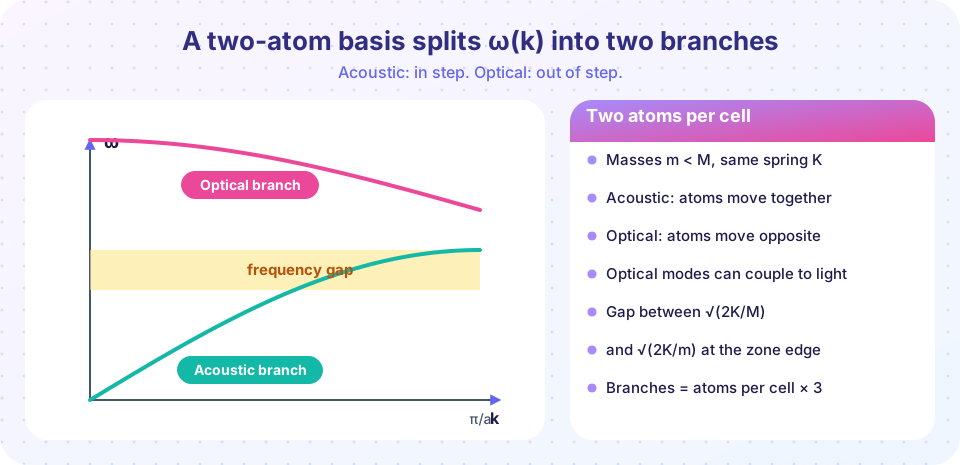
The minus sign is the acoustic branch and the plus sign the optical branch. Two atoms per cell gives two branches; p atoms per cell give 3p branches in three dimensions: 3 acoustic and 3(p−1) optical.
Special points
Let m < M. Evaluate at three places:
| k | Acoustic ω | Optical ω | What the atoms do |
|---|---|---|---|
| 0 | 0 | √(2K(1/m + 1/M)) | Acoustic: all move together. Optical: m and M move oppositely, center of mass fixed |
| π/a (zone edge) | √(2K/M) | √(2K/m) | Acoustic: only the heavy atoms move. Optical: only the light atoms move |
| small k | v k, with v = a√(K/(2(m+M))) | nearly flat | Sound wave |
The two branches never meet when m ≠ M. The gap runs from √(2K/M) to √(2K/m). If M = m, the gap closes and the two branches join into one folded version of the monatomic dispersion; the lattice constant then simply looks like a/2. That tells us the gap is created by the difference in the two atoms' masses (or in the two spring constants), a lesson that returns in band theory: a periodic perturbation opens a gap at the zone boundary.
Why "optical"?
In an ionic crystal such as NaCl the two atoms carry opposite charges. The optical mode at k ≈ 0 moves the positive and negative sublattices in opposite directions, creating an oscillating electric dipole in each cell. That dipole couples to the electric field of light of the same frequency, which is typically in the infrared (a few terahertz, wavelength 30 to 100 µm). Light with that frequency is strongly absorbed or reflected, producing the reststrahlen band. For ordinary light, whose wavelength is a thousand times larger than a, the wave vector is almost zero, so only the k ≈ 0 optical modes can absorb it. Covalent crystals with identical atoms (silicon, diamond) have no net dipole and do not couple this way, though they still have optical branches visible in Raman scattering.
In three dimensions, an ionic crystal's optical modes also split into transverse (TO) and longitudinal (LO) modes at k = 0. The longitudinal mode builds up a macroscopic electric field that stiffens it, so ω_LO > ω_TO. The Lyddane-Sachs-Teller relation connects the ratio to the dielectric constants: ω_LO²/ω_TO² = ε(0)/ε(∞).
Counting branches
A crystal with p atoms per primitive cell has 3p phonon branches: 3 acoustic (one longitudinal, two transverse) and 3p − 3 optical. Diamond or silicon: p = 2, so 3 acoustic + 3 optical. NaCl: p = 2, same. A crystal with 10 atoms per cell has 30 branches, of which only 3 are acoustic. The total number of modes is always 3N for N atoms.
Common misconceptions
"Optical modes are carried by light." They are vibrations of atoms. They are called optical because ionic crystals can excite them with infrared light.
"The gap means no vibrations at those frequencies." An external driver in the gap can still shake the crystal, but the response decays exponentially rather than propagating as a wave.
"Optical branches have zero group velocity." They are nearly flat but not exactly; v_g is small and vanishes at k = 0 and π/a by symmetry.
Try it
Press Run (or Ctrl + Enter) to see the result here.
Program input · what you'd type while the program runs
Type the answers before you press Run, one per line. Each time the program reads a line (with input()), it gets the next line from this box.
Press Run (or Ctrl + Enter) to see the result here.
Program input · what you'd type while the program runs
Type the answers before you press Run, one per line. Each time the program reads a line (with input()), it gets the next line from this box.
Check your understanding
Quick check · 5 questions
of 5 answered You scored / 5 · perfect!
-
1. At k = 0 on the acoustic branch the frequency is
At k = 0 all atoms move together, a pure translation with no restoring force, so ω = 0. -
2. On the optical branch at k = 0, the two atoms in a cell
The optical mode involves relative motion of the two sublattices, so the cell's dipole oscillates in an ionic crystal. -
3. What closes the gap in the diatomic chain?
When m = M the gap edges √(2K/M) and √(2K/m) coincide and the chain is effectively monatomic. -
4. A crystal has 4 atoms per primitive cell. How many optical branches does it have in 3D?
3p = 12 branches in total; 3 of them are acoustic, leaving 9 optical. -
5. Why does infrared light excite optical phonons in NaCl?
Light has k ≈ 0 relative to the zone, and the optical mode's oscillating dipole couples to its electric field.
Summary
- Two atoms per cell give ω² = K(1/m+1/M) ± K√[(1/m+1/M)² − 4sin²(ka/2)/(mM)], i.e., acoustic and optical branches.
- Acoustic atoms move together (ω → 0); optical atoms move oppositely (ω finite at k = 0).
- The gap between √(2K/M) and √(2K/m) closes if the masses are equal.
- p atoms per cell give 3p branches; optical modes couple to infrared light in ionic crystals.
Track your progress
Create a free account to tick off lessons and pick up where you left off on any device.
of Condensed Matter Physics lessons completed