


















Lesson 12 of 46 · Lattice Vibrations and Phonons
The monatomic chain and its dispersion
Derive the dispersion of a one-dimensional chain of identical atoms, find the Brillouin zone, sound speed and group velocity, and count the N modes of the chain.
Take N identical atoms of mass m on a line, equally spaced by a, connected to their nearest neighbors by springs of stiffness K. This is the simplest model of a crystal that still shows the real physics of lattice vibrations. Despite its simplicity, it explains why sound travels at constant speed in long waves, why there is a maximum vibration frequency, and why the wave vector can be restricted to a finite range called the first Brillouin zone.
The derivation takes four lines. We will do it carefully, then run it numerically as a check.
What you will learn
- How to write and solve the equations of motion for the chain.
- What the dispersion relation ω(k) = 2√(K/m)|sin(ka/2)| says physically.
- Why k can be restricted to the first Brillouin zone and why there are exactly N modes.
- How the group velocity and the speed of sound emerge.
Key terms
Nearest-neighbor spring constant K: force per unit stretch between adjacent atoms (N/m).
First Brillouin zone: the range −π/a < k ≤ π/a that contains every distinct wave.
Phase velocity: v_p = ω/k, the speed at which a crest moves.
Group velocity: v_g = dω/dk, the speed at which energy and wave packets travel.
Born-von Karman boundary conditions: periodic boundary conditions, u_{n+N} = u_n.
Equation of motion
Let u_n be the displacement of atom n from its equilibrium position x_n = n a. The spring to the right is stretched by u_{n+1} − u_n and pulls atom n with force K(u_{n+1} − u_n). The spring on the left is stretched by u_n − u_{n−1} and pulls back with K(u_n − u_{n−1}). Newton's second law gives
m d²u_n/dt² = K (u_{n+1} + u_{n−1} − 2 u_n).
This is a set of N coupled equations. Try a traveling wave solution
u_n = A exp[ i (k n a − ω t) ].
Substituting, the factors e^{±ika} appear from u_{n±1}, and the A and the time dependence cancel:
−m ω² = K ( e^{ika} + e^{−ika} − 2 ) = 2K (cos ka − 1) = −4K sin²(ka/2).
Therefore
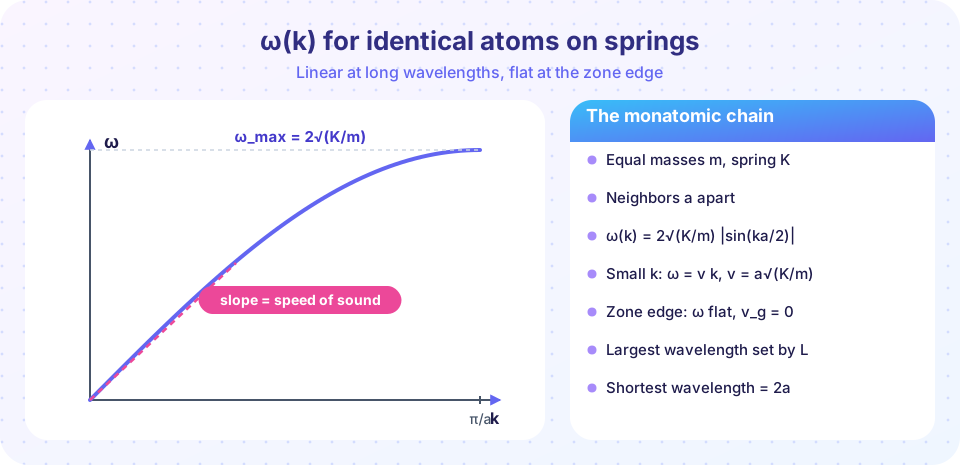
ω(k) = 2 √(K/m) |sin(ka/2)|
This single expression is the dispersion relation. A wave of any k propagates without changing shape only if ω is proportional to k; here it is not, so waves of different wavelength travel at different speeds (that is what dispersion means).
Reading the dispersion curve
Long wavelengths (k → 0). sin(ka/2) ≈ ka/2, so ω ≈ a √(K/m) k = v k, with v = a √(K/m). This is a sound wave. The speed v does not depend on k, and for atoms 0.25 nm apart with a typical bond stiffness it comes out near 4 km/s, the observed speed of sound in metals. Real crystals have v = √(modulus/density), and the chain model reproduces that form (K a plays the role of Young's modulus times area).
The maximum frequency. ω reaches its peak ω_max = 2√(K/m) at ka = π, where neighboring atoms move in exact opposition. Typical values are ω_max ≈ 10¹³ to 10¹⁴ rad/s, i.e., frequencies of a few terahertz. No wave of higher frequency exists in the chain: the lattice acts as a low-pass filter. The shortest wavelength is λ_min = 2a, because a pattern of atoms cannot vary on a scale shorter than two lattice spacings.
The group velocity. v_g = dω/dk = a √(K/m) cos(ka/2). It equals the sound speed at small k and falls to zero at the zone edge k = π/a. At the edge the wave is a standing wave: the energy does not move. This is the first example of a Bragg reflection of a wave by a periodic structure; the same thing will happen to electrons in Chapter 5.
The Brillouin zone
Replace k by k + 2π/a. Then e^{i(k+2π/a)na} = e^{ikna} e^{2πin} = e^{ikna}: the displacement pattern of atoms is identical. The new k describes the same physical wave because atoms exist only at the points x = n a. Hence every distinct wave can be labeled with k in an interval of length 2π/a, conventionally −π/a < k ≤ π/a. This is the first Brillouin zone, and 2π/a is the reciprocal lattice vector G of the chain (Lesson 250 generalizes this). Notice ω(k + G) = ω(k): the dispersion is periodic in k.
Counting modes
Choose periodic boundary conditions: u_{n+N} = u_n for a ring of N atoms (length L = N a). Then e^{ikNa} = 1, so k = 2π j/(N a) for integer j. Within the zone we have exactly N allowed values (j from −N/2 to N/2). So the chain with N atoms has N modes, equal to the number of degrees of freedom. In three dimensions, with N atoms in the sample, there are N allowed k values per branch, which prepares the ground for the Debye model. The spacing between neighboring allowed k values is 2π/L, extremely small for a macroscopic sample (L = 1 cm gives 6 × 10² m⁻¹ against a zone width of 10¹⁰ m⁻¹), so k can be treated as continuous.
Common misconceptions
"The wave carries atoms along." Each atom oscillates about a fixed position by a tiny amount. Only the pattern travels.
"Wavelengths shorter than 2a exist." They map onto longer waves. The zone limit is a statement about sampling, like aliasing in digital audio.
"Phase velocity equals group velocity." Only for k → 0. Near the zone edge ω/k stays positive but v_g → 0.
Try it
Press Run (or Ctrl + Enter) to see the result here.
Program input · what you'd type while the program runs
Type the answers before you press Run, one per line. Each time the program reads a line (with input()), it gets the next line from this box.
Press Run (or Ctrl + Enter) to see the result here.
Program input · what you'd type while the program runs
Type the answers before you press Run, one per line. Each time the program reads a line (with input()), it gets the next line from this box.
Check your understanding
Quick check · 5 questions
of 5 answered You scored / 5 · perfect!
-
1. The dispersion relation of the monatomic chain is
Substituting a traveling wave into Newton's law gives −mω² = −4K sin²(ka/2), hence ω = 2√(K/m)|sin(ka/2)|. -
2. What is the speed of sound in the long-wavelength limit?
For small k, ω ≈ a√(K/m) k, so v = a√(K/m). -
3. The group velocity at the zone edge k = π/a is
dω/dk ∝ cos(ka/2) vanishes at ka = π; the wave is standing. -
4. How many distinct normal modes does a chain of N atoms have?
k = 2πj/(Na) takes N distinct values in the first Brillouin zone. -
5. A chain has K = 20 N/m, m = 1 × 10⁻²⁵ kg and a = 0.25 nm. What is the sound speed?
v = a√(K/m) = 2.5 × 10⁻¹⁰ × √(2 × 10²⁶) = 2.5 × 10⁻¹⁰ × 1.414 × 10¹³ ≈ 3,540 m/s.
Summary
- The chain obeys m ü_n = K(u_{n+1} + u_{n−1} − 2u_n); a traveling wave gives ω = 2√(K/m)|sin(ka/2)|.
- Small k: ω = vk with v = a√(K/m), the speed of sound. At the zone edge v_g = 0 and ω is maximal.
- Wave vectors differing by 2π/a describe the same motion, so k lives in the first Brillouin zone and there are N modes.
- Periodic boundary conditions make k discrete with spacing 2π/L, effectively a continuum for macroscopic samples.
Track your progress
Create a free account to tick off lessons and pick up where you left off on any device.
of Condensed Matter Physics lessons completed