


















Lesson 30 of 46 · Semiconductors and Metals
Chapter 6 review: semiconductors and metals
Review chapter 6: intrinsic carriers, doping, the p-n junction, the Hall effect and mobility, with a recap table and ten mixed questions.
Chapter 6 turned the band picture into numbers you can measure: how many carriers, which sign, how fast. This review collects the main formulas and then tests how well you can switch between them.
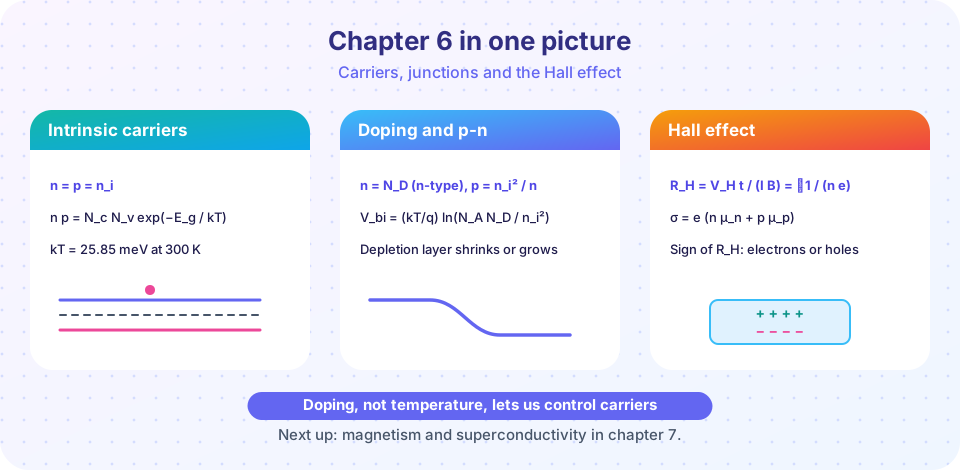
What you should be able to do
- Compute n_i, n and p from N_c, N_v, Eg and doping.
- Locate the Fermi level and compute the built-in voltage and depletion width of a junction.
- Use the Hall voltage to find carrier density, and σ and R_H to find mobility.
- Explain why holes and electrons both matter in an intrinsic or compensated sample.
Recap table
| Quantity | Formula | Typical value (Si, 300 K) |
|---|---|---|
| kT | 8.617 × 10⁻⁵ eV/K × T | 25.85 meV |
| Electron density | n = N_c exp(−(E_c − E_F)/kT) | depends on E_F |
| Intrinsic density | n_i = sqrt(N_c N_v) exp(−Eg/2kT) | about 10¹⁰ cm⁻³ |
| Mass-action law | n p = n_i² | 10²⁰ cm⁻⁶ |
| Doped carriers | n ≈ N_D − N_A (n-type) | 10¹⁶ for N_D = 10¹⁶ |
| Fermi level shift | E_F − E_i = kT ln(n/n_i) | 0.36 eV for n = 10¹⁶ cm⁻³ |
| Built-in voltage | V_bi = (kT/q) ln(N_A N_D/n_i²) | 0.77 V for 10¹⁷ and 10¹⁶ |
| Depletion width | W = sqrt(2ε(V_bi − V)/q × (1/N_A + 1/N_D)) | about 0.33 µm at V = 0 |
| Diode current | I = I_s[exp(qV/kT) − 1] | decade per 60 mV |
| Hall coefficient | R_H = 1/(nq) | sign of the carrier |
| Conductivity | σ = e(nμ_n + pμ_p) | 2.2 S/cm for 10¹⁶ cm⁻³ n-type |
Where students go wrong
Units. Semiconductor tables use cm⁻³ and cm²/(V·s); the Hall formula in SI needs m⁻³. Convert once and check the order of magnitude.
Forgetting the T-dependence of n_i. An intrinsic density that looks negligible at 300 K can dominate at 500 K.
Using n = N_D for lightly doped samples. If N_D is within a factor of 10 of n_i, use the full quadratic formula for n.
Try it
Press Run (or Ctrl + Enter) to see the result here.
Program input · what you'd type while the program runs
Type the answers before you press Run, one per line. Each time the program reads a line (with input()), it gets the next line from this box.
Check your understanding
Quick check · 10 questions
of 10 answered You scored / 10 · perfect!
-
1. n p = n_i² implies that in n-type silicon with n = 10¹⁶ cm⁻³ the hole density is
p = 10²⁰ / 10¹⁶ = 10⁴ cm⁻³ with n_i = 10¹⁰ cm⁻³. -
2. At what energy is the Fermi level of an intrinsic semiconductor?
Equal n and p place E_F near midgap. -
3. A donor in silicon has an ionization energy of about 45 meV. At room temperature (kT = 26 meV) the donors are
At 300 K nearly all shallow donors are ionized; freeze-out needs much lower temperatures. -
4. The built-in voltage of a junction increases if
V_bi = (kT/q) ln(N_A N_D / n_i²) grows with N_A N_D. -
5. Forward bias of 0.12 V (two decades at 60 mV per decade) multiplies the diode current by about
Each 60 mV multiplies by ten, so 120 mV gives a factor of 100. -
6. A measured Hall coefficient is negative. The dominant carriers are
R_H = −1/(ne) for electrons. -
7. A sample has σ = 200 S/m and R_H = −6.2 × 10⁻⁴ m³/C. The Hall mobility is about
μ = |R_H| σ = 6.2 × 10⁻⁴ × 200 = 0.124 m²/(V·s) = 1240 cm²/(V·s). -
8. Doubling the Hall bar thickness t at fixed I and B
V_H = IB/(nqt) is inversely proportional to t. -
9. In an intrinsic semiconductor with μ_n > μ_p, the Hall coefficient is
With n = p, R_H ∝ (μ_p² − μ_n²) < 0: the more mobile electrons dominate. -
10. Which change widens the depletion layer?
Reverse bias raises the voltage across the layer; higher doping would narrow it.
Summary
- Intrinsic densities are exponential in Eg/2kT; doping sets n and p with n p = n_i².
- The Fermi level moves toward the band of the majority carriers and fixes q V_bi at a junction.
- Hall and conductivity measurements together give n, sign and μ.
- Next the story moves from charge to spin: magnetism and superconductivity.
Track your progress
Create a free account to tick off lessons and pick up where you left off on any device.
of Condensed Matter Physics lessons completed