


















Lesson 34 of 46 · Magnetism and Superconductivity
Superconductivity: zero resistance and the Meissner effect
Learn the two signatures of superconductors, zero resistance and flux expulsion, the London equations, penetration depth, critical fields and the difference between type I and type II.
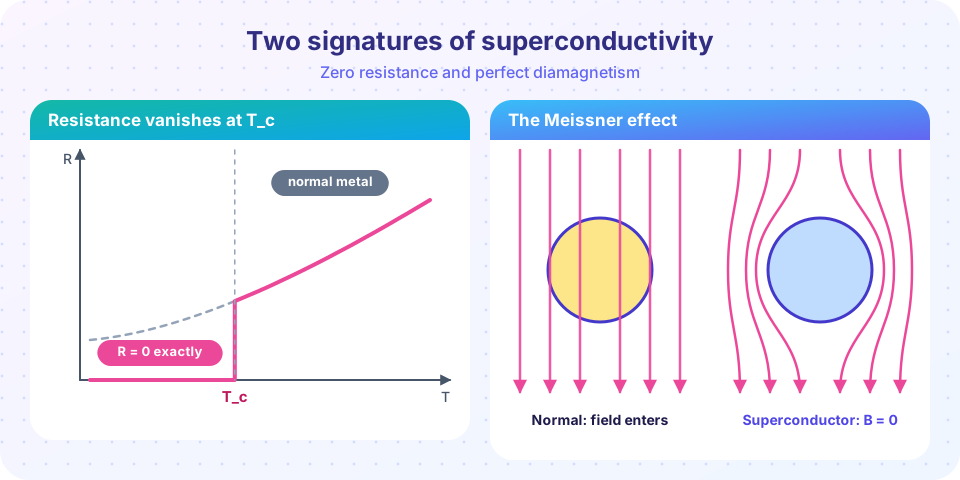
In 1911 Heike Kamerlingh Onnes cooled mercury in liquid helium and saw its resistance drop, within a fraction of a kelvin, to a value he could not measure. No known mechanism explained it. A resistance of zero is extraordinary, but it is the second signature of the superconducting state that makes it a genuine phase of matter: in 1933 Walther Meissner and Robert Ochsenfeld found that a superconductor expels magnetic field from its interior. This lesson describes what superconductors do; the next one explains why.
What you will learn
- The experimental signatures: R = 0 below T_c, and B = 0 inside (Meissner effect).
- Why perfect conduction alone does not explain the Meissner effect.
- The London equations and penetration depth λ_L = sqrt(m/(μ₀ n_s e²)).
- Critical field H_c(T), type I versus type II, and vortices.
Key terms
Critical temperature T_c: temperature below which the superconducting state exists (at zero field).
London penetration depth λ_L: the length over which a magnetic field decays inside a superconductor.
Critical field H_c: the field that destroys superconductivity; H_c(T) ≈ H_c(0)[1 − (T/T_c)²].
Type II superconductor: one that admits magnetic flux in quantized vortices between H_c1 and H_c2.
Zero resistance
Below T_c the DC resistance is zero, not merely small. The best test is a persistent current: induce a current in a superconducting ring and watch the magnetic field it produces. In careful experiments no decay has been detected over years, with lower bounds on the decay time of at least 100,000 years. Typical transition temperatures: Al 1.18 K, Sn 3.72 K, Hg 4.15 K, Pb 7.20 K, Nb 9.25 K among the elements; MgB₂ 39 K; YBa₂Cu₃O₇ about 92 K (the cuprates, discovered in 1986 by Bednorz and Müller). Materials above 77 K, the boiling point of liquid nitrogen, are called high-temperature superconductors. Reports of superconductivity in hydrides under megabar pressures (H₃S near 200 K) show high T_c is possible but only at extreme pressures. Claims of ambient-pressure room-temperature superconductors have repeatedly failed independent replication.
The Meissner effect
A perfect conductor (R = 0) would not change the field inside it if the field is switched on after cooling: induced currents would keep B fixed at zero. But if the field is applied first and the sample is cooled afterwards, a perfect conductor would keep the field inside. A superconductor does something different: it expels the field in both cases, B = 0 in the bulk. So superconductivity is an equilibrium state with a free energy lower than the normal state, not merely a hysteretic effect. The energy that the state gains by pairing (condensation energy) is paid out when the field is expelled; if the field exceeds the thermodynamic critical field H_c, expelling it costs more than it gains and the superconductivity is destroyed. For a type I material H_c(T) ≈ H_c(0)[1 − (T/T_c)²]; for lead H_c(0) ≈ 80 mT, for aluminum about 10 mT.
The London equations
Brothers Fritz and Heinz London (1935) proposed that the superconducting electrons, of density n_s, respond to the vector potential as ⃗j = −(n_s e²/m) ⃗A (in the London gauge). Combining with Ampère's law ∇ × ⃗B = μ₀ ⃗j gives
∇² B = B / λ_L², with λ_L = sqrt( m / (μ₀ n_s e²) )
The solution inside a half-space is B(x) = B₀ exp(−x/λ_L): the field penetrates only a thin surface layer. For n_s = 10²⁸ m⁻³, λ_L = sqrt(9.109 × 10⁻³¹/(4π × 10⁻⁷ × 10²⁸ × (1.602 × 10⁻¹⁹)²)) ≈ 53 nm. Measured values at low temperature: Al 16 nm, Sn 34 nm, Pb 37 nm, Nb 39 nm, with cuprates larger (150 nm or more). Because the screening currents flow within a distance λ_L of the surface, a piece of superconductor thicker than a few hundred nanometers is effectively a perfect diamagnet. The penetration depth grows as T → T_c as λ(T) = λ_L(0)/sqrt(1 − (T/T_c)⁴) (the empirical two-fluid form).
Type I and type II
A second length scale enters: the coherence length ξ, the distance over which the superconducting order can vary. The ratio κ = λ/ξ (the Ginzburg-Landau parameter) divides superconductors. If κ < 1/√2 (type I: most pure elements, e.g. Al, Pb, Hg), the superconductor-normal interface costs positive energy, so the material is superconducting with full Meissner expulsion up to H_c, then jumps to the normal state. If κ > 1/√2 (type II: Nb, alloys, cuprates, MgB₂), the interface energy is negative, and above a lower critical field H_c1 the field enters as vortices: tubes of normal material each carrying exactly one flux quantum Φ₀ = h/2e = 2.07 × 10⁻¹⁵ Wb, surrounded by circulating supercurrents. The vortices form a triangular lattice (Abrikosov lattice) and the superconductivity survives up to the upper critical field H_c2, which can be tens of tesla: the reason why superconducting magnets (NbTi up to ~10 T at 4 K, Nb₃Sn up to 20 T) are used in MRI scanners and particle accelerators. In the mixed state, pinning of vortices by defects is needed to carry current without dissipation.
Common misconceptions
"A superconductor is a perfect conductor with the resistance set to zero." The Meissner effect shows that the superconducting state is a distinct thermodynamic phase; a perfect conductor would not expel a field.
"Superconductors expel the field completely, down to zero depth." The field decays over λ_L (tens of nanometers). This is tiny but finite and has been measured.
"Superconductors carry unlimited current." There is a critical current density above which the state is destroyed; its value depends on the material, field and temperature.
Try it
Press Run (or Ctrl + Enter) to see the result here.
Program input · what you'd type while the program runs
Type the answers before you press Run, one per line. Each time the program reads a line (with input()), it gets the next line from this box.
Press Run (or Ctrl + Enter) to see the result here.
Program input · what you'd type while the program runs
Type the answers before you press Run, one per line. Each time the program reads a line (with input()), it gets the next line from this box.
Check your understanding
Quick check · 5 questions
of 5 answered You scored / 5 · perfect!
-
1. The Meissner effect shows that superconductors
B = 0 in the bulk regardless of whether the field was applied before or after cooling. -
2. In the London theory the field decays inside a superconductor as
∇²B = B/λ_L² has exponentially decaying solutions. -
3. Doubling the superconducting electron density n_s changes λ_L by a factor of
λ_L ∝ n_s^(−1/2). -
4. Which of the following is a type II superconductor behavior?
Type II materials admit quantized vortices in the mixed state. -
5. Superconducting magnets for MRI use type II materials because they
H_c2 can be many tesla, much higher than H_c of type I materials.
Summary
- Superconductors have R = 0 below T_c and expel magnetic flux (B = 0 inside): a new phase of matter.
- The London penetration depth λ_L = sqrt(m/(μ₀ n_s e²)) is tens of nanometers; the field decays as exp(−x/λ_L).
- Critical field H_c(T) ≈ H_c(0)[1 − (T/T_c)²]; type II materials have H_c1 < H < H_c2 with flux quantum vortices.
- High-field magnets rely on type II superconductors with pinned vortices.
Track your progress
Create a free account to tick off lessons and pick up where you left off on any device.
of Condensed Matter Physics lessons completed