


















Lesson 6 of 46 · Crystal Structure and Diffraction
Lattices and unit cells
Define lattice vectors, primitive and conventional cells, the Wigner-Seitz cell and the 14 Bravais lattices, and see why graphene and hcp are lattice plus basis.
If you stood inside a perfect crystal and looked around, the view from one lattice point would look identical to the view from any other. That is translational symmetry, and it is the single most useful fact about crystals. It lets us describe a sample of 10²³ atoms by a handful of numbers: the vectors that generate the lattice and the positions of the atoms in one small cell.
This lesson builds that description step by step, and then shows which familiar materials need a basis beyond a single atom.
What you will learn
- How to write a lattice with primitive vectors and find the volume of the primitive cell.
- The difference between primitive, conventional and Wigner-Seitz cells.
- How the 14 Bravais lattices arise from seven crystal systems and centering.
- Why NaCl, diamond, graphene and hcp metals are described by a lattice plus a basis.
Key terms
Primitive vectors: a set of vectors a₁, a₂, a₃ such that every lattice point is n₁a₁ + n₂a₂ + n₃a₃.
Primitive cell: the parallelepiped spanned by primitive vectors; volume V = |a₁ · (a₂ × a₃)|.
Conventional cell: a larger cell chosen to display the full symmetry (usually a cube for cubic lattices).
Wigner-Seitz cell: the region closer to one lattice point than to any other.
Coordination number: the number of nearest neighbors.
Translation vectors
Choose an origin at one lattice point. Every other point is reached by the translation vector
R = n₁ a₁ + n₂ a₂ + n₃ a₃ (n₁, n₂, n₃ integers)
The vectors a₁, a₂, a₃ are primitive if every lattice point can be reached this way and none is missed. They are not unique: you may swap in a₁ + a₂ for a₂ and still generate the same lattice. What is unique is the volume of the primitive cell, V = |a₁ · (a₂ × a₃)|, which is the volume per lattice point. The number density of lattice points is 1/V.
Primitive, conventional and Wigner-Seitz cells
The primitive cell has the smallest possible volume and contains exactly one lattice point. For a face-centered cubic lattice, however, the primitive cell is a skewed rhombohedron that hides the cubic symmetry. So we usually draw the conventional cell: the cube of side a that contains 4 lattice points in the fcc case and 2 in the body-centered case. Counting lattice points in a cell: a corner point is shared by 8 cells (1/8 each), a face point by 2 (1/2), an edge point by 4 (1/4), and an interior point belongs to one.
The Wigner-Seitz cell is built by drawing the perpendicular bisector planes between a lattice point and its neighbors and keeping the region around the point. It has the full point-group symmetry of the lattice and one lattice point. In the reciprocal lattice (next lessons) the equivalent construction is the first Brillouin zone, which is central to band theory.
For standard cubic lattices with lattice constant a:
| Lattice | Primitive vectors | Primitive volume | Lattice points per cubic cell |
|---|---|---|---|
| sc | (a,0,0), (0,a,0), (0,0,a) | a³ | 1 |
| bcc | (a/2)(−1,1,1), (a/2)(1,−1,1), (a/2)(1,1,−1) | a³/2 | 2 |
| fcc | (a/2)(0,1,1), (a/2)(1,0,1), (a/2)(1,1,0) | a³/4 | 4 |
The 14 Bravais lattices
Seven crystal systems are defined by the lengths a, b, c of the cell edges and the angles α, β, γ between them. Each lattice can in addition be centered: P (primitive), I (body-centered), F (all faces) or C (one pair of faces). Only certain combinations are distinct lattices, which gives 14.
| System | Edge and angle conditions | Lattices |
|---|---|---|
| Cubic | a = b = c; all angles 90° | P, I, F |
| Tetragonal | a = b ≠ c; all 90° | P, I |
| Orthorhombic | a ≠ b ≠ c; all 90° | P, C, I, F |
| Hexagonal | a = b ≠ c; α = β = 90°, γ = 120° | P |
| Trigonal (rhombohedral) | a = b = c; α = β = γ ≠ 90° | P |
| Monoclinic | a ≠ b ≠ c; α = γ = 90° ≠ β | P, C |
| Triclinic | all different | P |
That is 3 + 2 + 4 + 1 + 1 + 2 + 1 = 14. Many cells you might invent turn out to be another lattice in disguise. For example, a "base-centered tetragonal" lattice is just a primitive tetragonal lattice described with a larger cell.
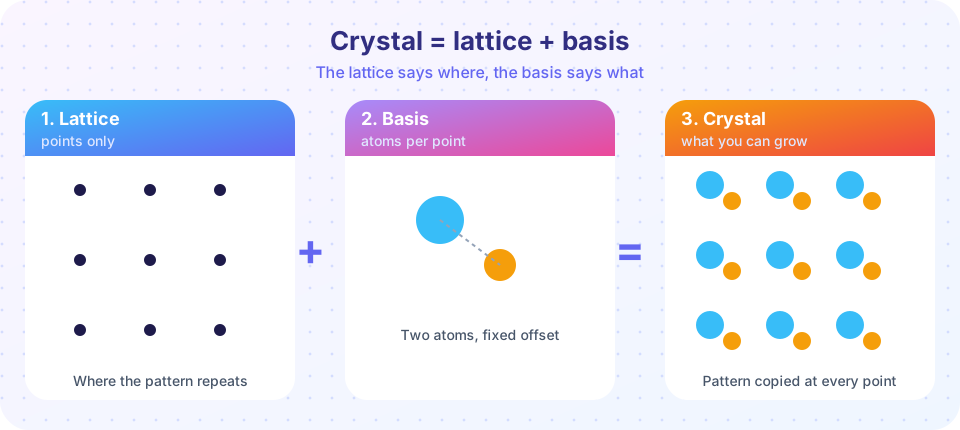
Lattice plus basis
Real crystals rarely place one atom per lattice point.
- Rock salt (NaCl): fcc lattice, basis Na at (0,0,0) and Cl at (a/2,0,0). Each ion has six unlike neighbors.
- Diamond and silicon: fcc lattice, basis of two identical atoms at (0,0,0) and (a/4,a/4,a/4). Each atom has four neighbors in a tetrahedron.
- Zinc blende (GaAs): the diamond structure with two different atoms.
- Hexagonal close-packed (Mg, Zn, Ti): simple hexagonal lattice with a basis of two atoms. It is not a Bravais lattice by itself.
- Graphene: a two-dimensional triangular lattice with a basis of two carbon atoms; the honeycomb pattern is not itself a lattice, because the vertices are not all equivalent under translation.
- Cesium chloride (CsCl): a simple cubic lattice with a two-atom basis; do not confuse it with bcc, where both atoms would be the same species.
The word crystal structure means lattice and basis together; the word lattice means just the translations.
Common misconceptions
"Close-packed metals are fcc or hcp Bravais lattices." fcc is a Bravais lattice. hcp is not: it needs a basis of two atoms on a simple hexagonal lattice.
"The honeycomb is a lattice." A lattice needs every point to look identical, but the two sets of honeycomb vertices point in opposite directions. Graphene is a triangular lattice with a two-atom basis.
"The primitive cell must be a parallelepiped." Any shape that tiles space with one lattice point counts; the Wigner-Seitz cell is a good example.
Try it
Press Run (or Ctrl + Enter) to see the result here.
Program input · what you'd type while the program runs
Type the answers before you press Run, one per line. Each time the program reads a line (with input()), it gets the next line from this box.
Press Run (or Ctrl + Enter) to see the result here.
Program input · what you'd type while the program runs
Type the answers before you press Run, one per line. Each time the program reads a line (with input()), it gets the next line from this box.
Check your understanding
Quick check · 5 questions
of 5 answered You scored / 5 · perfect!
-
1. The primitive cell of the fcc lattice with cubic side a has volume
The conventional fcc cube holds 4 lattice points, so each point owns a³/4. -
2. How many lattice points does the conventional bcc cell contain?
Eight corners at 1/8 each give 1, plus one body-center point: 2 in total. -
3. Which of these is NOT a Bravais lattice?
The honeycomb's two vertex types are not related by translation. It is a triangular lattice with a two-atom basis. -
4. Diamond is described as
Two identical carbon atoms, at (0,0,0) and (a/4,a/4,a/4), are attached to each fcc point. -
5. The Wigner-Seitz cell is
It is built from perpendicular bisector planes and always has one lattice point.
Summary
- A lattice is the set of points R = n₁a₁ + n₂a₂ + n₃a₃; the primitive cell volume is |a₁·(a₂×a₃)|.
- Conventional cells show symmetry; primitive and Wigner-Seitz cells contain exactly one lattice point.
- Seven crystal systems plus centering give 14 Bravais lattices.
- Most real crystals are a lattice with a basis: NaCl, diamond, GaAs, hcp metals and graphene.
Track your progress
Create a free account to tick off lessons and pick up where you left off on any device.
of Condensed Matter Physics lessons completed