


















Lesson 21 of 46 · Band Theory
Chapter 5 overview: why crystals have bands
See the big picture of band theory: how atomic levels broaden into energy bands, why gaps appear and what the next four lessons cover.
In the free electron model every electron moves as a plane wave and the only structure in the energy spectrum is a smooth parabola. That model explains the Drude conductivity and the Sommerfeld heat capacity, but it cannot answer a simple question: why is copper a metal, silicon a semiconductor and diamond an insulator? All three have electrons, and all three have a crystal. The missing ingredient is the periodic potential of the ions, and band theory is the theory of what that potential does to the electrons.
This chapter builds the answer from three directions. You will start from the symmetry of the crystal (Bloch's theorem), see how a weak periodic potential opens gaps in a nearly free electron picture, and then approach the same bands from the opposite side, by letting atoms hop electrons to their neighbors (tight binding).
What you will learn
- Why a periodic potential turns discrete atomic levels into bands separated by gaps.
- What the three lessons of this chapter contribute: symmetry, perturbation theory and tight binding.
- How band filling sorts materials into metals, semiconductors and insulators.
- What you should be able to compute by the end of the chapter.
The core idea in one picture
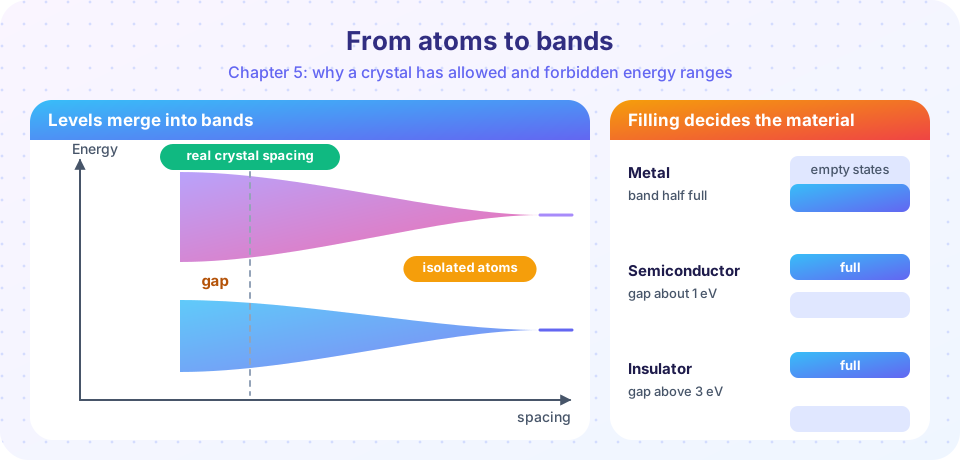
Take one atom. Its electrons occupy sharp levels. Take two atoms and bring them close: the overlap of their orbitals splits each level into two (the bonding and antibonding combinations). Take N atoms in a line and each level splits into N levels. For a crystal with N of the order of 10²³, the N levels are so close together that we treat them as a continuous band. Between the bands lie energy ranges with no states at all, the band gaps.
From atoms to crystals
Overlap of orbitals sets the width of the band.
Three ways to see bands
Filling decides the material
Each band holds 2N electrons, counting spin.
What you will compute
What each lesson covers
- Bloch's theorem and Bloch waves: the exact statement that follows from translation symmetry, crystal momentum and the Brillouin zone.
- The nearly free electron model: how a weak potential opens a gap of size 2|U| at the zone boundary, and the exactly solvable Kronig-Penney model.
- The tight-binding model: the band E(k) = ε₀ − 2t cos(ka), effective mass, and a dimerized chain that already has a gap.
- Chapter review: a recap table and ten mixed questions.
Counting states: why filling matters
A band built from N unit cells contains exactly N distinct values of the crystal momentum k, and each can hold two electrons (spin up and down). So a band holds 2N electrons. A crystal with one valence electron per atom, such as sodium, has N electrons for a band that can hold 2N: the band is half full and electrons next to the Fermi level can be excited by an arbitrarily small field. That is a metal. A crystal with two electrons per primitive cell can fill a band completely, and if a gap sits above it, no electron can change its state without a finite energy: an insulator or a semiconductor, depending on how big the gap is. (Two-electron elements such as magnesium are metals anyway because bands overlap in energy; counting is a guide, not a proof.)
Common misconceptions
"Gaps appear because electrons are blocked by the ions." The ions do not need to be hit: a gap arises from the wave nature of the electron. Waves with wavelength matching the lattice period are Bragg reflected into standing waves with different energies.
"An empty band conducts." A completely empty band has no electrons to carry current. A completely full band cannot respond either. Conduction needs partly filled bands.
Try it
Press Run (or Ctrl + Enter) to see the result here.
Program input · what you'd type while the program runs
Type the answers before you press Run, one per line. Each time the program reads a line (with input()), it gets the next line from this box.
Press Run (or Ctrl + Enter) to see the result here.
Program input · what you'd type while the program runs
Type the answers before you press Run, one per line. Each time the program reads a line (with input()), it gets the next line from this box.
Check your understanding
Quick check · 4 questions
of 4 answered You scored / 4 · perfect!
-
1. How many electrons can one band of a crystal with N primitive cells hold?
A band has N allowed k values and each holds two spin states. -
2. Why does a crystal of N atoms have a band instead of N separate sharp levels?
Orbital overlap broadens the level into N closely spaced states within a finite width. -
3. A solid has one valence electron per primitive cell and one band per cell. It is most likely
The band is half full, so electrons at the Fermi level can move into empty neighboring states. -
4. Which statement about band gaps is correct?
Gaps are a wave effect of the periodic potential, present even at zero temperature.
Summary
- A periodic potential turns discrete atomic levels into bands separated by gaps.
- Each band has N states per spin, so it holds 2N electrons.
- Band filling, not the mere presence of electrons, decides whether a solid conducts.
- This chapter approaches bands by symmetry, by perturbation theory and by tight binding.
Track your progress
Create a free account to tick off lessons and pick up where you left off on any device.
of Condensed Matter Physics lessons completed