


















Lesson 33 of 46 · Magnetism and Superconductivity
Ferromagnetism: exchange, the Curie temperature and hysteresis
Understand ferromagnetism: exchange interaction, Weiss molecular field, spontaneous magnetization below the Curie temperature, Curie-Weiss law, domains and hysteresis loops.
A paramagnet loses its magnetization the moment you remove the field. A ferromagnet does not: below its Curie temperature it carries a magnetization all by itself. In 1907 Pierre Weiss explained how, by assuming that each moment feels, in addition to the applied field, an effective field proportional to the magnetization of its neighbors. The idea is a mean-field theory, the first of its kind, and its predictions (a sharp transition, a Curie-Weiss susceptibility above T_C) match experiment well enough to remain the starting point for every textbook. Its explanation of the origin of that field had to wait for quantum mechanics.
What you will learn
- Why dipole-dipole forces cannot explain ferromagnetism and what exchange is.
- How the Weiss molecular field produces spontaneous magnetization and the Curie-Weiss law.
- How to solve the mean-field equation m = tanh(m T_C/T) numerically.
- What domains, remanence, coercivity and hysteresis mean.
Key terms
Exchange interaction: an effective spin-spin coupling −2J S₁·S₂ from the Pauli principle and Coulomb repulsion.
Weiss molecular field: an effective field B_W = λ μ₀ M that each moment feels from its neighbors.
Curie-Weiss law: χ = C/(T − T_C) for T > T_C.
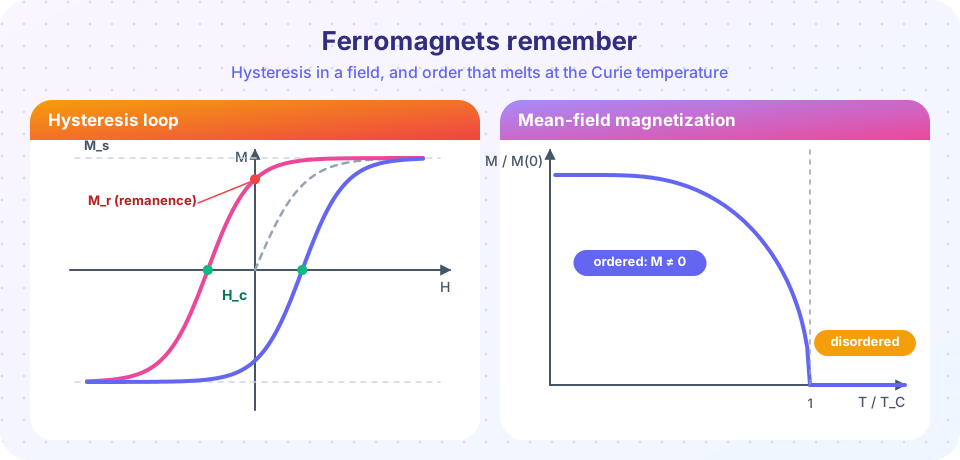
Hysteresis: dependence of M on the history of H, giving a loop with remanence M_r and coercive field H_c.
Why not dipole forces?
Two electron moments of 1 μ_B placed 2.5 Å apart interact with energy μ₀ μ_B²/(4π r³) ≈ 10⁻⁴ eV, which corresponds to roughly 1 K. Iron stays ferromagnetic up to 1043 K. The real mechanism is the exchange interaction. Two electrons with parallel spins are, by the Pauli principle, kept apart in space, so they feel less Coulomb repulsion than two electrons with antiparallel spins. The energy difference between parallel and antiparallel configurations is of order 0.1 eV ≈ 1000 K. In a Heisenberg model this appears as H = −Σ J_ij S_i·S_j with J > 0 favoring alignment (ferromagnet) and J < 0 favoring antialignment (antiferromagnet). In metals like Fe, Co and Ni the mechanism is itinerant: the Stoner criterion says that a large density of states at the Fermi level makes it energetically profitable to shift the spin-up and spin-down bands.
Weiss mean-field theory
Replace the interaction with each neighbor by an effective field proportional to the average magnetization: B_eff = B + μ₀ λ M. For spin-1/2 moments with g = 2 and moment μ = μ_B, the self-consistent magnetization is
M = N μ tanh( μ (B + μ₀ λ M) / kT )
Set B = 0 and write m = M/(Nμ), T_C = μ₀ λ N μ²/k. Then
m = tanh( m T_C / T )
At high temperature the only solution is m = 0. For T < T_C a second, nonzero solution appears and the system picks it spontaneously: the ordered state. Near T_C, m ≈ sqrt(3(1 − T/T_C)); mean-field theory predicts the exponent β = 1/2 (real 3D magnets have β ≈ 0.33 because fluctuations matter). At T → 0, m → 1. Above T_C, applying a small field gives the Curie-Weiss law:
χ = C / (T − T_C)
The susceptibility diverges as T approaches T_C from above and extrapolates to zero in a plot of 1/χ against T at T = T_C, which is how T_C is extracted from high-temperature data. Numbers. The Weiss field needed to explain iron is of order B_W ~ 10³ T, far beyond any lab magnet, a hint that it is not magnetic in origin. Measured Curie temperatures: Fe 1043 K, Co 1388 K, Ni 627 K, Gd about 293 K.
Mean-field theory overestimates T_C and gets critical exponents wrong because it ignores fluctuations. In one and two dimensions fluctuations are strong enough that the Mermin-Wagner theorem forbids long-range order in an isotropic Heisenberg magnet at any T > 0; magnetic anisotropy can restore it, which is why atomically thin ferromagnets such as monolayer CrI₃ (T_C ≈ 45 K) exist.
Domains and hysteresis
A bar of iron is usually not magnetized, even far below T_C. The reason is the magnetostatic energy: a single uniformly magnetized body has a large stray field outside it. The crystal minimizes total energy by breaking into domains magnetized in different directions, separated by thin Bloch walls (about 100 nm wide in iron) over which the moments rotate gradually. An applied field enlarges the favorably oriented domains by moving the walls, then rotates the remaining magnetization. At saturation M_s all moments are aligned. When the field is removed, wall motion is impeded by defects and a remanent magnetization M_r remains. A reverse field of magnitude H_c, the coercive field, is needed to bring M back to zero.
The shape and area of the loop determine applications. Soft magnets (H_c below about 100 A/m, e.g. silicon steel, permalloy) have thin loops and low energy loss per cycle, ideal for transformer cores. Hard magnets (H_c of 10⁵ A/m or more, e.g. NdFeB, SmCo) have fat loops and are used as permanent magnets. The area of the loop is the energy lost as heat per cycle per unit volume.
Common misconceptions
"A piece of iron without a net magnetization is not ferromagnetic." It is, but its domains point in different directions and the net moment cancels. Heating above T_C destroys the order at the atomic level.
"The Weiss field is a real magnetic field." It is an effective description of the exchange interaction; the true field would be orders of magnitude smaller.
"Above T_C the moments disappear." The atoms still carry moments; they are just no longer correlated over long distances, so the material behaves as a paramagnet with the Curie-Weiss susceptibility.
Try it
Press Run (or Ctrl + Enter) to see the result here.
Program input · what you'd type while the program runs
Type the answers before you press Run, one per line. Each time the program reads a line (with input()), it gets the next line from this box.
Press Run (or Ctrl + Enter) to see the result here.
Program input · what you'd type while the program runs
Type the answers before you press Run, one per line. Each time the program reads a line (with input()), it gets the next line from this box.
Check your understanding
Quick check · 5 questions
of 5 answered You scored / 5 · perfect!
-
1. Why is dipole-dipole coupling unable to explain ferromagnetism in iron?
Dipole energies of order 10⁻⁴ eV correspond to about a kelvin; exchange gives ~0.1 eV. -
2. The Curie-Weiss law above T_C is
The molecular field shifts the Curie law, making χ diverge at T_C. -
3. In mean-field theory, the equation for spontaneous magnetization (spin-1/2) is
The molecular field proportional to m enters the tanh argument, giving a self-consistency condition. -
4. A soft magnet is characterized by
Low coercivity means small loop area and small energy loss, good for transformers. -
5. Domains form in a ferromagnet to
Flux-closing domain patterns reduce the field energy outside the sample.
Summary
- Ferromagnetism comes from the exchange interaction (≈ 0.1 eV), not from dipole forces.
- Weiss theory gives m = tanh(m T_C/T): spontaneous magnetization below T_C and χ = C/(T − T_C) above.
- Mean-field theory overestimates T_C and gets critical exponents wrong; fluctuations matter, especially in low dimensions.
- Domains, remanence and coercivity explain hysteresis and the use of soft and hard magnets.
Track your progress
Create a free account to tick off lessons and pick up where you left off on any device.
of Condensed Matter Physics lessons completed