


















Lesson 31 of 46 · Magnetism and Superconductivity
Chapter 7 overview: magnetism and superconductivity
A map of chapter 7: the five kinds of magnetic response, ferromagnetism and the Curie temperature, and superconductivity with the Meissner effect, BCS theory and Josephson junctions.
Charge is only half of what an electron carries. It also has spin, a magnetic moment of about one Bohr magneton, and in a crystal 10²³ of these moments must decide how to live together. Sometimes they ignore each other and point at random (paramagnets). Sometimes they line up spontaneously (ferromagnets, the permanent magnets on your fridge). Sometimes they pair up and condense into a state that expels magnetic fields and carries current without resistance (superconductors). This chapter covers both ends of the story, because the spin-and-charge physics that gives us magnets also gives us the strangest states of electrons.
What you will learn
- The five kinds of magnetic response and how to tell them apart by susceptibility.
- The meaning of the Curie temperature and the Weiss molecular field.
- The two defining properties of a superconductor: zero resistance and perfect diamagnetism.
- How the chapter's four content lessons fit together.
Key terms
Magnetic susceptibility χ: M = χ H, the response of magnetization to an applied field. Dimensionless in SI.
Bohr magneton μ_B: eħ/2m = 9.274 × 10⁻²⁴ J/T, the natural unit of an electron's magnetic moment.
Curie temperature T_C: the temperature above which a ferromagnet loses its spontaneous magnetization.
Critical temperature T_c: the temperature below which a material becomes superconducting.
Five responses
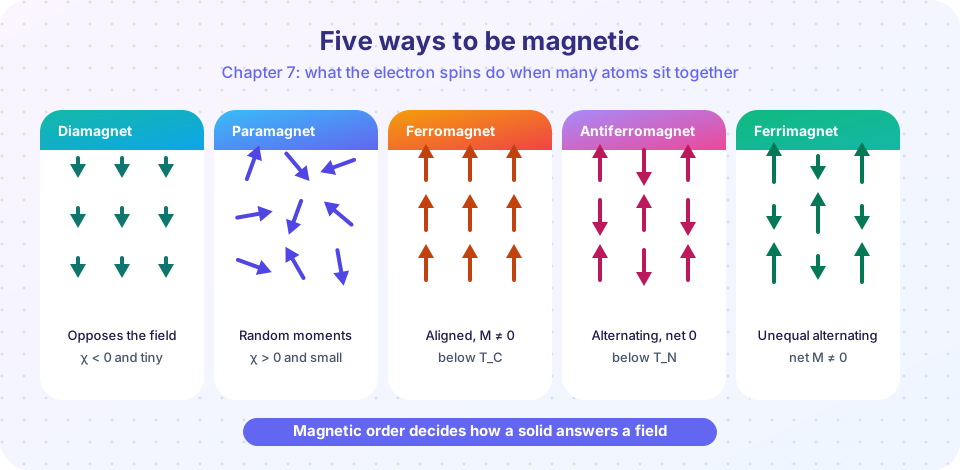
Apply a small field H to a solid and measure the magnetization M it acquires. The ratio χ = M/H sorts materials:
- Diamagnetic (χ < 0, about −10⁻⁵ for most solids): the field induces circulating currents that oppose it (Lenz's law at the atomic scale). Every material has this response; it dominates when no atom carries a permanent moment. Copper, water, bismuth and graphite are diamagnetic.
- Paramagnetic (χ > 0, about 10⁻⁵ to 10⁻³): atoms with permanent moments partly align with the field against thermal agitation. The Curie law gives χ ∝ 1/T.
- Ferromagnetic: neighboring moments align spontaneously below T_C, giving a large, nonlinear M with hysteresis. Iron, cobalt and nickel are the textbook examples.
- Antiferromagnetic: neighboring moments alternate, so the net magnetization vanishes. Chromium and MnO are examples.
- Ferrimagnetic: alternating moments of unequal size leave a net M. Magnetite Fe₃O₄ and the ferrites are examples.
A superconductor is a sixth case: it behaves like a perfect diamagnet with χ = −1 and has no resistance at all.
Magnets in three steps
Order needs interaction stronger than kT.
Superconductors
Why it matters
What each lesson covers
- Diamagnetism and paramagnetism: the Langevin function, the Curie law and why the Bohr magneton is the natural unit.
- Ferromagnetism: the Weiss molecular field, the Curie temperature, domains and hysteresis.
- Zero resistance and the Meissner effect: the phenomenology of superconductors, London penetration depth, type I and type II.
- BCS theory and Josephson junctions: Cooper pairs, the energy gap, flux quantization and the Josephson effects.
- Chapter review: formulas and ten questions.
Common misconceptions
"A superconductor is just a perfect conductor." A perfect conductor would trap whatever field was inside it when it became perfect; a superconductor expels the field (the Meissner effect). This is a thermodynamic equilibrium property, not just the absence of resistance.
"Ferromagnetism comes from the magnetic attraction between atomic moments." The dipole-dipole energy between neighboring atoms is about 10⁻⁴ eV, equivalent to roughly 1 K. Iron stays magnetic to over 1000 K because the real interaction is the electrostatic exchange interaction, a quantum effect of the Pauli principle.
Try it
Press Run (or Ctrl + Enter) to see the result here.
Program input · what you'd type while the program runs
Type the answers before you press Run, one per line. Each time the program reads a line (with input()), it gets the next line from this box.
Press Run (or Ctrl + Enter) to see the result here.
Program input · what you'd type while the program runs
Type the answers before you press Run, one per line. Each time the program reads a line (with input()), it gets the next line from this box.
Check your understanding
Quick check · 4 questions
of 4 answered You scored / 4 · perfect!
-
1. Which material response has a negative susceptibility?
Induced currents oppose the applied field, so χ < 0. -
2. Why does iron remain a magnet above 1000 K?
Dipole-dipole energy is of order 1 K; exchange is of order 0.1 eV. -
3. An ideal superconductor has susceptibility
It expels the field completely (B = 0 inside), which means M = −H. -
4. Antiferromagnets have
Neighboring moments cancel, so M vanishes even though order exists.
Summary
- Solids respond to fields as diamagnets, paramagnets, ferromagnets, antiferromagnets or ferrimagnets.
- Magnetic order needs an interaction (exchange) that beats thermal agitation.
- Superconductors have zero resistance and expel magnetic fields.
- This chapter covers the Curie law, the Weiss theory, the Meissner effect, BCS theory and Josephson junctions.
Track your progress
Create a free account to tick off lessons and pick up where you left off on any device.
of Condensed Matter Physics lessons completed