


















Lesson 14 of 46 · Lattice Vibrations and Phonons
Phonons and heat capacity
Quantize lattice vibrations into phonons, use Bose-Einstein statistics, and derive the Dulong-Petit, Einstein and Debye heat capacities with Python examples for copper.
By 1819 Dulong and Petit had found that the molar heat capacity of most solids at room temperature is about 25 J/(mol·K), nearly the same for lead, copper and iron. Classical physics explains the number (3R) but not the exceptions: diamond at room temperature has only 6 J/(mol·K), and every solid's heat capacity falls toward zero as T → 0. In 1907 Einstein used the new quantum idea to explain why, one of the first applications of quantum theory to matter. Debye refined it in 1912.
This lesson quantizes the chain's modes into phonons and uses them to derive both models and to compare them with data.
What you will learn
- What a phonon is and how Bose-Einstein statistics governs it.
- Why classical physics gives 3Nk_B and what quantum theory changes.
- How to compute the Einstein and Debye heat capacities.
- Why the low-temperature heat capacity is proportional to T³.
Key terms
Phonon: a quantum of a normal mode of frequency ω, carrying energy ħω and (crystal) momentum ħk.
Dulong-Petit law: the high-temperature limit C_V = 3Nk_B = 3R per mole.
Debye temperature θ_D: the temperature that characterizes the highest phonon energy: θ_D = ħω_D/k_B.
Bose-Einstein distribution: the mean occupation ⟨n⟩ = 1/(e^{ħω/k_BT} − 1) of a bosonic mode.
Quantizing the modes
A harmonic oscillator of frequency ω has energies (n + ½)ħω with n = 0, 1, 2…. A normal mode of the crystal is exactly such an oscillator, so its energy is (n + ½)ħω and we say n phonons occupy the mode. Phonons are bosons: any number may share a mode. At temperature T the mean number in a mode is the Bose-Einstein result
⟨n⟩ = 1 / (e^{ħω/k_BT} − 1).
The total vibrational energy is the sum over all 3N modes, U = Σ ħω (⟨n⟩ + ½), and the heat capacity is C_V = dU/dT. Everything depends on the distribution of mode frequencies.
For ħω ≪ k_BT the occupation is about k_BT/ħω, and each mode contributes k_BT, the classical result. For ħω ≫ k_BT, ⟨n⟩ is exponentially small: the mode is "frozen out" because thermal energy is too small to excite even one quantum.
Dulong-Petit
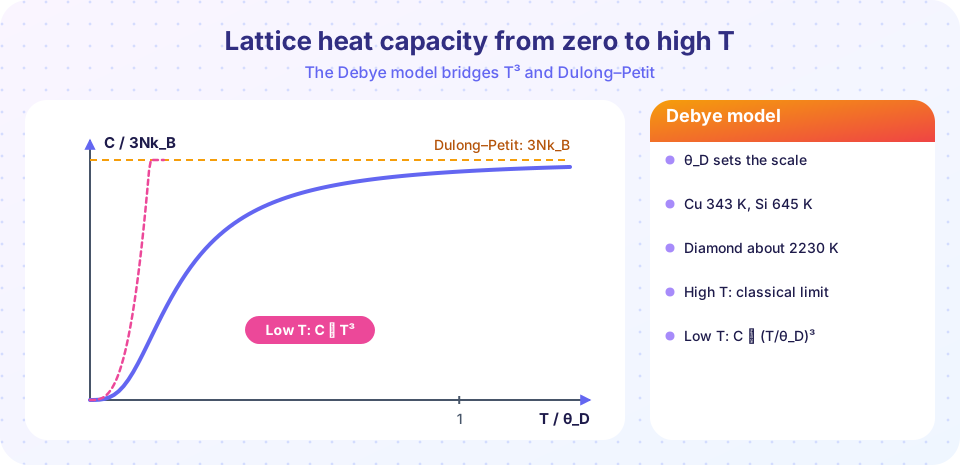
At high temperatures every mode contributes k_B to the heat capacity, so C_V = 3Nk_B. For one mole this is 3R = 24.94 J/(mol·K). It holds when T is above the characteristic phonon temperature, which is why most metals follow it at room temperature while diamond (θ_D ≈ 2230 K) does not.
The Einstein model
Einstein assumed that all 3N modes have the same frequency ω_E. Defining θ_E = ħω_E/k_B, the energy is U = 3N ħω_E/(e^{θ_E/T} − 1), and
C_V = 3Nk_B (θ_E/T)² e^{θ_E/T} / (e^{θ_E/T} − 1)².
This gives the right shape: C_V → 3Nk_B when T ≫ θ_E and → 0 when T → 0. It explains the diamond anomaly. But at low T it falls off exponentially (as e^{−θ_E/T}), whereas experiments show a power law. The flaw is that real crystals have low-frequency modes (long sound waves) that can be excited at low T.
The Debye model
Debye treated the solid as an elastic continuum: every mode has ω = v k up to a cutoff ω_D chosen so that the total number of modes equals 3N. In k-space the modes fill a sphere of radius k_D with 3N states, so
ω_D = v (6π² N/V)^(1/3) and θ_D = ħω_D/k_B.
Counting the modes in a frequency interval and summing their thermal energies gives
C_V = 9Nk_B (T/θ_D)³ ∫₀^{θ_D/T} x⁴ eˣ/(eˣ − 1)² dx.
Two limits are important:
- T ≫ θ_D: the integral becomes (θ_D/T)³/3 and C_V → 3Nk_B (Dulong-Petit).
- T ≪ θ_D: the upper limit may be extended to infinity, and the integral equals 4π⁴/15, giving
C_V = (12π⁴/5) N k_B (T/θ_D)³, i.e. about 1944 J/(mol·K) × (T/θ_D)³.
This T³ law, observed in insulators below about θ_D/50, is a great success. Only the lowest-frequency (long-wavelength acoustic) phonons are excited at low temperature, and they are exactly where the linear dispersion is exact.
Typical Debye temperatures: lead 105 K, sodium 158 K, copper 343 K, aluminum 428 K, iron 470 K, silicon 645 K, diamond about 2230 K. A material is "stiff and light" when θ_D is large.
Heat conduction
Phonons also carry heat. A kinetic estimate gives the lattice thermal conductivity κ = (1/3) C v ℓ with C the heat capacity per unit volume, v the sound speed and ℓ the phonon mean free path. At low T, ℓ is limited by sample boundaries; at higher T it is limited by phonon-phonon collisions, especially Umklapp processes in which the total wave vector changes by a reciprocal lattice vector. Diamond, with its high speed of sound and few Umklapp collisions at room temperature, conducts heat better than any metal (above 2000 W/(m·K)).
Common misconceptions
"Heat capacity is a property of the material only at high T." C depends strongly on temperature; the constant value 3R is just the high-T limit.
"Einstein's model fits low-T data." It captures the freeze-out but predicts an exponential decay; Debye's T³ law matches experiment.
"Phonons carry real momentum like photons." They carry crystal momentum ħk, which is defined only up to ħG and is not conserved in Umklapp collisions.
Try it
Press Run (or Ctrl + Enter) to see the result here.
Program input · what you'd type while the program runs
Type the answers before you press Run, one per line. Each time the program reads a line (with input()), it gets the next line from this box.
Press Run (or Ctrl + Enter) to see the result here.
Program input · what you'd type while the program runs
Type the answers before you press Run, one per line. Each time the program reads a line (with input()), it gets the next line from this box.
Check your understanding
Quick check · 5 questions
of 5 answered You scored / 5 · perfect!
-
1. What is the Dulong-Petit value of the molar heat capacity?
Each of the 3N modes contributes k_B classically, giving 3Nk_B = 3R per mole. -
2. Why is diamond's room-temperature heat capacity so small?
θ_D ≈ 2230 K means ħω/k_BT is large for most modes at 300 K, so they are barely excited. -
3. The low-temperature phonon heat capacity of an insulator varies as
The Debye result C ∝ (T/θ_D)³ comes from the number of long-wavelength acoustic modes excited. -
4. In the Debye model the cutoff frequency ω_D is fixed by
A solid of N atoms has 3N modes, and ω_D = v(6π²N/V)^(1/3) ensures the count is right. -
5. The mean number of phonons in a mode with ħω = k_BT is
⟨n⟩ = 1/(e^x − 1) with x = 1 equals 1/(2.718 − 1) = 0.582.
Summary
- A phonon is a quantum ħω of a vibration mode; occupation follows Bose-Einstein statistics.
- High T gives Dulong-Petit, C_V = 3Nk_B = 24.9 J/(mol·K); low modes are frozen out when k_BT ≪ ħω.
- Einstein's single-frequency model explains the freeze-out; Debye's continuum with a cutoff gives the T³ law.
- Phonons also transport heat, κ = (1/3)Cvℓ, limited by boundaries and Umklapp scattering.
Next: Chapter 3 review
Track your progress
Create a free account to tick off lessons and pick up where you left off on any device.
of Condensed Matter Physics lessons completed